Top Iranian general killed in blast; Tehran admits new virus has attacked its computers.
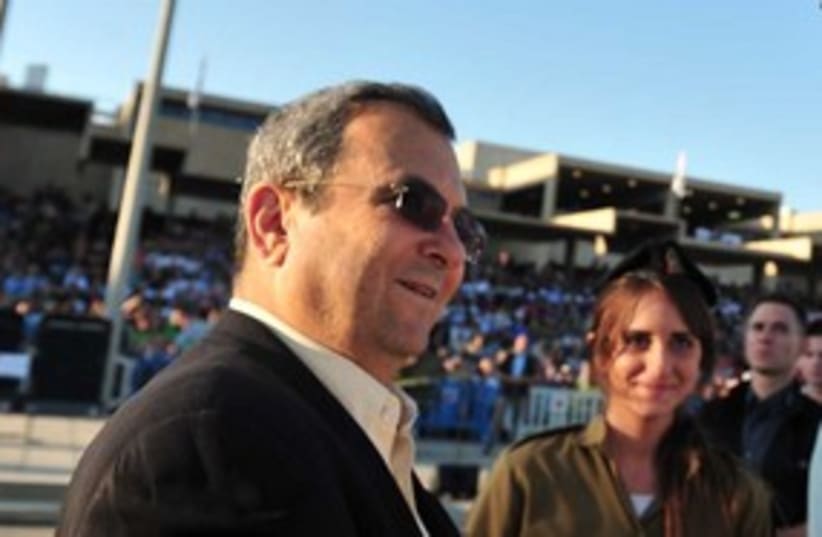
By YAAKOV KATZDefense Minister Ehud Barak at IDF officers' graduation 311(photo credit: Linoy Elihai / Defense Ministry)
“May there be more like it,” was all Defense Minister Ehud Barak had to say on Sunday when asked about the mysterious explosion that rocked an Iranian missile base on Saturday, killing 17 members of the Iranian Revolutionary Guards Corps.Iranian news sites identified one of the dead as Brig.- Gen. Hassan Moghadam, a top IRGC officer responsible for the development of some of Iran’s most advanced weapons. The explosion took place inside a base called Bid Ganeh, west of Tehran, which is reportedly used to manufacture and store Iran’s long-range ballistic missiles.RELATED:New ‘Stuxnet-related’ virus may be set for cyber-attackIran: Building nuclear bomb would be 'strategic mistake'The cause of the explosion was unknown and Iran claimed it occurred when soldiers were moving explosives between bases. There was some speculation on Sunday that sabotage had caused the blast and Israel was involved with the assistance of local Iranian opposition groups.
Barak, interviewed by Army Radio, said he did not have details on the blast except that there had been an explosion.It was not the first time that mysterious explosions struck in Iran. In recent years, a number of scientists have been killed in car bombings and dozens of IRGC officers have also been killed in various plane crashes.In related news, Iranian officials said they were investigating the death of Ahmad Rezaie, son of Mohsen Rezaie, a senior Iranian conservative politician who ran for president in 2009. Rezaie, the son, was found dead in a Dubai hotel on Sunday and while suicide appears to be the cause of death, Iranian officials have raised suspicions of foul play. Israel was accused of killing a senior Hamas terrorist in a Dubai hotel in 2010.The death of Rezaie was interesting due to the identity of his father, who is wanted by Interpol for his alleged involvement in the 1994 bombing of the AMIA Jewish community center in Buenos Aires, which killed 85 people. He was head of the IRGC at the time of the bombing.His death could have been caused also by Iranians. Rezaie left for the US in 1998, where he openly criticized his father and the Islamic regime before returning home five years later.He left Iran again in 2009.Also Sunday, Iran admitted that some of its computer systems have been infected by a new Stuxnet-like virus called Duqu. The virus was discovered several months ago and is believed to be a more advanced version of the Stuxnet virus which attacked Iran’s Natanz nuclear facility last year.Stuxnet is believed to have destroyed about 1,000 centrifuges at Natanz that were being used to enrich uranium.Israel and the US have been accused of creating Stuxnet.Head of Iran’s civil defense branch Brig.-Gen. Gholamreza Jalali told the official IRNA news agency that Duqu was discovered inside computer systems but Iran had developed a way to contain and neutralize the malware.All facilities and equipment that were affected with this virus have been cleaned, and the virus is under control, he said according to Tehran Times.Security software firm Symantec said in a report last month that it was alerted by a research lab with international connections to a malicious code that “appeared to be very similar to Stuxnet.” It was named Duqu because it creates files with “DQ” in the prefix.Security firms including Dell Inc’s SecureWorks, Intel Corp’s McAfee, Kaspersky Lab and Symantec say they found Duqu victims in Europe, Iran, Sudan and the US.Jerusalem Post staff and Reuters contributed to this report.
Related Tagsstuxnet
if(catID != 151){
var cont = `Take Israel home with the new Jerusalem Post Store