'If you make war, follow with comprehensive peace'
Noted political scientist Yehezkel Dror says Israeli attack on Iran's nuclear facilities should be combined with Mideast peace initiative.
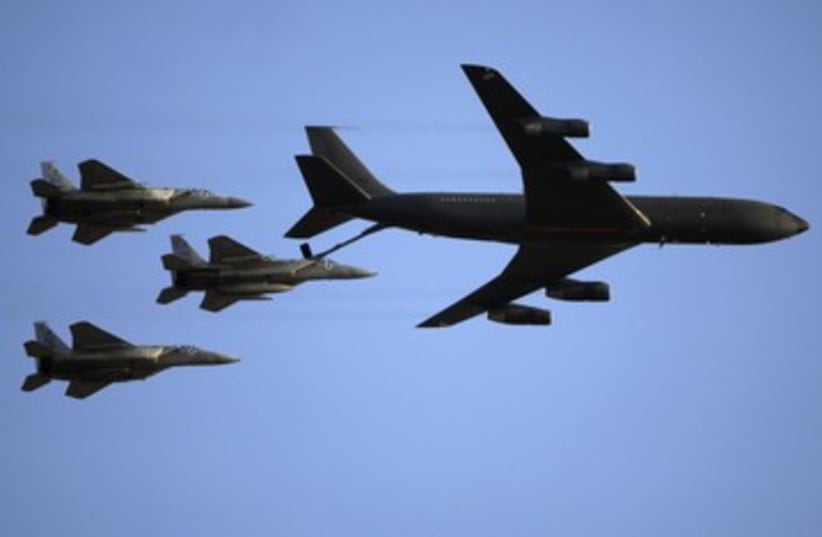
By HERB KEINONIAF F-15s refueling midflight 390 (R)(photo credit: Baz Ratner / Reuters)
Attack Iran – if necessary – to thwart its nuclear march, but at the same time launch a comprehensive Middle East peace initiative.That, at least, is the recipe for Israel’s leaders recommended by noted political scientist Prof. Yehezkel Dror.Dror, in a paper published by the Begin-Sadat Center for Strategic Studies just days before Wednesday’s Baghdad talks between Iran and six world powers, said that international sanctions – or a preemptive US attack – could prevent Iran from acquiring nuclear weapons.“But Israel cannot leave the future of its national security to the uncertain decision making of others,” wrote Dror, an Israel Prize laureate who sat on the Winograd Committee that investigated the 2006 Second Lebanon War. “If Iranian advances towards construction of a nuclear weapon are not halted, Israel will have no choice but to attack Iranian nuclear and military facilities while they are still vulnerable.”Dror wrote that while a violent reaction by Iran would follow, its impact “should not be exaggerated,” and it would in any event be much less than “the destructive potential of an Iranian nuclear attack on Israel.”Other potential consequences of a strike, he said, would be the harming of ties with the US, the “aggravation” of the Arab-Israeli conflict, and Iran’s redoubling of its nuclear program with determination to take revenge on Israel.To reduce those consequences, and bring about steps that would prevent the renewal of Iran’s nuclear efforts, Dror recommended combining an attack “with an initiative to advance a comprehensive Middle East peace agreement,” relying in part on the Saudi initiative from 2002.Click here for full Jpost coverage of the Iranian threat“Integrating an attack with a broad, multidimensional, credible peace initiative will multiply the benefits of both, whether or not there is an immediate favorable response from Arab states,” he wrote.The crisis sure to be caused by a preemptive Israeli strike would provide an “appropriate opportunity for the peace initiative,” he wrote.Dror framed the decision whether to attack Iran as a choice – if all else fails – of initiating a war under favorable conditions at present to prevent a much harder war, which is likely to break out in the foreseeable future.Such an attack, however, would surely infuriate the Arab public, though a number of governments would secretly applaud, and strain ties with the US. Therefore, Dror recommended integrating security with foreign relations, and linking the confrontation with Iran to an initiative to solve the Arab-Israeli conflict as a whole.Launching an initiative would improve Israel’s global standing after an attack, move the world’s attention from Iran back onto the Palestinians, “reduce the damage to US-Israel relations and encourage US action that will prevent any rehabilitation of Iran’s nuclear activities.“Israel should present a Middle East peace initiative even if it does not attack Iran’s nuclear facilities, either because Iran stopped its nuclear activities due to sanctions or other causes, or because the US attacked the nuclear facilities with or without linkage to an Israeli peace initiative,” he said. “However, presenting this peace initiative while Iran continues to develop nuclear weapons may be regarded as a sign of weakness and cannot be recommended before further consideration of actual developments.”
if(catID != 151){
var cont = `Take Israel home with the new Jerusalem Post Store