Rial plunges to all-time low as Iran sanctions bite
Israeli official says the tanking economy is still not affecting Tehran's nuclear march.
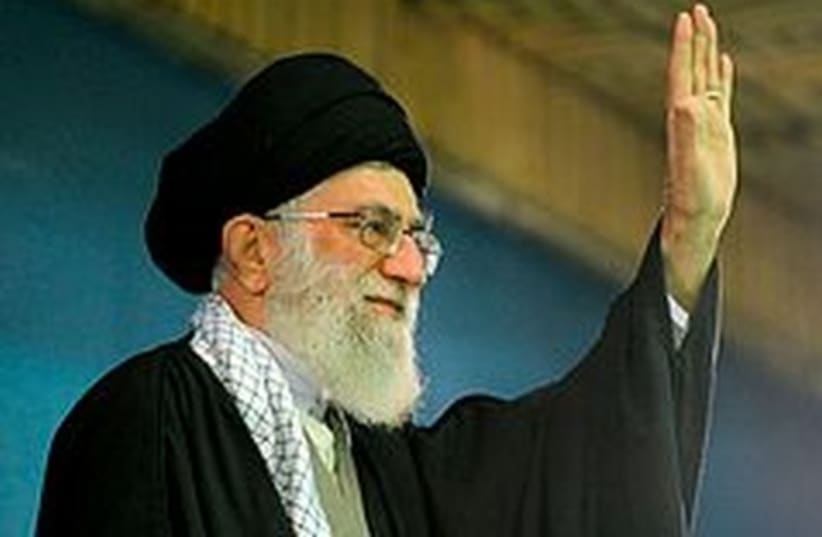
By HERB KEINON, REUTERSIran's supreme leader Ayatollah Ali Khamenei 521 (R)(photo credit: REUTERS)
Iran’s rial plunged against the US dollar in open-market trade on Monday, taking its loss in value over the past week to more than a quarter in further evidence that Western sanctions are shattering the economy.The free fall suggests sanctions imposed over Iran’s nuclear program are undermining its ability to earn foreign exchange and that its reserves of hard currency may be running low.A day before Monday’s dramatic drop in the Iranian currency, Finance Minister Yuval Steinitz said the sanctions were edging the Iranian economy toward collapse.“The sanctions on Iran in the past year jumped a level,” Steinitz told Israel Radio, noting that as finance minister, he follows Iran’s economy. “It is not collapsing, but it is on the verge of collapse.The loss of income from oil there is approaching $45 billion to $50b. by the year’s end,” Steinitz said.“The Iranians are in great economic difficulties as a result of the sanctions,” he said.But, one government official noted, even as the Iranian economy was reeling, the government in Tehran continued to pursue its nuclear program unabated.“There is no doubt that the sanctions are affecting the Iranian economy,” he said. “We have seen signs of that for months now, and obviously that is without question. The problem is that despite the current level of economic pressure, there has been no slow down of the Iranian nuclear program and the recent IAEA report attests to that.”The official said the sanctions “were not there for sanctions sake, but rather to stop the nuclear program. And in that they have not succeeded.”The official added this was why Israel, in addition to calling for clear red lines on Iran’s nuclear program, was calling for ratcheting up the sanctions.The official said tightening the sanctions came up in Prime Minister Binyamin Netanyahu’s meetings last week in New York. Netanyahu met there with US Secretary of State Hillary Clinton, Canadian Prime Minister Stephen Harper and UN Secretary-General Ban Ki-moon. He also spoke by phone to US President Barack Obama.EU foreign ministers are expected to discuss ideas for further sanctions against Iran’s energy, finance, trade and transportation sectors at a meeting on October 15.Parliamentary opponents of President Mahmoud Ahmadinejad say sanctions are not a major cause of Iran’s economic problems and accuse his government of mismanaging the economy.“The first approach today is that authorities accept their mistakes and failures, second, that they not blame their mistakes on others, and third, that they invite all the pundits and experts to find a way to solve the problems of the economy,” Iranian legislator Ezzatollah Yousefian was quoted as saying by the Mehr news agency.The rial traded at 34,200 per dollar according to currency-tracking website Mazanex, down from about 29,720 on Sunday. It was trading at 24,600 last Monday, according to website Mesghal.The rial’s losses have accelerated in the past week after the government launched an “exchange center” designed to supply dollars to importers of some basic goods at a special rate slightly cheaper than the market rate.Instead of allaying fears about the availability of dollars, the center seems to have intensified the race for hard currency by linking the special rate to the market rate, meaning that even privileged importers will face sharply higher costs.Click here for full Jpost coverage of the Iranian threat“The government’s initiative... brought to the surface a tremendous lack of confidence in its ability to manage the currency,” said Cliff Kupchan, a Middle East expert at the Eurasia Group, a political risk research firm. “The attempt to fix it triggered a worse crisis via market psychology.”The rial’s sinking value will fuel inflation, officially running at about 25 percent; economists say the real rate is higher. Rising costs could worsen the job losses that Iranians say are hitting the country’s industrial sector.But that kind of language is premature, said Hassan Hakimian, of the School of Oriental and African Studies of the University of London, because Iran has stockpiled some basic goods.“I am not aware of any shortages of basic necessities as yet,” he said. “Well before that, the government will resort to some kind of basic rationing so as to introduce a safety net.”Some Iranian officials continued to insist on Monday that the exchange center, which is supposed to be funded by dollars earned with Iran’s oil exports, would eventually meet demand for hard currency and thus strengthen the rial.“The exchange center is operating and once the next phase of the plan is implemented, the price of currency will drop,” said Gholamreza Mesbahi- Moghaddam, who heads parliament’s planning and budget committee, according to the Mehr news agency.But the rial’s accelerating slide indicates many Iranians have lost faith in authorities’ ability to support it, and are scrambling to buy hard currencies to preserve their savings.“There is very little, effectively, the central bank and authorities can do to calm the situation, because even when they take extraordinary measures to calm the market... the market interprets those additional measures as a sign of abnormality,” Hakimian said.At the end of last year, Iran had $106b. of official foreign reserves, enough to cover an ample 13 months of imports of goods and services in normal times, according to the International Monetary Fund.But Nader Habibi, economist at the Crown Center for Middle East Studies at Brandeis University, estimated last month that the government now had about $50b. to $70b. of hard currency reserves left.Iran does not disclose timely data on its reserves – but if they have dropped steeply, the central bank may have become reluctant to run them down by supplying dollars to the market.In a statement on Sunday, the central bank said just $181m. had been traded on the new exchange center since its launch six days earlier – a fraction of Iran’s imports of goods and services, which total around $2b. per week in normal times.“The president has deliberately kept the market agitated,” Elias Naderan, who sits on parliament’s economic committee, said on Sunday, according to Mehr.“I really don’t know what Mr. Ahmadinejad is thinking. What plan does he have, what is his expectation of the system, and how does he plan to manage this disorder?” The crisis has also prompted criticism of the central bank and authorities by private businessmen.“When the exchange center provides only 10 to 20% of the market’s demand, one cannot expect it any more to play a role in the exchange market,” Muhammad Nahavandian, head of Iran’s Chamber of Commerce, was quoted by Mehr as saying on Monday.
if(catID != 151){
var cont = `Take Israel home with the new Jerusalem Post Store