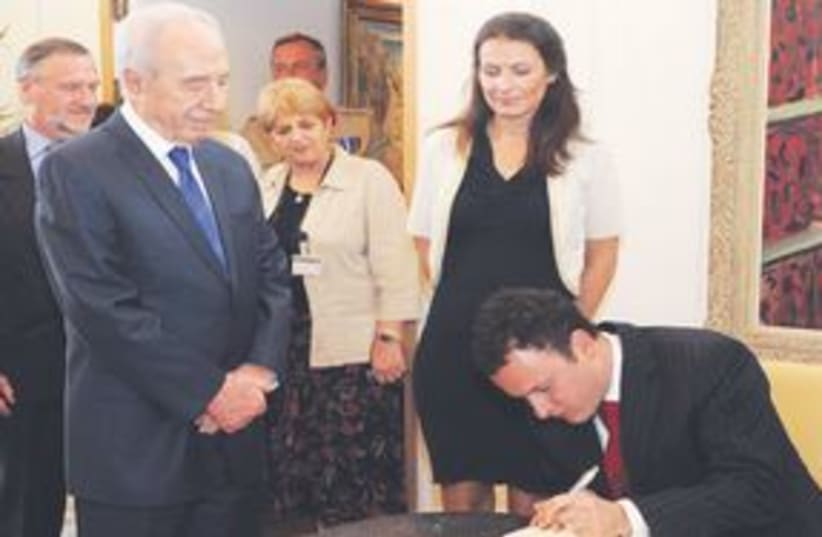
Gould: “I’m proudly Jewish. I was brought up in a staunchly Jewish household, it was also a Zionist household."
By GREER FAY CASHMANUK ambassador Matthew Gould 311(photo credit: GPO)
After presenting his credentials to President Shimon Peres on Tuesday, Matthew Gould officially became the first British ambassador of the Jewish faith in Israel.Gould was the fourth of five new ambassadors who presented their credentials to the president in a series of separate ceremonies.RELATED:UK to boycott OECD conference in JerusalemFirst Jewish British ambassador to Israel set to arrive The others, in order of arrival in Israel, were Alfredo Rivera of Guatemala, for whom this is his first ambassadorial posting; Svein Sevje of Norway, who was previously ambassador to Sudan, and before that to Syria; Elinor Hammarskjold of Sweden, a great-niece of former UN secretary-general Dag Hammarskjold; and Paul Hunt of Canada.Both Sevje and Hammarskjold have served in Israel before. From 1994-1998, Sevje was minister counselor at the Norwegian Embassy in Tel Aviv, and Hammarskjold served as consul and deputy head of mission at the Swedish Consulate- General in Jerusalem from 2000-2002.Sevje also served as a Middle East special envoy from 2005-2008.Hunt was most recently Canada’s ambassador to Brazil.In welcoming Gould, Peres noted that since the appointment of Herbert Viscount Samuel as the first High Commissioner of Palestine in 1920, never had a Jew been appointed as the top-ranking representative of the British government in Israel.Israel’s history is interwoven with that of Britain, said Peres, recalling that in November 1917, British foreign secretary Arthur James Balfour gave Baron Walter Rothschild a letter stating that His Majesty’s government viewed with favor the establishment of a national home for the Jewish people in Palestine.It was around this period, said Peres, that the Arab and Jewish movements enjoyed a renaissance: The Jews, after 2000 years in exile were returning to their homeland, and the Arabs, after centuries of being subjected to Ottoman domination, were given independence when the British and the French expelled the Ottoman Empire from the region.Today, Peres continued, there is a renewal of the appetite for empire, this time on the part of the Iranians, who through enriched uranium, terror and violence, threats against the State of Israel, denial of the Holocaust, and accusations that the Americans destroyed the Twin Towers, want to rule the Middle East.Should Iranian ambitions be realized, the Middle East will, for the first time, have to forget about separation of church and state; “it will be just church,” said Peres, warning that the takeover would also include Shi’ite elements.Peres noted the irony that it was Israel that had first recognized the Palestinian right to self-determination.“There never was a Palestine State,” he reminded Gould; the West Bank belonged to Jordan and Gaza to Egypt. Now Israel is helping the Palestinians to build their economy and is supporting the Palestinian defense force, he said.“This is an immensely happy and proud day for me,” responded Gould. “This is the best job in the British Foreign Service.”Gould said he was aware that he’d come with a good deal of historical and personal baggage. Although relations between Britain and Israel are warm, he added, they are also complex.His personal baggage relates to his religion.“I’m proudly Jewish. I was brought up in a staunchly Jewish household,” he said. It was also a Zionist household, but that didn’t prevent him from spending two-and-a-half years in Teheran, where he was deputy head of mission, and where in addition to dealing with the Iranian regime, he visited the city’s synagogues and kept in touch with the Jewish community.Prior to leaving for Israel, he told Peres, he had been instructed by his prime minister to promote and develop relations in dealing with the threat from Iran. There is close cooperation on this matter between the British and Israeli governments in dealing with the Iranian issue, he said, but stated that the extent of the cooperation could not be made public.His country shares Israel’s concerns, he said, and how to deal with Iran will be a major part of his mission in Israel.He also pledged to do everything possible to help with the Palestinians.It was important to Gould to deliver a strong message to Israel and the Israelis that Israel was not as isolated as it would appear from reports in the international media.“You are not alone. You have friends in the international community,” he said.“Israel should not feel that only Israel cares about Israel’s security.”Peres and Sevje are old friends, having worked together during the Oslo process.“I feel that I have come at a time when the distance to the goal is longer and the road deeper,” Sevje said.However, Peres instanced government concessions, the change in policy vis-à-vis the West Bank, acceptance by a primarily right-wing government of a two-state solution to the conflict with the Palestinians, and other measures designed to improve relations and build confidence.While appreciative of the role played by Norway in the Middle East peace process, Peres could not understand why more was not being done to stop Iran.Sevje, who has been coming to Israel for some four decades and who is keen to improve relations between Israel and Norway, was candid in declaring that as warm as such relations may become, “there are issues relating to the West Bank that we don’t agree on.”With the Swedish Ambassador, Peres spent a long time discussing her great uncle, whom he had known personally and whose intellect he greatly admired.He also thanked Sweden for its annual $90 million donation to the Palestinian Authority, and recalled how he and Yasser Arafat had come to the Swedish Parliament to ask for a donation to help the Palestinians build up their economy – and how forthcoming Sweden had been.Hammarskjold reiterated Sweden’s commitment to peace.At his meeting with Rivera, Peres underscored the important contribution made by Guatemala to the establishment of the State of Israel.In speaking to Hunt, Peres brought up the names of Canadian political leaders who had helped Israel during its fledgling years, even to the extent of supplying arms when most other countries refused.Peres was heartened when both Gould and Hunt told him that scientific cooperation was high on their respective agendas.Meanwhile, for Yitzhak Eldan, who has been the Foreign Ministry’s chief of protocol for the past seven years, Tuesday was a sad day, because it was the last time he would be introducing ambassadors to the president. He is due to retire at the end of October, and Hunt was his last ambassador.
if(catID != 151){
var cont = `Take Israel home with the new Jerusalem Post Store