The trials and triumphs of an English small-town rabbi.
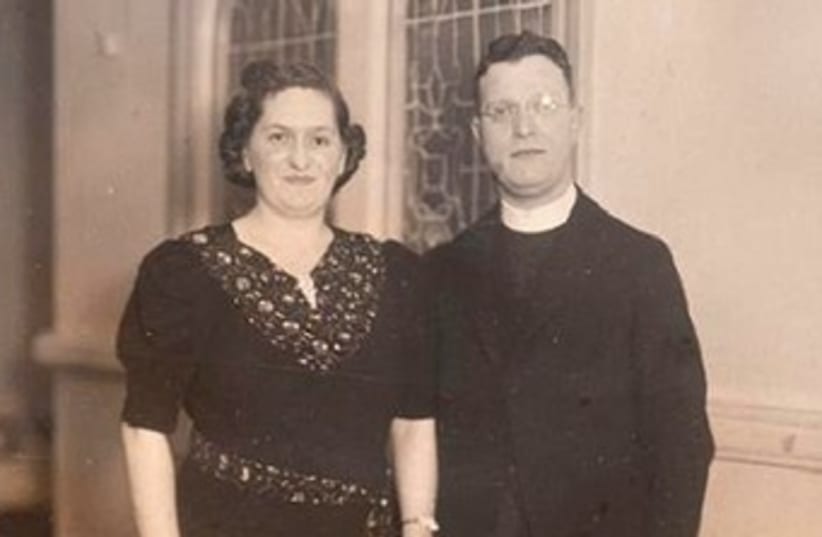
By YONATAN SILVERRabbi Abraham Freedman 370(photo credit: Courtesy Sarah Peters)
In 1931, Rabbi Abraham Freedman, a young man from Leeds, England, arrived in the Welsh mining town of Tredegar. A graduate of Manchester Yeshiva, a cantor and a shochet, the Hebrew term for a ritual slaughterer, my quiet and unassuming maternal grandfather Abie, as he was known, had been hired by the town’s small Jewish community to provide religious services.It probably wasn’t the easiest place for Abie to begin his career. Relations between the Jewish community and the town’s other residents were, at times, strained.Although the people of Tredegar were generally good, hard-working, honest folk, years before my grandfather arrived, anti-Jewish riots and looting had broken out in the impoverished town, and troops had been sent in to protect the community. To be fair, though, the Tredegar residents were equal-opportunity rioters – several years beforehand, there had been violent skirmishes between the townsfolk and the Salvation Army. Abie threw himself into leading prayers, preaching, teaching, reading from the Torah, ritually slaughtering, and advising on religious issues.Then, one day, shortly after his arrival in Tredegar, he wrote a letter to his parents, Lazar and Rivke, in Leeds telling them he’d met a young woman: Celia Gaba, the eldest daughter of Isaac, a licensed peddler who had diversified into real estate, and Malka, immigrants from the Ukraine who lived in nearby Cardiff.“We want to get married,” he informed his surprised parents.Click for more JPost High Holy Day featuresAccording to family folklore, as related by Abie’s cousin to her daughter, Abie’s father was not at all pleased, as Abie and his intended fiancée were very young, and had only just met. He felt that matters were moving far too fast.So, Lazar and his brother-in-law, Benjamin Meyer Mankunsky, hopped onto a train and traveled down to Wales to talk some sense into Celia’s father.This first meeting with Abie’s family must have been a déjà vu experience for Isaac: When he and Malka had wanted to get married, her father had objected, not wanting his daughter to leave the Kiblitch shtetl and go off to Wales. It was only after Malka went on a hunger strike that he relented.And now, the father and uncle of the man that his daughter wanted to marry were confronting him in his living room and babbling on about how his 19-year-old, a fine Jewish girl from a respectable family, was too young to marry.Isaac left the room, turned round, locked Lazar and Benjamin in, and informed them that he wouldn’t let them out until they agreed to the marriage.The argument continued for a little while through the locked door. But it didn’t take too long before Lazar and Benjamin came round to Isaac’s point of view.The two young lovers had quite a bit in common: Like Abie, Celia’s paternal grandfather Velvel had also been a ritual slaughter in Ladishen, near Odessa. But Celia was probably pleased that her husband didn’t follow in the footsteps of Velvel, who considered the provision of kosher chickens to be a holy calling, and therefore couldn’t bring himself to charge poor people for his services, resulting in the poverty of his own family. Also, Abie was a man of the cloth in more ways than one. His parents were tailors; and Celia’s aunts, Velvel’s daughters, had surreptitiously studied dressmaking so they could feed the family while their father was off slaughtering chickens for free. It’s ironic, though, that the cantor’s wife was the only one in the community who could never hear him sing; when Celia was 4 years old, she’d contracted measles and lost her hearing.At the time, Jews in the UK were becoming increasingly mobile; and new communities were sprouting up around the country. Every few years, Abie and Celia and, eventually, their children – my mother Rita and her siblings Wallace and Linda – would uproot themselves and drift off to a new home, to wherever Abie’s services and kosher meat were required, including Stockport, Bristol, Cardiff, Belfast, and Darlington.Abie and Celia were quiet people, unsuited for the inevitable synagogue politics in the various communities they served. Abie simply wanted to honorably support his family, without being dragged into internal intrigues.Some communities were kinder to Abie than others. Although synagogues somewhat reluctantly accepted that they needed someone to provide for their religious needs, not all were enthusiastic about paying for this.One of my earliest memories of my grandparents was of visiting them from London in the small town of Darlington before Passover. I remember accompanying my grandfather, who was carrying a metal bucket, as we walked down the road to a nearby farm to buy milk obtained directly from a cow. In honor of Passover, Abie and Celia had taken the opportunity afforded by living near a farm to make a special effort and personally supervise the production of the milk they drank during the festival.One year, long after Abie had retired, a synagogue hired him as a cantor for the High Holy Days.Abie put his heart and soul into leading the Rosh Hashana services, and was expected to return a few days later to perform at the grand climax of the Ten Days of Repentance – Yom Kippur.However, this was not to be: A couple of days after Rosh Hashana, Abie passed away.One can only imagine the reaction of the community when they learned why their cantor wouldn’t be showing up on the holiest day of the year.By his very absence and the timing of his passing, Abie in all likelihood profoundly affected the congregation and made them more acutely aware of the transient, fragile nature of our brief sojourn in this world than could possibly be achieved by the most impassioned sermon or melodious cantorial performance.Yonatan Silver is a writer living in Jerusalem. He has recently become interested in family research and tracking his ancestors across the Diaspora.
if(catID != 151){
var cont = `Take Israel home with the new Jerusalem Post Store