Wartime unity conceals political differences among American Jews
One of the outliers in the American Jewish community is the left-wing J Street lobby, which pulled out of a community- wide pro-Israel rally in Boston.
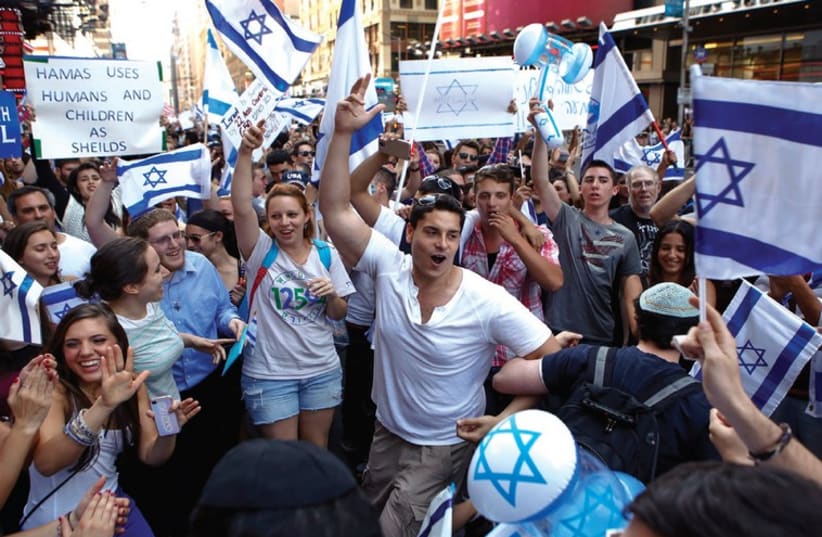
By SAM SOKOLSUPPORTERS OF ISRAEL dance during a rally in New York on Sunday.(photo credit: REUTERS)
Political differences among the main American Jewish denominations and organizations have been put on the back burner during Israel’s Gaza incursion, indicating the emergence of a rare consensus.“There is across the board solidarity,” Malcolm Hoenlein, the executive vice chairman of the Conference of Presidents of Major American Jewish Organizations, told The Jerusalem Post on Wednesday.Over the past several days, a number of US Jewish organizations, including a number of traditionally liberal and dovish groups, have issued statements of unqualified support for Israel’s invasion of the coastal territory.Groups such as B’nai B’rith and the Anti-Defamation League have publicly endorsed Operation Protective Edge, while Rabbi William Gershon, the president of the Conservative movement’s Rabbinical Assembly, called for Hamas to be “isolated, removed from power and structurally dismantled.”According to Hoenlein, whose organization lobbies the White House on behalf of a wide range of American Jewish interests, American Jews believe that the Israeli government has “acted with restraint and that the current situation is intolerable.”Gershon and others have acknowledged the large number of Gazan civilians who have died in the fighting, but place the onus for their deaths squarely on Hamas, which operates out of civilian areas and has called on noncombatants to remain in their homes despite Israeli calls for the evacuation of conflict zones.“I believe that for many American Jews, and actually there are polls suggesting Americans in general, what has become clear is that no matter what your political persuasion prior to this conflict is, that Israel faces an enemy that is sworn to its destruction,” Gershon said.The current conflict, he continued, is not about West Bank settlements or a two-state solution, but about fighting an organization calling for the destruction of the Jewish state.“We want to be a moral people, but you can’t be a moral people if you are dead. I think that this is the stark reality that the American Jewish community has come to understand,” he said.When a country is under attack people tend to move to the Right, Prof. Steven Cohen of Hebrew Union College explained.The Right tends to have a more critical attitude toward adversaries while the Left maintains a more charitable view, he said. “Obviously when the enemy is attacking Israel then people are going to adopt a more hostile view of the enemy, so in that respect the so-called movement to the Right is really a reflection of there being combat conditions.”The real question, he continued, is what happens during the weeks and months after the cessation of hostilities.“You think about the war in Lebanon or the Yom Kippur War where Jews were seemingly very hawkish and then they moved to a more dovish posture.So we don’t know what is going to happen here,” Cohen said.The current rightward shift comes as Israel is fighting what many Jews perceive as a more morally simple conflict than the Israeli-Palestinian situation as a whole and seems to be a temporary departure from the overall shift to the Left among younger American Jews.According to the Pew Research Center, American Jews under the age of 30 are “less apt to say Israel is making sincere efforts at peacemaking as compared with Jews 30 and older.”“Younger Jews who care about Israel who are not Orthodox tend to have more skeptical views of the Israeli government and of Israeli policy,” Cohen said.Jonathan Sarna, the president of the Association for Jewish Studies, agreed, recalling that “historically, American Jews have united around Israel when it is under attack.“That was true in 1967 and has been true to a greater or lesser extent ever since. At the moment, most Israelis are united behind the operation, so American Jews who take their cue from one or another Israeli position or newspaper are happy to unite as well,” he explained.US support for the war, with 57 percent of Americans backing Israeli actions in Gaza, further emboldens Jews in their positions, and the relative lack of media coverage compared to previous rounds of violence, due mainly to events in Syria, Ukraine and elsewhere, has “makes it easier to unite behind Israel,” Sarna said.Leonard Saxe, a researcher at Brandeis University, said there is anecdotal evidence that Birthright participants who have returned from Israel over the past several weeks “came away profoundly affected” and that their views have helped shape opinion on the Jewish street in the US.Communal leaders who spoke with the Post largely agreed with such assessments.“I believe that in times of existential threat – we have always come together. Because, in the end, that which divides us is so much less than that which unites us,” explained Rabbi Leonard A. Matanky of the Rabbinical Council of America.One of the outliers in the American Jewish community is the left-wing J Street lobby, which pulled out of a community- wide pro-Israel rally in Boston several days ago.In a letter to the Jewish Community Relations Council of Boston, which organized the rally and which counts J Street as a member, the lobby stated that it had pulled its sponsorship of the rally because the “roster of speakers did not include a pro-Israel, pro-peace perspective.”“What was missing for us in this rally, and what ultimately precluded our co-sponsorship, was that despite our efforts, there was no space made to raise the issues that follow from our commitment to Israel’s Jewish and democratic future. There was no voice for our concerns about the loss of human life on both sides, or the acknowledgment of the conflict’s complexity and that the only way to truly end it is through a political solution,” J Street’s Shaina Wasserman wrote.J Street’s decision to not participate was “shocking,” Barry Shrage, president of Boston’s Combined Jewish Philanthropies, told The Post. “We have a very big tent and want to include everybody who wants to be pro-Israel.”According to Shrage, the issue of casualties on both sides was raised at the rally, but “issues like this that don’t have to do with the West Bank” or other political contretemps between Israel and the Palestinians.Gershon also took issue with J Street’s decision, calling it “reprehensible” and saying it sent a message that would be “seized upon” by “Israel’s enemies.”“There is a time to debate nuance and complexity and there is a time to come together to defend the right of Israel to exist,” he said. “In the middle of a war is not the time in my opinion to be exploring the complexities of the Arab-Israeli conflict.”“I do want to be clear that our decision not to participate in the rally was not based on what statements the other participating organizations have or have not made about the current crisis, nor was it based on some implication that J Street is the only organization that sees the complexity of the conflict,” a spokeswoman for J Street told the Post.“In solidarity with Israel during this difficult time, we have co-sponsored pro-Israel community-wide rallies in Philadelphia and San Diego. While we chose not to co-sponsor one rally in Boston, we sent representatives and mobilized support for the event, just as we have for events in many other communities nationwide,” J Street said.A National Leadership Assembly, gathering hundreds of American Jewish leaders from across the country, is slated for Monday at the National Press Club in Washington.The group, which will include representatives of the more than 50 member-organizations of the Conference of Presidents of Major American Jewish Organizations, the Jewish Federations and others, will gather at the National Press Club “to show support across the board of the Jewish community and the bipartisan support for Israel in Washington,” Hoenlein announced.
if(catID != 151){
var cont = `Take Israel home with the new Jerusalem Post Store