Isaac is not the only biblical model of a continuator among the founders of our faith.
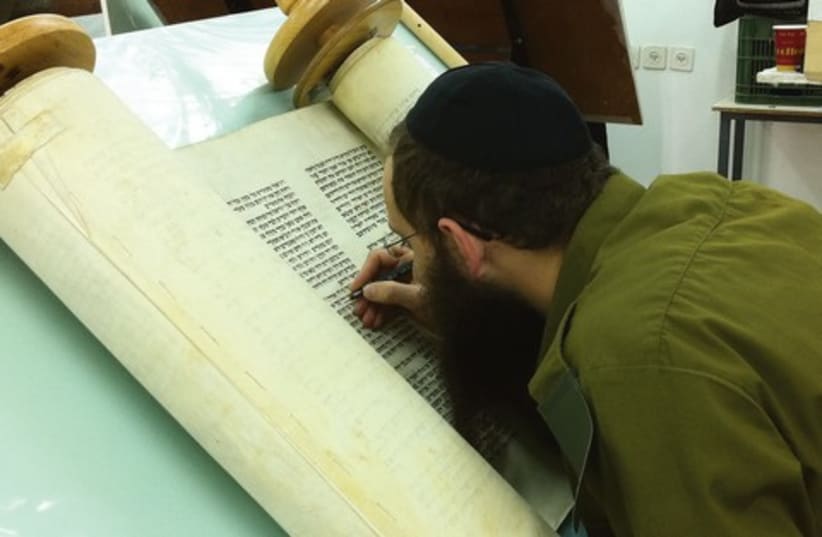
By SHLOMO RISKINTorah scribe 521(photo credit: Courtesy Derech AMI)‘And the two of them went together... And the two of them went together’ (Genesis 22:6, 8)In previous commentaries, I have queried which of the two major protagonists of the akeda (binding of Isaac) story suffered the greater test: Abraham (Abram), the father who had to take the responsibility for the sacrifice of his son, or Isaac, the son who had to undergo the anguish of being laid out upon the altar. I have offered the interpretation of my mentor, Rav Moshe Besdin, who explained that Abraham received the command directly from God, which made his acquiescence almost understandable; Isaac is even more praiseworthy, because he only heard the command from his father, yet he was still willing to submit himself to the sacrificial act. In doing so, Isaac becomes the paragon of the ideal Jewish heir, who continues the traditions of his father even though he cannot be certain of their truth because he himself has not heard the Divine command.However, Isaac is not the only biblical model of a continuator among the founders of our faith. What about Abraham, the very first patriarch, who is pictured by the midrash as well as by Maimonides as a rebellious and a revolutionary iconoclast? Abraham’s father, Terah, was a prominent Chaldean idolater, a leader of the royal council, a purveyor of idols and idolatry. Abraham – as a result of his own reasoning and his individualistic understanding, smashed his father’s idols and ideals in favor of his newly discovered vision of ethical monotheism.I would submit that the midrashic and Maimonidean picture of Abraham the iconoclast, the breaker of his father’s idols, is not the only possible understanding of the patriarch’s early life; indeed, a careful reading of the biblical text might very well lead us to an opposite conclusion. Maimonides seems to base his acceptance of Abraham as the midrashic rebellious son upon the fact that the Bible is uncharacteristically silent about why God suddenly commanded Abraham to leave Ur of the Chaldees for the unknown land which God would show him (which turned out to be Canaan) and considered him worthy of becoming a great nation and a blessing for the world. Why Abraham? Maimonides concludes that Abraham must have discovered ethical monotheism through his own rational thinking and therefore merited God’s election. However, this is not a necessary conclusion. The last verses of the portion of Noah, which identify Terah as the father of Abraham, Nahor and Haran, also record that “Terah took his son Abram, and Lot, the son of Haran, his grandson, and his daughter-in-law Sarai… and they departed with them from Ur Kasdim to go to the Land of Canaan; they arrived at Haran and they settled there… and Terah died in Haran” (Gen. 11:31, 32).Why must scripture tell us that Terah had originally set out for the Land of Canaan if he never reached it because he died on the way in Haran? The Bible will soon record a fascinating meeting between Abraham and Melchizedek, king of Shalem (Jerusalem, capital city of Canaan, see Ramban ad loc), and the text goes on to identify him as a “priest of God Most High” to whom Abraham gives tithes (Gen. 14:18, 19, 20). Is it not logical to assume that there was one place in the world where the idea of a single God who had created the world and created the human being in His own image was still remembered from the time of Adam, and that place was Jeru-Shalem, Canaan, Israel? And if Terah had left Ur of Kasdim to reach Canaan, might it not have been because he wanted to identify with that land and with that God of ethical monotheism? And if Abraham, Terah’s son, had joined his father in the journey – while Nahor had not – may we not assume that Abraham identified with his father’s spiritual journey even though his brother did not? From this perspective, we understand why this story is followed by God’s command to Abraham: Conclude the journey you began with your father and reach the destination, and perhaps the destiny, which unfortunately eluded him.We now can similarly understand a heretofore difficult verse at the conclusion of God’s Covenant Between the Pieces with Abraham, wherein He guarantees the patriarch “you will come to your fathers in peace and will be buried in a good old age.”To which of Abraham’s fathers will he come in peace after he dies? Which direct ancestor of Abraham was righteous? According to the version we have just suggested, the verse refers to Terah, who repented in his journey to Canaan.Abraham, then, emerges as the true continuator of his father’s mission. The biblical message, through the lives of Abraham, Isaac and Jacob, is that it behooves us to continue in our parents’ footsteps and to pass down the mission of ethical monotheism from generation to generation. Indeed, we must even attempt to improve upon their vision and accomplishments and to take proper advantage of the new possibilities the unique period in which we live may provide for us.The writer is the founder and chancellor of Ohr Torah Stone Colleges and Graduate Programs and chief rabbi of Efrat.
if(catID != 151){
var cont = `Take Israel home with the new Jerusalem Post Store