Two centuries ago there was no Modern Orthodox or Haredi Judaism. How are 2 movements most different?
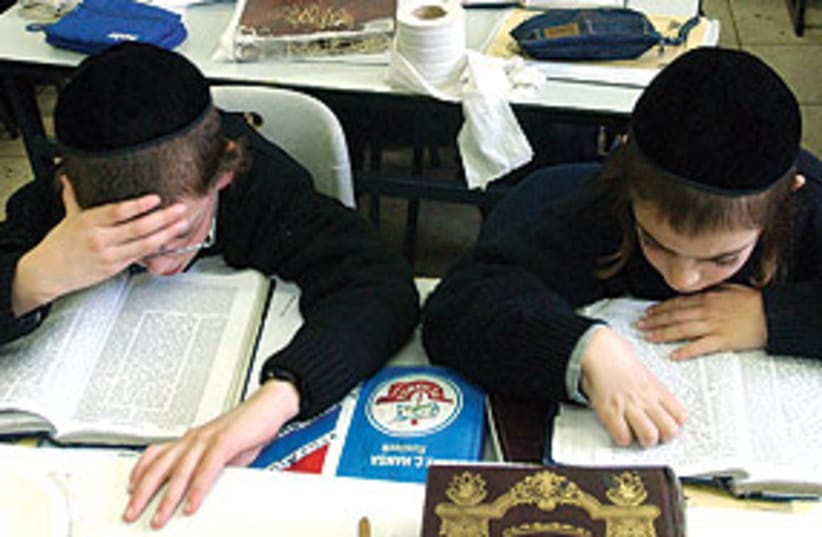
By AHARON WEXLERHaredi children studying 311(photo credit: Ariel Jerozolimski)
I am often asked to explain the differences between Modern Orthodoxy and haredi (ultra-Orthodox) Judaism. Contrasting their black hats, white shirts and wigs to our jeans, T-shirts and bandanas is easy enough, but appearances, as they say, can be deceiving.The reality is that we share something fundamental, something that connects us through both time and space; we share the primacy of Torah.Both our Modern Orthodox community and their haredi community believe that the Torah is the absolute most important facet of our lives, shaping who we are and how we ought to behave towards our fellow man and God.We both believe that we all stood at Sinai some 33 centuries ago and accepted upon ourselves to be in a covenant with God. The covenant, a supreme responsibility, shapes every fiber of our being. We both believe that the Torah is the ipsissima verba, the very word of God, and it is that fact that dictates our interpersonal relationships and our entire world view.Just two centuries ago there was no “haredi” or “Modern Orthodox” Judaism. There was just plain Judaism. That doesn’t mean that Judaism wasn’t without its dissenters. Perhaps the most famous of the modern era, Baruch Spinoza, was promptly excommunicated when he shared ideas that were outside the communal framework of how Judaism was universally understood.Only in the beginning of the 19th century, when the walls of the ghettos came tumbling down and Jews were offered civil rights in their host countries, did dissent become part and parcel of Judaism. What two millennia of Christian oppression failed to do, two generations of Christian openness accomplished: mass assimilation.Jews gave up on their traditions and even on their identity, en masse. Many were alarmed by this mass defection and attempted to reform Judaism and its beliefs. This led to the Reform movement, which is still struggling to this day in how to find the balance between its reforms and keeping an engaged constituency. With the advent of Reform Judaism, there was no longer any consensus of how Judaism was universally understood.In reaction to the mass assimilation and the changes wrought by Reform Judaism, haredi Judaism stood as a dam against the flood of changes Judaism was undergoing.The word “haredi” means “to tremble,” as in “tremble at the word of God.” It is thus a fear-induced siege mentality in reaction to the inroads made by the secular world. It is an attempt to rebuild and strengthen the walls of the ghetto that were previously not strong enough to withstand the last breach.Modern Orthodoxy, on the other hand, saw the breaking down of the ghettos as an opportunity to take Judaism from the small kitchens of our great-grandparents and apply it to the world entire.No longer should the main question be if our chicken was kosher; rather, are our economic policies kosher? Are our employee/employer relationships kosher? Are we allocating enough resources to social services? The chief concern of Modern Orthodoxy wasn’t keeping its flock in to protect them, but how best to take its adherents out of the ghetto and apply the Torah to a new circumstance and a new environment.How best do we apply the ancient word of God to our increasingly Godless world? It is because we share the primacy of Torah that we have taken two very different approaches in how to foster that relationship.PERHAPS THE simplest way to explain it is what I call the Hamburger Paradigm. Everyone agrees that the meat patty is the most important part of the hamburger experience. A burger joint can still open its doors if it is out of pickles, onions, or even rolls (just visit any Israeli hamburger restaurant on Passover). If the French fries run out, the burger place can still operate. The one thing that is absolutely necessary for the continued function of any burger place is the meat patty.Both the Modern Orthodox and the haredi world see Torah as the burger, but here is where we differ: The haredi logic is that if the burger is the most important element, why waste time on French fries, rolls, tomatoes or onions? Just eat more burgers! In other words, let’s concentrate on what is truly important and not fill our stomachs with anything that would take away from having as much meat as possible. After all, any calories, capital, or even room in our stomach spent on the bread or vegetables inevitably takes away room from consuming more of the all-important meat.The Modern Orthodox world also accepts the hamburger paradigm. We both believe that the meat patty is the most important part of the hamburger experience. The difference is that we believe that the best way to enjoy the hamburger is on a lightly toasted roll, with fresh red onions, tomatoes, pickles, topped with a bit of ketchup and washed down with cold Coca-Cola.If Torah in our paradigm is represented by the hamburger, then we believe that the best way to appreciate Torah is with the roll, which can represent world literature; onions, which can represent science; tomatoes, which can stand for math; and Coca-Cola as our engagement with the gentile world. We get that sometimes we have to beef up our hamburger and add a second or even third patty. We also understand that the Torah is best enjoyed with that roll and those toppings, no matter how important the meat is.Our argument with our haredi brethren isn’t to change their burger, but rather to recognize that ours as well is a valid menu choice.
The writer is a doctoral candidate in Jewish philosophy and currently teaches in many post-highschool yeshivot and midrashot.
if(catID != 151){
var cont = `Take Israel home with the new Jerusalem Post Store