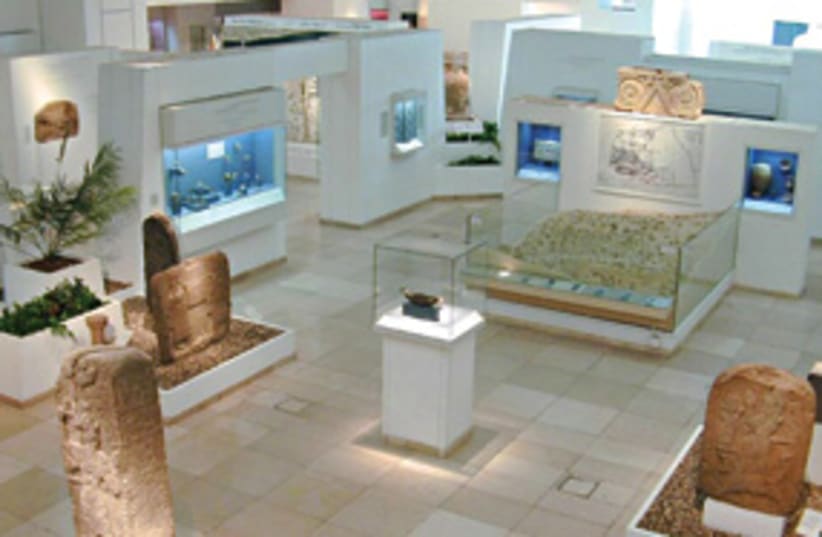
By PEGGY CIDORBible Lands Museum Gallery 311(photo credit: Haim Zach)
Through one of those weird and wonderful mysteries of life, Toronto, of all places, was the reason behind the decision to establish the Bible Lands Museum in Jerusalem, which is celebrating its 18th anniversary this month.What’s more, Batya Borowski, the associate founder and former director of the museum, is celebrating her 80th birthday. She is the widow of Dr. Elie Borowski, whose unique collection of artifacts of the ancient Near East tracing the history of this region and the Jewish People lies at the heart of the museum.“I met Elie for the first time at the bar of the King David Hotel in 1981,” recalls Borowski (then Weiss). “I was attending a gathering of 15 people who had come for the opening of the Joseph Ternbach exhibition at the Israel Museum and there he was, talking about his collection of ancient Near East artifacts, which was to be displayed at the Royal Ontario Museum in Toronto. He showed us the catalog of the exhibition, and I realized at once what a magnificent thing it was. I asked him, tongue in cheek, ‘But where is Toronto? I have never heard of the place. My daughter Amanda, who accompanied me and immediately understood what I had in mind, answered, ‘Toronto? I think it is somewhere in the remote north, where the Eskimos live.’”Borowski, who still laughs so many years later while recalling that scene, says that Elie Borowski – who died seven years ago – was so shocked at Batya’s hutzpa that he was rendered speechless.Then he virtually screamed at her, “Who are you, and where do you come from?”And she replied, “I’ve been to the west, to the south, to the east, but to the north, to Canada? I’ve never been to Canada. Why would I?” she continued.She recounts that once some calm was restored around the table at the hotel bar, she asked him to lend her the catalog until breakfast the following morning.“I knew by the way he was talking about his collection how important it was, yet I couldn’t understand – why was it in Canada? It didn’t belong there. I took the catalog and couldn’t put it down for most of the night. I said to myself, ‘You are going to marry that man and build a museum for his collection in Jerusalem,’” recalls Batya, who at the time had been divorced for many years.Her daughter said to her, “Mom, what just happened to you?”“Amanda saw it happening,” says Borowski. “And I simply replied, ‘Something quite wonderful.’ It was really like a miracle; it was bashert. Suddenly I knew that everything I had been doing until that moment was very nice but unimportant. It didn’t contribute anything to the world.”The next morning, she looked Elie in the eye and told him quietly that he had to bring his collection to Jerusalem. His answer was a shrill “No,” explaining that in the past other museums had threatened to break up his collection.RELATED:Exhibiting the FactsBut she simply responded that they should talk about it, and that was it. “I told him what I had understood at once: That he should forget about Toronto and hurry to find a way to bring this marvelous collection to the only place it belonged – Jerusalem. And the rest is history,” she says.THE SOMEWHAT caustic first encounter between the two – he a highly educated and respected antiquities dealer and artifacts collector, deeply marked by the annihilation of his family during the Shoah, and she, a tough real-estate businesswoman born in New York to a Yemenite father and a Polish mother and single mother to two daughters – developed into a deep love affair, and the two were soon married.She was determined to bring her husband’s superb collection on the region’s history to Jerusalem. It took a while and a lot of support from some of her wealthiest and most influential friends around the world, as well as the help of mayor Teddy Kollek, who had seen the collection and had fallen in love with it and was more than willing to help pave the way. In 1992, exactly 10 years after the couple were married, the Bible Lands Museum became a reality.Meanwhile, the Borowskis took up residence in Jerusalem in one of the Kiryat Wolfson villas overlooking the Knesset, and Batya became the first woman in Israel to be a museum director. Her two daughters, Amanda Weiss and Jessica Waller, also joined the team. Amanda recently succeeded her mother as museum director, while Jessica serves as exhibition designer.The Bible Lands Museum, while maintaining its special character as a privately established and family-run institution, has become over the years a major stop on Museum Row below the Knesset, overcoming quite a few battles to obtain government funding. Today, two years after her retirement, Batya Borowski is officially retired from the museum, but it doesn’t take long to see how deeply involved she still is.Borowski has agreed to tell her personal story, which reveals how far her childhood was from the high-powered position she has held as an adult. The successful, independent woman who never took no for an answer when she had an important project in mind grew up in abject poverty in New York during the dark days of the Depression.“When I met Elie, I was a self-sufficient businesswoman,” says Borowski, who is now remarried to Dr. Leonard Wolfe. “I was making a lot of money in real estate and property development, and I supported my children. I was totally independent and was very content with my life. I was 51 years old and I didn’t want to marry anyone anymore; I didn’t want anybody disrupting my life. My life was so complete. But when I met him, I realized that I was going to marry this man right away because I was so intrigued by someone who had such a passion, such an exciting mission in life, while all I was doing was making money.”But she also understood immediately that not only was his life about to change, but hers as well. “I knew when I decided to marry him that I was going to give up a certain amount of my freedom. Because he was such a powerful personality, I could no longer be the independent woman I had been. I knew that I had to become submissive to his power and his strength, to his knowledge and his education. So this was a definite agreement that I made with myself because it could only work that way. There couldn’t be any competition between us, otherwise, we would have clashed – we were two such strong personalities. And though later on he came to appreciate my strength, it took time because he was not accustomed to women who were strong. It was a totally different world that I opened to him. In fact, until the day he met me, he’d never heard of a woman in business.”ALTHOUGH BATYA Borowski had not always been a well-to-do and self-sufficient businesswoman, when hearing her reminiscences of her childhood during the Depression in New York, one can trace the first seeds of what she was to become.“At the age of five, my father came from Yemen to Jerusalem with his family in 1910,” she says. “They settled in Beit Yisrael, where my grandfather continued the family craft of making Yemenite jewelry. When my father turned 16, he decided it was time to see the world. He found an American ship and set sail for Guatemala as a crew member. One of the first ports they stopped at was Marseille in France. It was the night before Bastille Day. So he thought, ‘Well, I must go to Paris – that’s where all the celebrations will be.’ So he got on a train and went to Paris. And where does a Jewish boy go when he arrives in Paris? To the Jewish Quarter, of course, where there was dancing in the streets and where he saw this cute Polish girl and fell madly in love with her.”The two apparently spoke to each other in Yiddish. She had gone to Paris from Lodz at 17 to live with her married sister. They got married in Paris, and the groom took his bride home to Palestine.“My grandfather’s reaction was ‘You’ll have to marry again so I can be sure you’re married properly according to Jewish law,’” Borowski recalls with a laugh. Her parents moved to Petah Tikva, where they stayed for six years. But in 1921 the situation became very bad in Palestine, so they set sail for New York, hoping for the best.“I was born in 1930, at the worst time, just when everything collapsed during the big stock market crash in New York,” says Borowski. “My father lost everything. I grew up in a poor Jewish neighborhood, knowing that money was very tight. I still remember how I would walk 15 blocks with my mother carrying a pail to buy milk in bulk, which cost a penny less than the milk sold at the grocery. I was only five years old. In the winter it was so cold. I remember it like it was yesterday,” she says.But she says she also had wonderful dreams. “We lived on a street that was just behind a Yiddish theater. I would stand on the stairs and watch the Yiddish comedians who performed vaudeville plays. One of the stage managers saw me standing there and asked me if I wanted to perform in one of the shows. I said, ‘Absolutely!’ Remember, it was the Depression, so I thought I could make money – at the age of five! I said, ‘But you’ll have to discuss it with my mother first.’ My mother said, in Yiddish, ‘Meine tochter a shoeshpiele? Only whores play in the theater.’ I said, ‘Mom, I’m not going to do anything like that. I only want to act and make money.’ Well, that was the end of my theatrical career,” says Borowski summarily.Her childhood memories are very vivid. While she recalls them, her two daughters listen with rapt attention. Some of these stories they are hearing for the first time.“We spoke Yiddish and Hebrew at home,” Borowski continues. “My father was quite a linguist. We ate Yemenite food, which my father taught my mother how to cook, such as saluf and marak haweidj. To this day, my cuisine is Yemenite,” she says.Even though poverty was the main thread in Borowski’s life as a child, there is not a drop of bitterness or frustration in these early memories. At the age of five, she was sent to a Yiddish school; and a year later she went to public school in English. “We were religious and we were very poor. My father couldn’t make jewelry because nobody was going to buy it, so he did any kind of work he could find. We didn’t eat very well. If we had a chicken for Shabbat, it was really a special occasion. But I never felt that I was poor. I never said that I never felt underprivileged. Whatever I had, I managed to make do with it.”BUT NOT all her memories were happy ones. In third grade she won a spelling contest, for which she was awarded three shiny pennies and three pencils. Her teacher said to her, “I must say you are one of the happiest children I have ever met. You always have such a positive outlook on life. You must have such a happy life at home.”At that, the eight-year-old burst into tears.“That was the wrong thing to say to me,” she explains. “What I looked like was my facade, and I didn’t want her to see inside me. I didn’t need her to intrude in my life. That pretty much has been my policy all my life,” says Borowski.That attitude was to prevail often in her youth. “I was eight or nine years old, walking home from school with my younger brother. It was snowing and cold, and we were wearing thin coats. Half a block from our home there was a delicatessen, and the two of us stood there with our noses pressed against the window, inhaling the smell from that delicatessen. It looked so warm inside and the smell was so delicious, I can still smell it even today. A woman came out to us and said, ‘Little girl, are you hungry? Would you like to come inside and have something to eat?’ And I said, ‘Certainly not!! We’re not hungry.’ I grabbed my little brother and walked away. I was so offended that she had the nerve to talk to me that way, to think that I would be hungry! I was starving, but she should see that I was offended. It’s a question of dignity. You know, sometimes I’m afraid that perhaps we’ve lost it. My dignity, that was my great defense. I never dreamed or thought I would become rich. I didn’t even know what rich was!”BOROWSKI IS not only a businesswoman who found a great cause to defend and fight for, but she is also a mother. As the Bible Lands was a private institution, there was no reason not to include members of her family into its staff. Her two daughters, Amanda and Jessica, became staff members. But they always had to prove they they deserved the great honor of working at the museum.“I always considered it a privilege to work at the museum,” says Weiss. “We had right from the beginning an American kind of work ethic. Everyone had the right to express himself. And since I became assistant director and later director of the museum, I have been very careful to have an open policy. In fact, we are a team. When we have a new exhibition, we all work together, overnight if necessary, doing anything that is required, not only things connected to our specific tasks. If necessary, I will vacuum the floors the night before the opening of an exhibition, and I know that any other employee here would do so as well,” she says.The two sisters admit that they came to the museum first and foremostbecause of their mother, who trusted their capabilities and wanted themat her side.“And Batya Borowski never takes no for an answer,” they say in unison.One thing is certain: The entire staff has been working very hard todisplay Elie Borowski’s collection in this aesthetic museum dedicatedto his dream.One of Elie’s dreams has certainly been fulfilled. His vision ofcloseness between the sons of Abraham is expressed in various educationprograms led by the museum’s education department, the largest of theinstitution.“Elie was totally dedicated to his people, to his legacy. I rememberhim standing on this terrace in our villa, facing the Knesset andfuming at what he regarded as a total lack of understanding of what isreally important to this country and these people – education, Jewishlegacy – by those sitting over there inside,” concludes Batya Borowski.
if(catID != 151){
var cont = `Take Israel home with the new Jerusalem Post Store