Analysis: Peace talks highlight internal tensions in Hamas
Many in the West Bank say Mashaal and his Gaza followers are issuing ‘impossible’ directives.
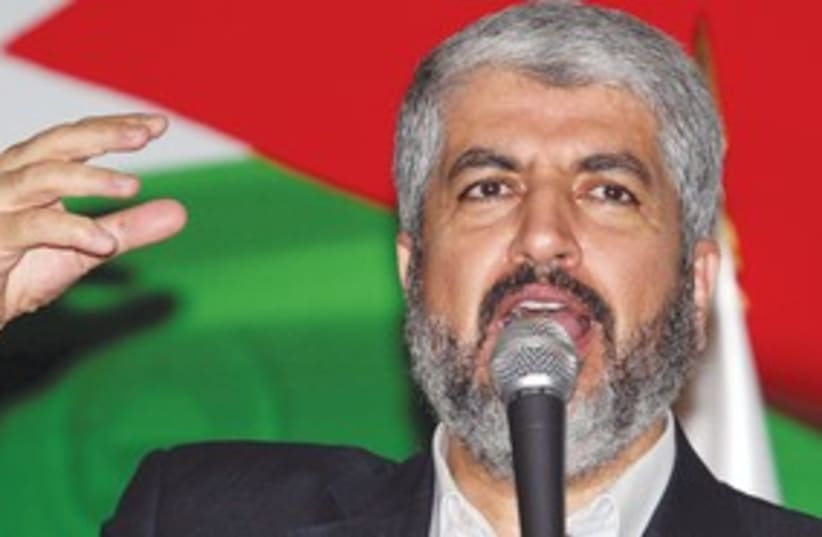
By EHUD YAARI3311_Khaled Mashaal face shot(photo credit: ASSOCIATED PRESS)
Unsurprisingly, the Hamas leadership – both in Gaza and Damascus, and less so in the West Bank – has greeted the resumption of direct Israeli-Palestinian talks with a flood of contrarian rhetoric.Characterizing the process as a “sellout” of the Palestinian “cause,” the movement argues that President Mahmoud Abbas lacks the necessary “mandate” to represent his people. Hamas leader Khaled Mashaal went so far as to call Abbas “a zero,” amid accusations of “treason” and “betrayal.”The group has also issued fiery denunciations of the growing cooperation between Palestinian Authority security agencies and their Israeli counterparts. According to Hamas spokesmen, only ongoing “resistance” and uncompromising adherence to the “basic tenets” of Palestinian struggle will pave the way forward.Rhetoric aside, how will Hamas respond on the ground as the renewed US-sponsored negotiations unfold? Will it attempt to thwart the talks through violence right from the start, or will it limit the counteroffensive to the political domain? Several revealing indicators suggest that the group’s top echelons have already held intense closed-door debates on these questions, shaped to some degree by prodding from Iran and Syria.Between Gaza and Damascus In deliberating its next moves, Hamas was compelled to change some elements of its typical decisionmaking process.Egypt’s refusal to allow the group’s leaders to leave Gaza complicated matters by preventing face-to-face Political Bureau meetings in Damascus. The group also apparently had to curtail its usual procedure of seeking advice from prominent Hamas activists in jail.Decisionmaking was therefore split between Gaza and Damascus, with the West Bank leadership – now headed by Omar Abd al-Razeq from Salfit – largely left out of the discussions. Even so, the deliberations and resulting developments provide a fair forecast of the group’s course on a number of fronts.On direct negotiations Hamas will no doubt avoid declaring an open campaign to subvert the talks – as Gaza chief Mahmoud Zahar put it, “You do not need to foil what is doomed to fail anyway.”This statement drew numerous negative comments from rank-and-file Hamas members and some of Mashaal’s subordinates in Damascus, reflecting the heightened tensions between the two leaders. In private, Zahar has accused Mashaal of “trying to design himself as a new Arafat.”Yet, setting aside internal rifts and the group’s insistence that Abbas has no legitimacy to negotiate, Hamas consistently maintains that the outcome of the talks will soon demonstrate that pursuing any agreement with Israel is futile. Echoing this belief, Izzadin Kassam military commander Ahmed Jabari – who often allies with Mashaal – said in his Ramadan message that “the enemy does not lower its head except to the sword and bullets.”Accordingly, Hamas communiqués and remarks following the recent West Bank shootings carefully emphasized that they were not intended to derail the talks, but were simply a reflection of the group’s traditional resistance doctrine.On military activity The August 31 and September 1 and 2 shootings show that Hamas has decided to make a full effort toward resuming attacks in the West Bank. Over the past three years, the group eschewed major attacks there, preferring to absorb blows and portray itself as the victim of unlawful persecution rather than be perceived as provoking retaliation. Meanwhile, most of its terrorist operatives in the West Bank were arrested through joint Israeli-PA efforts, seemingly leaving the group with no surviving operational network there.Yet Hamas is now encouraging dormant cells to take action, and attempts are under way to send new operatives from abroad – unknown to Israeli, PA, or Jordanian security services – in order to establish new terrorist infrastructure in the territory. The group has also continued its efforts to send Gaza operatives through the Rafah tunnels to Sinai with the goal of infiltrating the West Bank. Hamas seems to believe that a wave of successful terrorist attacks will create unbearable strain between Israel and the PA, casting a dark shadow over the negotiations.Yet it is important to bear in mind that, according to well-placed sources within Hamas, the group is not planning a reversion to suicide bombings. Past internal decisions to refrain from such attacks apparently remain in force, along with the policy of restricting operations to the Palestinian territories and Israel. For example, when missiles were lobbed from Sinai against Eilat and Aqaba on August 3, Hamas told Egyptian intelligence that the strike was an “unauthorized endeavor” by a handful of activists.On the de facto ceasefire in Gaza Although Hamas is clearly inclined to maintain the relative calm in Gaza, it has allowed – temporarily, one would assume – a noticeable spike in militant activity. The past two weeks have seen an increase in the number of locally upgraded Kassam missiles (with a payload of 10 kilograms compared to three in the past) and mortar shells fired into Israel, up to 10 strikes daily. Many of these attacks are carried out by Palestinian Islamic Jihad, by several small Salafi armed groups, and even by ex- Fatah militiamen recently converted to a new unit operating under Hamas command.Israel’s response has so far been restricted to a few air raids against the tunnels and Hamas workshops, resulting in minimal casualties. If Hamas manages to mount a series of drive-by shootings and ambushes in the West Bank, however, pressure will grow to complement this with a second front involving increased strikes from Gaza.Attitudes toward the PA Hamas has now instructed its members to actively resist any arrests by PA security forces, with firearms whenever available.West Bank members have yet to heed this new order, however; despite PA arrests targeting some 400 activists in the past three weeks, they are unlikely to seek violent clashes with the PA. Indeed, many Hamas leaders in the West Bank are complaining that Mashaal and his Gaza followers are unaware of the real conditions on the ground and issue “impossible” directives without consulting the local leadership.Several of these figures have demonstrated their displeasure by holding warm, public meetings with Abbas and participating in joint demonstrations with Fatah against Israel’s West Bank security barrier.At a time when Hamas leaders elsewhere are stepping up criticism of the PA and urging confrontation, the West Bank leadership is heading in the opposite direction, despite – or perhaps because of – the constant pressure the PA has brought to bear against their network of institutions.Iran and Syria’s role Iran and, to a lesser extent, Syria were quick to applaud the renewal of terrorist attacks in the West Bank, a move that lent support to their favorites within Hamas: Izzadin Kassam commander Jabari and his deputy, Marwan Issa. At the same time, both countries helped mediate a secret understanding between Hamas and Islamic Jihad to prevent further deterioration in their relations, which had previously erupted into small armed clashes in Gaza.Encouraged by these state sponsors, 13 Palestinian factions combined in Damascus to deny Abbas the right to act on behalf of the PLO – since Oslo, the official Palestinian interlocutor with Israel. Both countries had a role in convincing the Popular and Democratic Fronts for the Liberation of Palestine and the ex-communist People’s Party to withhold support for the decision to engage in direct negotiations. This maneuvering deprived Abbas of any backing outside Fatah, at a time when many Fatah officials avoided supporting him in public or, as in the case of party leader Muhammad Dahlan, expressed doubts regarding the wisdom of the move.Hamas’s reactions reflect the ongoing struggle between its different factions regarding the movement’s future course.This debate was eloquently exposed by Ahmed Yousef, a former US resident and current director-general of the Gaza government’s Foreign Ministry, who asked whether Hamas aspires to end up a Palestinian version of the Taliban or a copy of Turkey’s ruling Justice and Development Party. In other words, does the group want to be an armed militia that imposes its interpretation of Islam and political worldview by force, or a civilian party playing by the rules of a pluralistic democracy?Risk of terrorism Most of Hamas’s West Bank leaders have privately criticized the military wing and the way it is running Gaza. They advocate quiet reconciliation with Abbas rather than confrontation and question the effectiveness of “armed struggle” at this juncture.Similar attitudes can be found among some of the group’s veteran leaders in Gaza and even among a handful of Mashaal’s entourage in Damascus.For now, though, Mashaal, the military chiefs in Gaza, and their civilian political allies have managed to keep the upper hand. As a result, further deterioration in PA-Hamas relations may be accompanied by a new phase of terrorist attacks, unless the Israeli and PA intelligence agencies can find a way to abort them.Ehud Yaari is an Israel-based Lafer International Fellow with The Washington Institute. This article is republished by permission of The Washington Institute.
if(catID != 151){
var cont = `Take Israel home with the new Jerusalem Post Store