Analysis: No longer afraid, Egyptians take to the streets to express their dissatisfaction with Morsi.
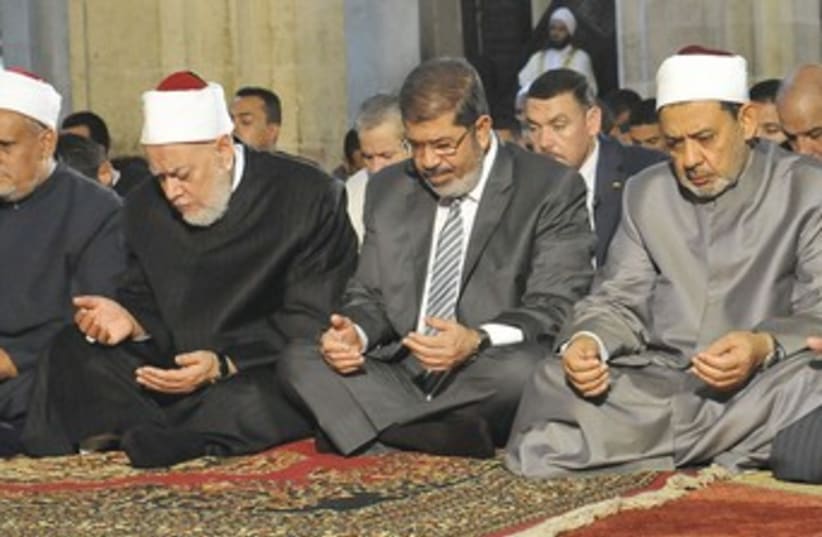
By ZVI MAZELMOHAMED MORSI, center, prays at Al-Azhar mosque in Cairo 370(photo credit: REUTERS)
Having conquered parliament, the constituent assembly and the presidency in less than a year, the Muslim Brotherhood thought Egypt was theirs.They may have been a little hasty. Forces long kept dormant by the Hosni Mubarak regime are waking up.Independent media is criticizing the government on a daily basis, and government-owned newspapers sometimes follow suit.Egyptians are no longer afraid, and take to the streets to express their dissatisfaction and demand changes.It seems as if no Friday goes by without a demonstration on iconic Tahrir Square, and similar protests are held throughout the country.Mohamed Morsi is well aware of the danger and is hard at work to neutralize opposition.Having gotten rid of the army old guard, he is busy putting his own men everywhere, from ministries to provinces and is trying to “reform” the educational system.The dissolution of the lower house of parliament stopped him but briefly, since the provisional constitution gives him extensive legislative powers until a new parliament is elected.The judiciary is the last stronghold to evade Morsi. The president’s attempts to fire the state attorney ended in a humiliating defeat when lawyer told him politely he was not empowered to do so.In retrospect, it seems that the Brotherhood’s stunning success a year ago in the parliamentary elections – where they found themselves with 47 percent of the seats, while the Salafists, their natural allies, got 25% – has gone to their heads, and they did not sense that the mood of the country was changing.Worse, instead of tackling burning economic and social issues, “their” parliament – before it was dissolved – discussed ways to impose Shari’a laws, from lowering the marriage age for girls to introducing corporal punishments.Then there were accusations of corruption, and even accusations of lewd conduct, against some members of parliament.That Morsi was elected with the votes of barely a quarter of registered voters shows that people were losing faith in the Brotherhood. The president has done nothing since the election to restore hope.It took him more than a month to appoint a prime minister without charisma, or vision, who has surrounded himself with ministers who do not have the clout needed to launch much needed reforms.The government has not even been able to come to an agreement with the International Monetary Fund, regarding the loan the country so desperately needs.Morsi has not kept any of the promises he made during the elections, and hasn’t even fulfilled the modest objectives he had set for his first 100 days in office. Though he likes to talk about renewal, he is yet to offer a concrete program of actions.Morsi boasts of having restored Egypt to its rightful place, as leader of the Arab world, through his foreign trips, and Western media praise for his “moderate” or “pragmatic” approach. However, his own people are not convinced.Opposition forces called for a mass protest on Friday, October 19, proclaiming, “Egypt does not belong to the Muslim Brotherhood.”The Brotherhood organized a counterdemonstration so violent that many were reminded of the way Arab dictators used to quell opposition.There was such an outcry that the president and the group had to admit that they had been wrong.The government’s apparent incapacity to deal with the economic crisis fuels the opposition.Political parties are getting ready to fight the proposed constitution and win the next elections (which have not yet been scheduled).A number of blocks are taking shape – liberals, leftist formations and Nasserists – united for the moment in their common intent to topple the Brotherhood regime.The Sixth of April youth, who had launched the revolution by taking to the streets in January 2011, is now waging an all-out campaign against the Brotherhood and distributing tracts exposing what they call the group’s true nature and real objectives.Morsi is desperately trying to stifle the opposition; he had planned to use his legislative powers to promulgate a law “for the protection of the achievements of the revolution,” a name soon changed to “For the protection of society.”The law would have granted the regime the right to summarily arrest and try people, in a way only too reminiscent of the infamous “emergency laws” of the old regime.Once again there was such an outcry that the law has been shelved – for the moment.The Egyptian Institute for Human Rights has stated that human rights are not among the priorities of the new government.Police abuse continues. As to women’s rights, the president has fired four women who held senior positions in the public service or local government.The constitution currently being drafted stipulates that women are equal – within the limits of the Shari’a.Right now the judiciary appears to be the most urgent threat to the Brotherhood.Both the Supreme Constitutional Court and the Higher Administrative Court are due to rule on a number of explosives issues: There is a request to order them dissolved on the grounds that they has not been registered.Should it be accepted, the “Freedom and Justice” party created by the movement would be dissolved as well – and its successful candidate for the presidency disqualified.Then there is the much awaited verdict on the dissolution of the constituent assembly, because its predominantly Islamic membership does not allow for the representation of all currents – as set down by the law.The constituent assembly is trying to complete its work before the verdict, but is hampered by the fierce opposition of secular forces and that of the Salafists.The former are against the extraordinary powers given to the president – powers exceeding by far those of Mubarak – as well as against the curtailing of basic human rights, and subject them to the Shari’a.However Salafists are not satisfied; they object to article 2, which stipulates that “the principles of the Shari’a are the main source of legislation” and want the text changed to “The Shari’a is the sole source of legislation.”Salafists had called for a mass demonstration on Friday, November 2, and later backed down, though a disappointingly small number of militants did show up “to test the waters” and were met by angry secular demonstrators.The Brotherhood is now trying to come to grips with the new situation and its own deteriorating image. It has failed to regain control of Sinai and is now facing terror cells inside mainland Egypt.Incidents opposing Muslims to Copt Christians – an estimated 10% of the population – are getting worse. But the Brotherhood’s main problem is that they have failed to provide a solution to the country’s economic woes and to restore order to the streets.Will they resort to even greater repression to retain power? The writer, a Fellow of The Jerusalem Center for Public Affairs, is a former ambassador to Romania, Egypt and Sweden.
Related TagsHosni Mubarak
if(catID != 151){
var cont = `Take Israel home with the new Jerusalem Post Store