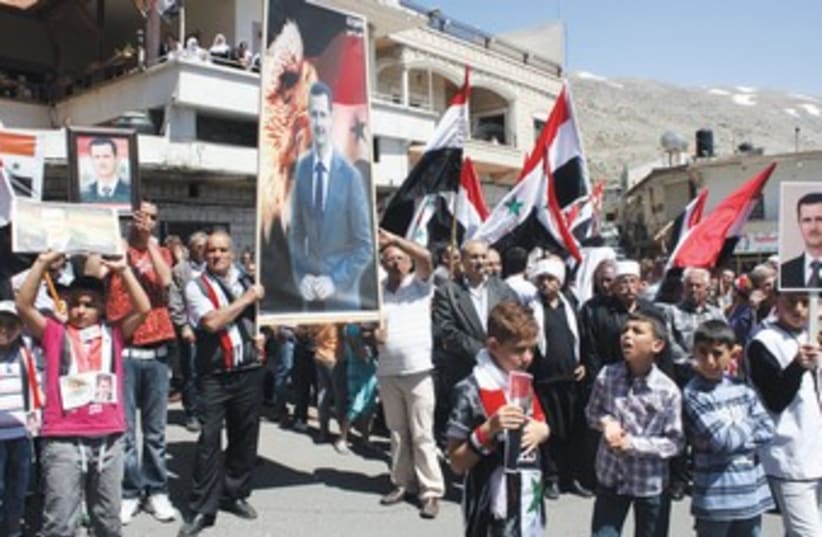
Chanting “the army and the people are with Assad“ around 200 people marched in Druse village of Majdal Shams.
By BEN HARTMANDruse rally in Majdal Shams for Assad 370(photo credit: Ben Hartman)
Syrian President Bashar Assad may be a pariah in most parts of the world, but in parts of Israel the autocrat still has a diehard following, at least at first glance.Around 200 people, chanting “the army and the people are with Assad,” marched around the central square of the Druse village of Majdal Shams on Monday, in a rally held to mark Syrian Independence Day and to show support for the Assad regime, whose forces have murdered thousands in a 13- month violent uprising.Demonstrators of all ages held up posters of Assad, and at least two of former Egyptian president Gamel Abdul Nasser, and women threw rice at the crowd and ululated as fiery speeches screamed out of a stack of speakers on the stage.Majdal Shams resident Rafik Kalami, 46, said most people still support Assad because the Golan Heights is an inseparable part of Syria.When asked about the thousands of civilians killed in Syria since the uprising began, he said that he supports Assad, and is opposed to “all those from the Gulf States, Turkey and elsewhere who are against Syria and we will fight them with all of our might.”Kalami offered an explanation heard repeatedly at protests and in conversation with the village’s residents since the uprising began: The Syrian army is not massacring civilians. Rather, gunmen sent from the Gulf states and elsewhere in the Arab world are murdering civilians and soldiers in order to frame the Assad regime in the eyes of the world. Kalami also accused Arabic satellite networks Al Jazeera and Al-Arabiya of twisting the reality, an accusation not leveled at Syrian state TV.He added that the Arab world is colluding with Israel and the US to attack Syria as a means of harming Iran and further cementing Israel’s standing as the region’s preeminent power, through supporting “terrorists” streaming into Syria from Libya and elsewhere.The show of support for Assad, like many things in the Syrian Druse villages of the Golan Heights, should be taken with a grain of salt. Most of the residents of Majdal Shams have relatives in Syria who could pay the price if they spoke out against the regime, and many err on the side of supporting Assad on the off chance that the land they live on will eventually return to Syria. Furthermore, in a town of over 10,000, a protest that drew barely 200 people on a morning when nearly all businesses in town were closed is arguably not a massive show of support for the Assad regime.Since the uprising began in Syria, there has been, on occasion, violence directed at people in town who voiced opposition to Assad. According to one local resident, who asked not to be named, a group of teenagers in Majdal Shams beat and hospitalized a 60- year-old father of four in the town Sunday night, because he was believed to support the Syrian opposition. The teenagers reportedly waited for him outside of his medical practice.Majdal Shams is the largest Druse village in the Golan Heights, followed by Bukata, Ein Kuniya and Mas’ada. The Golan Heights Druse refused to take Israeli citizenship when the country annexed the territory in 1981 and consequently, most are considered Syrian citizens.One resident, who asked not to be named, said “I look at what’s happening in Syria and it’s very difficult, it’s a genocide. To see innocent people being murdered, it’s very hard.”He added that the Druse of the Golan work and live in Israel, “which protects our rights and doesn’t kill us like the Syrian regime kills its people.”When asked what percentage of residents support Assad privately as well as publicly, he said that the silent majority don’t speak about the issue and those who are most vocal are those who support Assad.He said part of their reason for supporting him is also because he is from the minority Alawite sect, and the Druse worry that if Assad falls, Alawites and other minorities in Syria like the Druse will be targeted.In addition, he said many fear the rise of Islamists, who he said could single out Druse as being not true Muslims.He added that “they also worry that Israel will return the Golan Heights like they did Sinai or Gush Katif and they want to protect themselves and their families in Syria.”
if(catID != 151){
var cont = `Take Israel home with the new Jerusalem Post Store