Egypt crisis worst disaster since Iran’s revolution
Analysis: Without learning lessons from past, Obama gambles that anti-American Islamist government allied with Iran won’t emerge from the chaos.
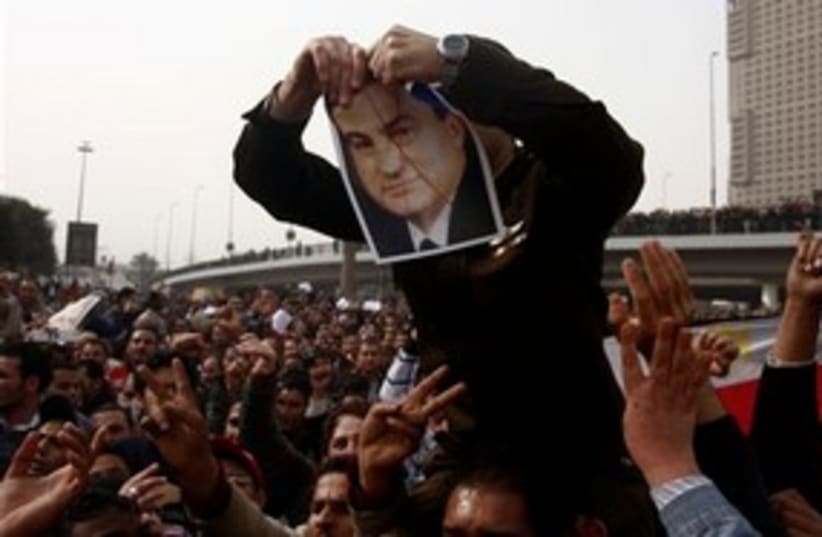
By BARRY RUBINMubarak picture ripped 311(photo credit: Associated Press)
When polled recently, 59% of Egyptians said they backed the Islamists and only 27% favored modernizers. There is no good policy for the United States regarding the uprising in Egypt but the Obama administration may be adopting something close to the worst option.This is its first real international crisis. And it seems to be adopting a policy that, while somewhat balanced, is pushing the Egyptian regime out of power. The situation could not be more dangerous and might be the biggest disaster for the region and Western interests since the Iranian revolution three decades ago.RELATED:Analysis: Egyptian chaos and the Palestinian question Background: Who are the Muslim Brothers?If Brotherhood takes over, IDF will face formidable enemyExperts and news media seem to be overwhelmingly optimistic, just as they generally were in Iran’s case. Wishful thinking is to some extent replacing serious analysis. Indeed, the alternative outcome is barely presented: This could lead to an Islamist Egypt – if not now, then in several years.What’s puzzling here is that a lot of the enthusiasm is based on points like saying that the demonstrators are leaderless and spontaneous. But that’s precisely the situation where someone who does have leaders, is well organized, and knows precisely what they want takes over.Look at Tunisia. The elite stepped in with the support of the army and put in a coalition of leadership, including both old elements and oppositionists. We don’t know what will happen but there is a reasonable hope of stability and democracy. This is not the situation in Egypt where the elite seems to have lost confidence and the army seems passive.Can Omar Suleiman, long-time head of intelligence, as vice-president and former Air Force chief (the job Mubarak himself used to have) Ahmed Shafiq as prime minister stabilize the situation? Perhaps. He is an able man. But to have the man who has organized repression running the country is not exactly a step toward libertarian democracy.There are two basic possibilities: the regime will stabilize (with or without Mubarak) or power will be up for grabs.Now, here are the precedents for the latter situation: Remember the Iranian revolution when all sorts of people poured out into the streets to demand freedom? Mahmoud Ahmadinejad is now president.Remember the Beirut spring when people poured out into the streets to demand freedom? Hizbullah is now running Lebanon.Remember the democracy among the Palestinians and free elections? Hamas is now running the Gaza Strip.Remember democracy in Algeria? Tens of thousands of people were killed in the ensuing civil war.It doesn’t have to be that way but the precedents are pretty daunting.What did Egyptians tell the Pew poll recently when asked whether they liked “modernizers” or “Islamists"? Islamists: 59%; Modernizers: 27%. Now maybe they will vote for a Westernized guy in a suit who promises a liberal democracy but do you want to bet the Middle East on it? Here’s the problem.On one hand, everyone knows that President Hosni Mubarak’s government, based on the regime that has been running Egypt since the morning of July 23, 1952, is a dictatorship with a great deal of corruption and repression.This Egyptian government has generally been a good ally of the United States, yet has let Washington down at times. For example, the Mubarak government has continued to purvey anti-American propaganda to its people; held back on solving the Israel-Palestinian conflict (it did not endorse the 2000 Clinton plan, though I have good sources saying Mubarak said later he regretted that decision); has not taken a strong public stance on pressuring Iran; and so on.For a long time, it was said that Egypt was the most important US ally in the Arabic-speaking world. There is truth in this but it has been less true lately, though due more to passivity in foreign policy than to hostility.Clearly, though, Egypt is an American ally generally, and its loss to an anti-American government would be a tremendous defeat for the United States. Moreover, a populist and radical nationalist – much less an Islamist – government could reignite the Arab-Israel conflict and cost tens of thousands of lives.The US's gambleSo the United States has a stake in the survival of the regime, if not so much that of Mubarak personally or the succession of his son, Gamal. This means that US policy should put an emphasis on the regime’s survival.The regime might be better off without the Mubaraks, since it can argue it is making a fresh start and will gain political capital from getting rid of the hated dictator.Given the weakness of designated successor, Gamal Mubarak, who is probably too weak to deal with the situation, the regime might well be a lot better off.On the other hand, the United States wants to show that it supports reform and democracy, believing that this will make it more popular among the masses in the Arab world as well as being the “right” and “American” thing to do. Also, if the revolution does win, the thought is, it is more likely to be friendly to America if the United States shows in advance its support for change.Finally, the “pro-democracy” approach is based on the belief that Egypt might well produce a moderate, democratic, pro-Western state that will then be more able to resist an Islamist challenge. Perhaps the Islamists can be incorporated into this system.Perhaps, some say (and it is a very loud voice in the American mass media) that the Muslim Brotherhood isn’t really a threat at all.So, in this point of view, US policy should favor the forces of change.Of course, it is possible to mix these two positions and that is what President Obama is trying to do.Thus, Obama said, “I’ve always said to [Mubarak] that making sure that they are moving forward on reform – political reform, economic reform – is absolutely critical to the long-term well-being of Egypt, and you can see these pent-up frustrations that are being displayed on the streets...Violence is not the answer in solving these problems in Egypt, so the government has to be careful about not resorting to violence and the people on the streets have to be careful about not resorting to violence. I think that it is very important that people have mechanisms in order to express legitimate grievances. As I said in my State of the Union speech, there’s certain core values that we believe in as Americans that we believe are universal: freedom of speech, freedom of expression – people being able to use social networking or any other mechanisms to communicate with each other and express their concerns.”On paper, this is an ideal policy: Mubarak should reform; the opposition should not use violence; and everything will turn out all right. Again, this is the perfect policy in theory, and I’m not being sarcastic at all here.Unfortunately, it has little to do with reality.For if the regime does what Obama wants it to do, it will fall. And what is going to replace it? And by his lack of support – his language goes further than it might have done – the president is demoralizing an ally.And it is all very well to believe idealistically that even if Egyptians are longing to be free, one has to define what “free” means to them. Also, the ruler who emerges is likely to be from the best organized, disciplined group. People in Russia in 1917 were yearning to be free also and they got the Bolsheviks.In Iran, where people are yearning to be free, the Obama administration did nothing.No matter what the United States says or does at this point, it is not going to reap the gratitude of millions of Egyptians as a liberator. For the new anti-regime leaders will blame America for its past support of Mubarak, opposition to Islamism, backing of Israel, cultural influence, incidents of alleged imperialism, and for not being Muslim.If anyone thinks the only problem is Israel, they understand nothing.This is not the first time this kind of problem has come up and it is revealing and amazing that the precedents are not being fully explained. The most obvious is Iran in 1978-1979. At that time, as I wrote in my book Paved with Good Intentions: The American Experience and Iran, the US strategy was to do precisely what Obama is doing now: announce support for the government but press it to make reforms. The shah did not go to repression partly because he didn’t have US support. The revolution built up and the regime fell. The result wasn’t too good.Click here for full Jpost coverage of unrest in EgyptThere is a second part of this story also.Experts on television and consulting with the government assured everyone that the revolution would be moderate, the Islamists couldn’t win, and even if they did, this new leadership could be dealt with. So either Ayatollah Ruhollah Khomeini couldn’t triumph – Islamists running a country, what a laugh! – or he couldn’t really mean what he said. That didn’t turn out too well either.Even more forgotten is that, regarding Egypt, that’s how the whole thing started! Back in 1952, as I wrote in my book, The Arab States and the Palestine Conflict, US policymakers supported – don’t exaggerate this, it was not a US-engineered coup but they were favorable – to an army takeover.The idea was that the officers would be friendly to the United States, hostile to the USSR and communism, and more likely to enjoy mass support.In other words, policymakers and experts are endorsing a strategy today that has led to two of the biggest disasters in the history of US Middle East policy. And now it is even worse, since we have these precedents and particularly the point about what happens when Islamists take power.There is no organized moderate group in Egypt. Even the most important past such organization, the Kifaya movement, has already been taken over by the Muslim Brotherhood. Since 2007, its leader has been Abdel Wahhab al-Messiri, a former member of the Muslim Brotherhood and a virulent anti-Semite.Muhammad ElBaradei, leader of the reformist movement, makes the following argument against my analysis: “Mubarak has convinced the United States and Europe that they only have a choice between two options – either they accept this authoritarian regime, or Egypt will fall into the hands of the likes of bin Laden’s al-Qaida. Of course, that is not exactly true. Mubarak uses the specter of Islamist terror to prevent a third way: the country’s democratization. But Washington needs to know that the support of a repressive leadership only creates the appearance of stability.In truth, it promotes the radicalization of the people.”This is a reasonable formulation. But one might also say that nothing would promote the radicalization of the people more than having a radical regime. Even ElBaradei says that if he were to be president, he would recognize Hamas as ruler of the Gaza Strip and end all sanctions against it.That is not to say that there aren’t good, moderate, pro-democratic people in Egypt but they have little power, money, or organization. Indeed, Egypt is the only Arab country where many of the reformers went over to the Islamists believing – I think quite wrongly – that they could control the Islamists and dominate them once the alliance got into power.Nothing would make me happier than to say that the United States should give full support for reform, to cheer on the insurgents without reservation. But unfortunately, that is neither the most honest analysis nor the one required by US interests. In my book, The Long War for Freedom, I expressed my strong sympathy for the liberal reformers but also the many reasons why they are unlikely to win and cannot compete very well with the Islamists.I have pointed out that the Brotherhood’s new leader sounds quite like al- Qaida and has called for war on both Israel and America.And here is Rajab Hilal Hamida, a member of the Brotherhood in Egypt’s parliament, who proves that you don’t have to be moderate to run in elections: “From my point of view, bin Ladin, al-Zawahiri and al-Zarqawi are not terrorists in the sense accepted by some. I support all their activities, since they are a thorn in the side of the Americans and the Zionists... [On the other hand,] he who kills Muslim citizens is neither a jihad fighter nor a terrorist, but a criminal murderer. We must call things by their proper names!” A study of the Brotherhood members of Egypt’s parliament shows how radical they have been in their speeches and proposals.They want an Islamist radical state, ruled by Shari’a and at war with Israel and the United States.Then it is also being said that the Brotherhood is not so popular in Egypt. Then why did they get 20 percent of the vote in an election when they were repressed and cheated? This was not just some protest vote because voters had the option of voting for secular reformers and very few of them did.The mass media is full of “experts” who also argue that the Brotherhood is not involved in terrorism. Well, partly true. It supports terrorism against Americans in Iraq and against Israelis, especially backing Hamas. In major cases of terrorism in Egypt – for example the assassination of Farag Fouda and the attempting killing of Naguib Mahfouz – Brotherhood clerics were involved in inciting the violence beforehand and applauding it afterward.The deeper question is: why does the Brotherhood not engage in violence in Egypt? The answer is not that it is moderate but that it has felt the time was not ripe. Knowing that it would be crushed by the government, and its leaders sent to concentration camps and tortured or even executed, as happened under Gamal Abdel Nasser in the 1950s and 1960s, is a deterrent. It is no accident that Hamas and Hizbullah – unrestrained by weak governments – engaged in violent terrorism while the Muslim Brotherhood, facing strong and determined regimes in Egypt and Jordan, did not.Having said all of this, US influence on these events, already rejected by Egypt’s government, is minimal. It is morally good to speak about freedom and seem to support the protesters but also quite dangerous and will not reap the gratitude of the Egyptian masses in the future. After all, aside from the likely radicalism of their leaders, a revolutionary regime would be hostile toward the United States since America would be blamed for supporting the Egyptian dictatorship for decades. President Obama will not charm them into moderation.The Egyptian elite wants to save itself and if they have to dump Mubarak to do so – as we saw in Tunisia – the armed forces and the rest will do so. But if the regime itself falls, creating a vacuum, that is going to be a very bad outcome. If I believed that something better could emerge that would be stable and greatly benefit Egyptians, I’d be for that.Yet is that really the case? Consider this point: Egypt’s resources and capital are limited. There aren’t enough jobs or land or wealth. How would a new regime deal with these problems and mobilize popular support? One route would be to embark on a decades-long development program to make the desert green, etc. Yet with so much competition, where would the money come from? How could Egypt try to gain markets already held by China, for example? More likely is that a government would win support through demagoguery: blame America, blame the West, blame Israel, and proclaim that Islam is the answer. That’s how it has been in the Middle East in too many places. In two cases – Lebanon and the Gaza Strip – democracy (though other factors were also involved) has produced anti-democratic Islamist regimes that endorse terrorism and are allied to Iran and Syria.Is America ready to bet that Egypt will be different? And on what evidentiary basis would that be done? The emphasis for US policy, then, should be put on supporting the Egyptian regime generally, whatever rhetoric is made about reforms. The rulers in Cairo should have no doubt that the United States is behind them.If it is necessary to change leadership or make concessions, that is something the US government can encourage behind the scenes.But Obama’s rhetoric – the exact opposite of what it was during the upheavals in Iran which he should have supported – seems dangerously reminiscent of President Jimmy Carter in 1978 regarding Iran.He has made it sound – by wording and nuance, if not by intention – that Washington no longer backs the Egyptian government.And that government has even said so publicly.Without the confidence to resist this upheaval, the Egyptian system could collapse, leaving a vacuum that is not going to be filled by friendly leaders.That is potentially disastrous for the United States and the Middle East. There will be many who will say that an anti-American Islamist government allied with Iran and ready to restart war with Israel “cannot” emerge. That’s a pretty big risk to take on the word of those who have been so often wrong in the past.The writer is director of the Global Research in International Affairs (GLORIA) Center and editor of the Middle East Review of International Affairs (MERIA) Journal.
if(catID != 151){
var cont = `Take Israel home with the new Jerusalem Post Store