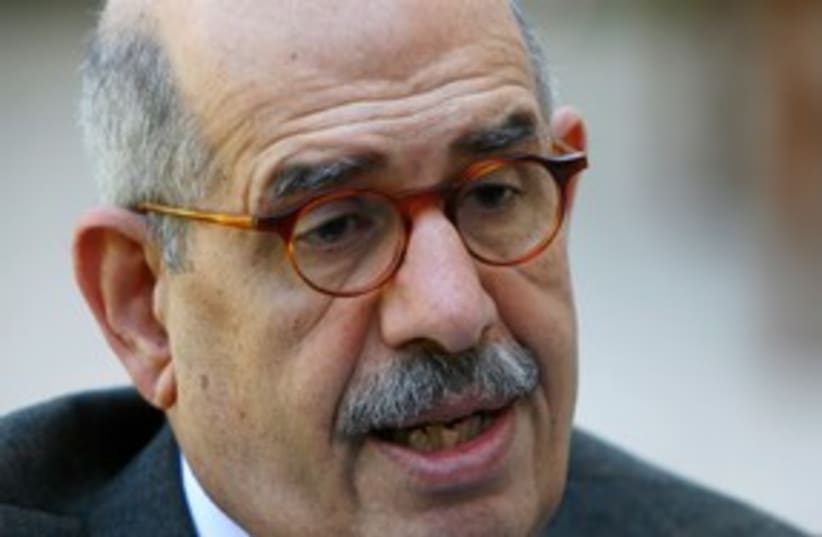
Mohamed ElBaradei says maintaining Israeli-Egyptian peace treaty the central issue in secret talks.
By REBECCA ANNA STOIL, JPOST.COM STAFFEgyptian presidential candidate Mohamed ElBaradei 311(photo credit: REUTERS)
Maintaining the Israeli- Egyptian peace treaty has been the central issue in secret US discussions with Egypt’s military rulers, Iranian Fars news agency quoted Egyptian political figure Mohamed ElBaradei as saying Tuesday.The Egyptian presidential contender has been relatively quiet on the issue of Egyptian- Israel relations and on the push-button issue of the Camp David peace treaty, until he reportedly broke his silence on Tuesday.RELATED:'Egypt indicts 2 Israelis for smuggling gun'Muslim Brotherhood welcomes Hamas PM in EgyptThe former leader of the International Atomic Energy Agency told Fars that “what the supreme military council said was that the talks were about bilateral and mutual relations, but I believe that Americans wanted to ensure that the deals signed between Egypt and Israel will remain intact if Islamists ascend to power.”“The negotiations were completely secret and confidential,” ElBaradei continued.In the initial hours after its publication, no Egyptian figure denied that such meetings took place. ElBaradei himself did not push the issue – there was no mention of his Fars interview on either his Facebook page or his Twitter feed, both usual outlets for broadcasting the candidate’s positions.
The Egyptian peace treaty with Israel has become a hot issue in the fledgling Egyptian democracy, partially due to what the Washington Institute for Near East Policy’s Eric Trager described as its close association with the former regime of ousted president Hosni Mubarak.“If it’s true that the US is holding conversations with Egyptian political players about Camp David, it would be a very positive thing,” said Trager.Trager said that the Fars report seemed “a little bit strange.”“ElBaradei has been a lot less populist on the issue of Camp David than other contenders. He has occasionally stepped out to criticize Israel and gas deals with Israel, but it is not clear what the upside is of him speaking as he reportedly did,” explained Trager, who observed the first round of Egyptian elections on the ground in Egypt earlier this year. “This report is quite out of the ordinary.”Trager said that although “Israel in general has been a secondary issue in post- Mubarak period,” there is “a consensus among political players that Camp David should be changed or be eliminated.”The Muslim Brotherhood has been at the forefront of Camp David skepticism.The Brotherhood, says Trager, “wants to find a way to sink Camp David without being responsible for it,” and is championing the idea of holding a national referendum to revoke or amend the over three-decades-old peace treaty.“I hope that the American administration really has been having these types of conversations with Egyptians,” added Trager. “What America needs to do is force the Muslim Brotherhood to decide between their ideology and their pragmatic interests. It is not in Egypt’s interest to start a conflict with the most powerful military force in the region.”According to Fars, senior Muslim Brotherhood member Kamal al-Halbawi said in early December that “the issue of revising the Camp David Accords will also be in the list of the top priorities of [Egypt’s new] officials to be studied in its appropriate time.”The Muslim Brotherhood’s Freedom and Justice party is leading in Egypt’s parliamentary elections.But anti-Camp David sentiment, said Trager, is present in many of Egypt’s political streams, including leftist-secular movements and parties with even more radical Islamist ideology than that of the Muslim Brotherhood.Nader Bakar, a spokesman of the Salafi al-Nour party, which has won about a quarter of the Egyptian vote thus far, told Fars on Saturday that “al-Nour is against the establishment of any relations with the Zionist regime.”The spokesman also rejected reports that Nour leaders met with Israel’s ambassador to Egypt, calling them a smear campaign against the Islamist party.George Ishaq, a member of the National Association for Change, led by ElBaradei, was also quoted telling Fars earlier in the fall that “Camp David has been annulled and has no more credit and value.”
if(catID != 151){
var cont = `Take Israel home with the new Jerusalem Post Store