GCC members to discuss ties amid growing threats from Iran, al-Qaida; seek to avoid heavy influence of Saudi Arabia.
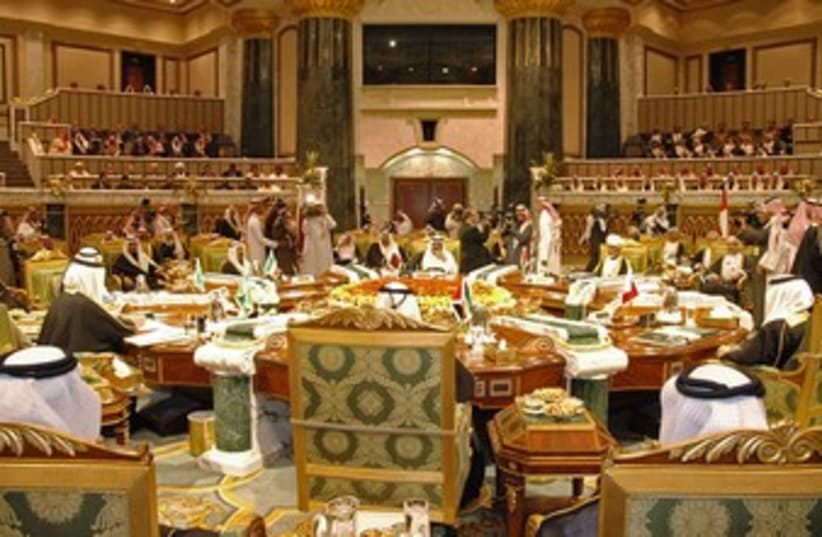
By REUTERSGulf Cooperation Council Summit in Riyadh 370(photo credit: REUTERS/Stringer .)
RIYADH - Gulf Arab leaders meeting on Monday will discuss closer union between their six states because of what they see as growing threats from Iran and al-Qaida after the Arab uprisings, but significant political obstacles loom.Some members of the Gulf Cooperation Council (GCC), which includes Kuwait, Bahrain, Qatar, the United Arab Emirates and Oman, worry that convergence might spell dominance by the group's largest member, Saudi Arabia.They also view dimly reports that Saudi Arabia will merge initially with Bahrain, where majority Shi'ite Muslims have rebelled against a monarchy that like the other GCC dynasties is Sunni Muslim and is allied with the United States against Iran."Qatar sees this all as Saudi's way of undermining the Gulf states' bilateral relations and forcing its own agenda," said a source close to the Qatari government.Smaller Gulf Arab states fear losing economic and political influence to Saudi Arabia, which has a population five times greater than the next largest member, Oman, and dominates the region's all-important oil and gas sector.Riyadh's overarching concern is its regional tussle for influence with Iran, its Shi'ite Islamist arch-rival on the other side of the Gulf, and it wants more defense integration and foreign policy coordination to help in that struggle.The Saudis believe Iran used the fall of Iraqi president Saddam Hussein in 2003 as a launchpad towards realizing region-wide supremacy, and they accuse Tehran of fomenting the uprising in Bahrain and unrest among Saudi Arabia's own Shi'ite minority. The Islamic Republic denies such allegations.When GCC leaders last convened in December, Saudi King Abdullah urged member nations to move "beyond the stage of cooperation and into the stage of unity in a single entity".On Monday that might prompt the establishment of two much-discussed Gulf commissions to coordinate foreign and defense policy - although a Gulf government official said these would likely be purely consultative and might not be announced until the next full summit in December.The king's call for integration was seen at the time as a response to Gulf Arab worries that the Arab Spring would destabilize the Middle East, giving al-Qaida the opportunity to get a foothold in some states and Iran to gain sway over others."The desire increasingly is to present a more convincing front of unity in the context of some internal and regional pressure. But the preeminent importance of national sovereignty and wariness of the weight Saudi Arabia would have militate against any practical steps," said Neil Partrick, visiting fellow at the London School of Economics Gulf Program.Security threats loom over Gulf countriesThat sense of pressure has not abated in the intervening half year. Shi'ite protests have flared anew in Bahrain, an old feud between the UAE and Iran over disputed Gulf islands has reignited and another exposed al Qaeda bombing plot reminded many of a nagging security threat emanating from Yemen.Given the obstacles to substantive political integration between the six states, Gulf capitals have recently buzzed with speculation about some form of initial union between Bahrain and Saudi Arabia."Saudi Arabia and Bahrain are likely to establish a mini confederation," said a Eurasia Group research note on Thursday, saying the move would give Riyadh more formal leverage over its small neighbor's security.Saudi Arabia and Bahrain accuse Iran of fomenting the unrest in the island state and fear it aims to install a Shi'ite government that would pay obeisance to the Islamic Republic as part of longstanding aspirations to being the predominant regional power and rolling back US clout in the Middle East.Riyadh sent troops to help its fellow Sunni monarchy quash unrest by Bahraini Shi'ites last year and has long propped up its neighbor with a gift of crude oil to supply an important refinery. The United States bases its naval Fifth Fleet in Bahrain, underlining the country's strategic importance.Still, diplomats in the Gulf say such a confederation seems unlikely, citing probable opposition from other GCC members who would be wary of increasing Saudi influence and the historical antipathy of monarchies to surrendering any sovereignty."It's a way to pressure the Bahrainis to get their house in order. If there really was a union (between Saudi and Bahrain), it would put a chill over the entire Gulf," said Justin Gengler, a Bahrain researcher based in Qatar.A Saudi foreign affairs spokesman could not be reached for comment.GCC members have increased cooperation, but differences remainThe summit will come at a time when Saudi Arabia and Qatar, the two most politically active Gulf Arab states, are working productively on regional issues such as Syria and Yemen.The two have led Arab efforts to isolate Syrian President Bashar Assad, an ally of Iran, over his bloody crackdown on a popular uprising and were instrumental in easing Ali Abdullah Saleh from power in Yemen in January to defuse an uprising that was tearing the impoverished Arabian Peninsula country apart.Moreover, the GCC has finally made some progress in building a customs union - a first step towards economic integration.But despite decades of urging by the United States, GCC members have still not agreed to set up a shared missile shield - seen by Western military analysts as the minimum step towards a joint arms pact, and one that would require basing radar systems in one country and missiles in another.There is a history of inter-Arab feuding in the region.Saudi Arabia has in the past bickered with Qatar over its support for the Al Jazeera satellite news channel, which has criticized Riyadh's ruling family, and it has had tensions with the UAE over closer economic union and a border dispute.The UAE, meanwhile, has suffered friction with its neighbor Oman, which last year accused the emirates of running a spy network in Muscat, a charge the UAE denied."The elites in the GCC saw this call to unity as a reaction to the Arab Spring. But the support in some countries will be weak. There are no united policies in defense or foreign policy," said Abdullah al-Shammari, a Saudi political analyst.
if(catID != 151){
var cont = `Take Israel home with the new Jerusalem Post Store