Mubarak's ex-spy chief says Israel might use Brotherhood presidential victory as pretext to invade Sinai.
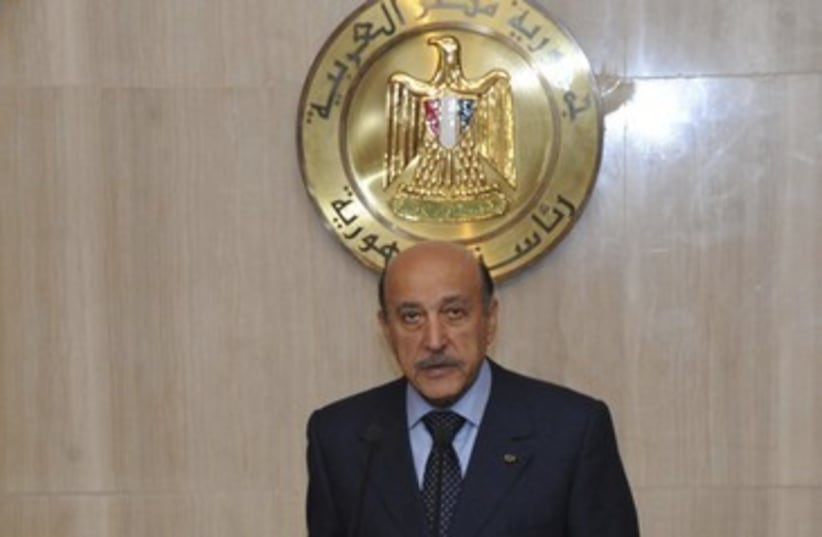
By OREN KESSLEREgyptian presidential candidate Omar Suleiman 370(photo credit: reuters)
Omar Suleiman joined two other Egyptian presidential candidates Monday in filing appeals against election commission orders disqualifying them from next month’s long-awaited race.The commission said Suleiman, a longtime intelligence chief under deposed president Hosni Mubarak, was barred from running because he had not accumulated enough voters’ signatures to register. His team had gathered 49,000 signatures in 15 provinces – more than the 30,000 needed – but the commission said he had 1,000 votes too few in one province.The Muslim Brotherhood’s Khairat al-Shater and the even-harder-line Islamist Hazem Salah Abu Ismail also filed appeals Monday. Their applications came two days after they and eight other candidates were informed of their ineligibility to run.In an interview published Saturday in the Egyptian newspaper Al-Youm Al-Saba’a, Suleiman warned that Israel would view a Muslim Brotherhood president in Cairo as an enemy.“I suspect Israel thinks Egypt has become one of its enemies,” he said. “Israel regards the Sinai Peninsula as insecure and believes Egyptian territory is being used for rocket launching. Israel may therefore consider returning to secure borders.”Eight people were killed last summer in a terror attack in southern Israel that had been launched from Sinai, and earlier this month two rockets were fired from the area toward Eilat.Suleiman was Mubarak’s point man on ties with Israel and visited the country many times. His reference to Israel on Saturday was the former spy chief’s first since he announced his candidacy earlier this month.“It is possible Israel will confront us and use its national security as a pretext for doing so,” he said in the interview.“Israelis are experts in presenting such excuses to the world.If the Israelis reenter Sinai, they will not be quick to leave again. Egypt could pay a heavy price if that happened.”Suleiman told the paper that Egypt should pursue rapprochement with the Hamas government of the Gaza Strip, but not at the expense of national interests.“Egypt should continue tightening its relationship with Hamas but not at the expense of the country’s national interests, regional security and peace that will all enable Egypt to further develop internally,” he said.Thousands of Egyptians protested in Cairo’s Tahrir Square on Friday against Suleiman’s run, making an Islamist show of strength against a symbol of Mubarak’s old guard. Banners there showed Suleiman and Mubarak alongside the Star of David and depicted both as agents of Israel, a perception stemming from policies that included Egypt’s role in enforcing the blockade on Gaza.In an interview Sunday with Reuters, Suleiman said he wanted the presidency to stop it from going to the Brotherhood but saw the Islamist group playing a vital role in Egyptian politics.“This is why they sought me, as a balance between Islamists and civilian forces,” said Suleiman, who describes himself as a devout Muslim but adds that Egyptians fear their country is being turned into a theocracy.The Muslim Brotherhood won nearly 50 percent of Egypt’s parliamentary seats in elections earlier this year, with even stricter Salafist Islamists taking another 25 percent.“Many people felt that the state is going to the Muslim Brotherhood – in parliament, in government and now the presidency,” Suleiman said.“They have the right to practice politics and to have a role in society so long as it is within law and constitution,” he added. “There is nothing to stop them from participating as ministers or deputy prime minister or prime minister... I will base my choice on competence, not party affiliations.”Asked if he would trim the military’s role in Egypt, he said: “Why would you reduce its role? Are we going to tell it not to defend the state? ...Are we going to tell them not to become involved in any crisis that happens in the state?” The powers of the next president are to be defined by a constitution that has yet to be written. Suleiman said he supported the idea of a presidential system but added: “I hope the president will not have wide influence... so we do not go back to the system of one-man rule.”Suleiman described his role in Mubarak’s administration as one that dealt purely with external and security affairs, and not government, though he said he had sometimes offered the former president advice on domestic affairs.“I was not part of the previous administration. I was the head of general intelligence and I took care of the Egyptian national security and my work was all for Egyptian interests abroad,” he said. “I had nothing to do with domestic affairs. My relationships were with spies and foreign interests.”Reuters contributed to this report.
if(catID != 151){
var cont = `Take Israel home with the new Jerusalem Post Store