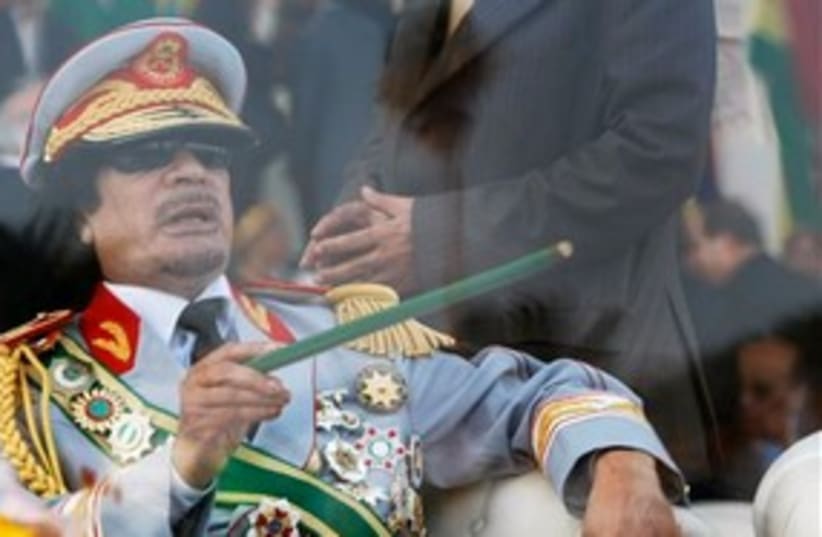
UN's Ban speaks with Gadhafi, condemns violence in Libya
White House closely monitoring situation in N. African country; senior Libyan officials resign in protest of state violence; British FM says Gadhafi may have fled to Venezuela; officials in Caracas deny report.
By JPOST.COM STAFF, ASSOCIATED PRESSLibyan leader Moammar Gadhafi 311 AP(photo credit: AP)UN Secretary-General Ban Ki-moon spoke with embattled Libyan leader Moammar Gadhafi on Monday, telling him that violence against protesters "must stop immediately," Reuters reported."The secretary-general expressed deep concern at the escalating scale of violence and emphasized that it must stop immediately. He reiterated his call for respect for basic freedoms and human rights, including peaceful assembly and information," the spokesman said.RELATED:EU foreign ministers set to condemn Libya repressionOpinion: Shattering illusions of tranquilityLibya: Gadhafi's son warns protests may lead to civil war'Libyan soldiers defect to protesters’ side in Benghazi'In the conversation, Ban stressed "the need to ensure the protection of the civilian population under any circumstances. He urged all parties to exercise restraint and called upon the authorities to engage in broad-based dialogue to address legitimate concerns of the population."Libya's diplomatic mission to the United Nations on Monday said they were siding with anti-government protesters in a break from what they called, "the regime's despicable actions," The Los Angeles Times reported.Libyan diplomat Adam Tarbah said that a speech by Libyan leader Moammar Gadhafi's son on Sunday was "inciting civil war." He added that "it was shameful." "We are aware that this will put our families back home in danger, but they are in danger anyway," Tarbah told the LA Times.The White House on Monday said it was analyzing the speech by Gadhafi 's son, Saif al-Islam Gadhafi, to determine whether it has possibilities for democratic changes in Libya.A White House official said the administration is seeking clarification from senior Libyan officials about their intentions. The official spoke Monday on condition of anonymity because of the sensitivity of the subject.The official said US President Barack Obama was briefed by National Security Adviser Tom Donilon late Sunday and is being kept abreast of events. The official said the Obama administration is considering "all appropriate actions."Libyan Justice Minister Mustafa Abdel-Jalil tendered his resignation in protests of what he called, "excessive use of force against unarmed protesters," DPA reported on Monday.Abdel-Jalil confirmed to Libyan newspaper Quryna that he was in fact resigning, according to the report.The justice minister's resignation followed those of Libya's envoy to the Arab League, Abdel Moneim al-Honi, who said he was "joining the revolution," and Libyan Ambassador to India Ali al-Essawi.Also on Monday, three local employees at Libya's Embassy in Stockholm said they have resigned in protest over the government's crackdown on demonstrators.The three men announced their resignation in a letter to Swedish news agency TT "condemning the genocide of civilians in Libya" and urged other embassy workers to follow suit.One of them, Sayed Jalabi, told the AP "It would be hypocritical to assist the Libyan government while we see them attacking people in the streets."British Prime Minister David Cameron, visiting neighboring Egypt, called the Libyan government's crackdown on protesters "appalling.""We can see what is happening in Libya which is completely appalling and unacceptable as the regime is using the most vicious forms of repression against people who want to see that country — which is one of the most closed and one of the most autocratic — make progress. The response they have shown has been quite appalling," he told reporters in Cairo.Libyan protesters celebrated in the streets of Benghazi on Monday, claiming control of the country's second largest city after bloody fighting, and anti-government unrest spread to the capital with clashes in Tripoli's main square for the first time. Moammar Gadhafi's son, Seif al-Islam Gadhafi, vowed that his father and security forces would fight "until the last bullet."Arab League Secretary-General Amr Moussa on Monday called for an end to violence in Libya saying the demands of Arab people for change are legitimate, Reuters reported."The demands of the Arab peoples for reform, development and change are legitimate and ... the feelings of all the (Arab) nations are joined in this decisive moment in history," MENA cited Moussa as saying.Gadhafi's regime has unleashed the bloodiest crackdown of any Arab country against the wave of protests sweeping the region, which toppled the leaders of Egypt and Tunisia. More than 200 have been killed in Libya, according to medical officials, human rights groups and exiled dissidents.Seif al-Islam Gadhafi warned of civil war in Libya if protests continue, a theme continued Monday on Libyan state TV, where a pro-regime commentator spoke of chaos and "rivers of blood" turning Libya into "another Somalia" if security is not restored.The Arab world's longest ruling leader in power for nearly 42 years, Moammar Gadhafi has held an unquestioned grip over the highly decentralized system of government he created, called the "Jamahiriya," or "rule by masses."The spiraling turmoil in Libya, an OPEC country that is a significant oil supplier to Europe, was raising international alarm. Oil prices jumped $1.67 to nearly $88 a barrel Monday amid investor concern.European countries sent planes and ferries to Libya on Monday to evacuate their citizens, and some international oil and gas companies pulled their foreign staff out and suspended operations, as anti-government protests spread to Tripoli for the first time.Many countries had already urged their citizens to avoid nonessential travel to Libya or recommended that those already there leave on commercial flights. But as the bloody protests moved to Libya's capital countries and companies alike stepped up their contingency plans.Oil companies, including Italy's Eni, Royal Dutch Shell PLC, U.K.-based BP and Germany's Wintershall, a subsidiary of BASF, were evacuating their expat workers or their families or both. BP and Wintershall said they were temporarily suspending operations; Eni said production continued normally.Denying a report that UK Foreign Minister William Hague said Gadhafi had fled to Venezuela, Senior Venezuelan government sources said the Libyan ruler was not in the South American country.
if(catID != 151){
var cont = `Take Israel home with the new Jerusalem Post Store