Lindenstrauss submits longest-ever report to Knesset
61 chapters detail hundreds of failures in public sector; entire section dedicated to Barak’s finances; report reveals ‘severe deficiencies’ in functioning of Jerusalem Islamic Wakf trust.
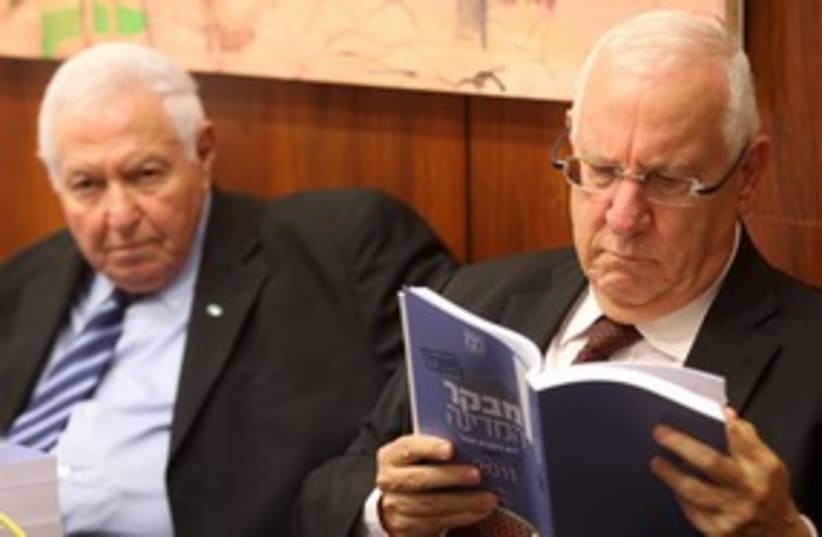
By RON FRIEDMANlindenstrauss and rivlin_311(photo credit: Marc Israel Sellem)
State Comptroller Micha Lindenstrauss submitted a 61-chapter report to Knesset Chairman Reuven Rivlin Tuesday, highlighting hundreds of failures in the public sector.The report – the longest ever submitted – identified and analyzed a wide range of government activities and provided comprehensive critiques of the failures, including recommendations on ways to rectify the problems it discovered.RELATED:'IDF branches, Defense Ministry don't coordinate documentation'Lindenstrauss: Tax Authority doesn't use all tools at its disposal to chase debtorsLindenstrauss said that the submission of the longest report since the founding of the state was a “day of celebration for democracy.”Upon receiving the report, Rivlin thanked Lindenstrauss and his staff. “The State Comptroller has proven time after time that effective critique does not shy away from any person or position,” he said.The report deals with a vast assortment of issues, ranging from donations to hospitals, to youth trips to Poland, as well as providing insight into the regular activities of government ministries and authorities and publicly-held companies.A special chapter in the report was dedicated to the treatment of the elderly by the various government agencies, with a emphasis on their medical and welfare needs.A special assessment of Ehud Barak’s finances ordered by the State Control Committee reported that Barak avoided fully revealing his substantial assets prior to joining the Cabinet in 2007.The report stated that Barak had transferred his stock in his companies to his daughters only three days before being appointed, despite the fact that he could have done so earlier – and thus acted in violation to the accepted norms.Aside from the special assessment on Barak’s financial dealings, the report included two other special assessments requested by the Knesset State Control Committee: one dealing with suicides in the prisons system, and the other a secret report on excavations taking place at the Temple Mount.The report opened with criticism over long-standing disputes between government ministries that hinder public services, either to the general citizenry or to aided sectors. Forty such disputes were reported on in a survey of 15 out of 30 ministries, with some of the disputes lasting for decades.The injured parties include children and teens in state institutions, who because of a 15-year dispute between the Ministry of Health and the Ministry for Welfare Services, failed to receive proper treatment after being released from psychiatric hospitalization.Other special-needs children sometimes had to miss school because a dispute between the Health Ministry and the Education Ministry meant that they didn’t receive the medical supervision they were entitled to by law.Lack of cooperation between ministries also created redundancies, budgetary waste and burden on the system. Such communication breakdowns meant, for example, that the Ministry of Education and the Ministry of Industry Trade and Labor both had bodies responsible for overseeing engineering colleges.Another example given in the report was a dispute over responsibility of developing the city of Eilat as a tourism-based destination. The report said that while the government had decided to invest in the city, confusion over responsibilities between the ministries of tourism, finance, transportation and the Israel Land Authority, meant that the proposed development was not taking place, and the city was gradually ebbing.The reports stated that ad hocmediation mechanisms were unable to solve all differences, and that often the ministries did not address the disputes to the proper resolution agents, including the Attorney General’s Office, the Prime Minister’s Office and the specifically-tailored Interministerial Committees.The State Comptroller recommended that the government conduct an in-depth discussion on the matter, and take on a more proactive role in identifying and resolving disputes between ministries.The next section of the report addressed the use of search committees for appointing senior positions in the public service. The report found that the practice of conducting search committees largely replaced tenders as the preferred method of staffing senior positions, and that the number of jobs filled in this way had ballooned from nine to 100 since 1999, when the method was first approved.The report said that the number had risen so steeply because the Civil Service Commissioner failed to create a list limiting the number of jobs that could be filled by a search committee, and as a result ministries and statutory bodies took it upon themselves to adopt the method – often using it to fill less senior positions than intended.The report said that additional reform to the selection method, introduced by Justice Minister Yaakov Neeman, whereby the search committee would only recommend a short list of candidates that the minister then chooses from, could (and did) lead to the politicizing of appointments previously considered independent.The report recommended that the use of such committees be carefully monitored and implemented.Meanwhile, the report slammed the Finance Ministry for lack of oversight on gambling. A full chapter of the report dealt with different aspects of gambling, both legal and illegal.In its inspection of Mifal HaPais, the country’s legal gambling monopoly, the State Comptroller identified breaches of the organization’s operating permits, and deficient oversight of the permit conditions by the Finance Ministry.According to the report, the operator would occasionally change the rules of the games in some of its lotteries – at times substantially reducing the chances of winning – all without the knowledge or approval of the Finance Ministry.“The findings revealed that Mifal HaPais did not act properly in order to create a balance ensuring the public good. Its actions were directed mainly at increasing incomes, and to do so it altered raffle plans without permission of the Ministry of Finance, and in methodical violation of part of its permit articles,” read the report.The company also failed to adequately prevent minors from gambling, and as a result children were exposed to gambling activities on a regular basis. The report also said that not enough was being done to inform the public of the risks of gambling addiction, and the means with which to cope with such addiction.Additionally, it pointed to an increasing trend of the criminalization of legal gambling, with lax oversight on who can open a lottery franchise; and increased purchase of winning tickets by criminal elements for the purpose of money laundering.Criminal activity on a wider scale was discovered by the State Comptrollers investigation into online gambling operations. The report stated that even though the problems inherent in illegal-online gambling started surfacing in the beginning of the 21st century, it was only since the end of the decade that law enforcement agencies began seriously coping with the problem.The report called for better cooperation among the ministries of communications, justice, and finance and the police. Additionally, it called for the Bank of Israel to establish the legal foundations necessary to meet the challenges of the new breed of online financial crime so that the Internet does not become a refuge for criminal activity.In its inspection of the public broadcasting networks, the State Comptrollers Office investigated both the Israel Broadcasting Authority and the Second Authority for Television and Radio, which supervises commercial broadcasting.The report found that both bodies needed to do better in their staffing of positions and hiring of outside talent, and in their investment in local productions. Both bodies did not meet their requirements for purchasing locally produced content, thus failing to meet their obligations to the public interest by investment in local cultural endeavors.Other matters that the report examined include: significant lapses in Transportation Ministry oversight of vehicle licensing bureaus and mechanics; criticism over management of public transportation companies; supervision of experiments on animals; overlap in public diplomacy operations; discrimination in acceptance to schools; delays in the issuing of “smart” identification cards; port management; and defense purchasing.The report also dedicated a special section to the phenomena of suicides of inmates in the prison system.The inspection, which took place between March and July of 2010, studied a series of infamous jail suicides, including that of popular entertainer Dudu Topaz. Additionally, it looked into the Prison Services Authority’s plans for suicide prevention, and its adoption of recommendations submitted by an internal investigation committee on the phenomenon.According to Prison Services Authority data, 103 prisoners committed suicide between 2000 and 2009. The report found that the PSA was in the midst of a widescale process aimed at improving its ability to cope with suicides.This process includes adding professional personnel, including social workers and psychiatrists, introducing new surveillance methods and training guards and other prison staff to prepare them for identifying and preventing potential suicides.The report concluded that though the process underway was bearing fruit and promised to decreases the number of suicides by inmates, some of the planned actions and initiatives had yet to be sufficiently budgeted, and it urged the PSA to ensure the funding so as to enable the completion of the multi-year plan.A majority of the State Comptrollers investigation into the excavation works being conducted by the Jerusalem Islamic Wakf trust under the Temple Mount has not been approved for publication because of the sensitivity of the issue to Arab-Israel relations.But the report did say that it found severe deficiencies in the oversight of the appropriate bodies over the works – deficiencies that according to the report, put ancient artifacts at risk.“Protection of artifacts from the Temple Mount and preventing their ruin is a public goal of the first order. It is important to note that any digging and other works in the Temple Mount must be conducted in consideration of the character of the place, and after receiving all required permits and meeting all archeological guidelines. As a rule use of heavy machinery should be avoided,” read the report.The four state agencies entrusted with enforcing the law in the Temple Mount are the Israel Police, the Israel Antiquities Authority, the Justice Ministry and the Jerusalem municipality. The report found that the agencies did not do enough to conduct continuous supervision of the works and make sure that all the artifacts were protected.Knesset Jerusalem faction chairman Uri Ariel (National Union) said the section of the report made available to the public did not include the most important information, and called on the report to be published in its entirety so that the public realizes the extent of the danger.The 2011 State Comptrollers report also conducted an in-depth investigation into Israel’s public diplomacy activities and surveyed the work of the Foreign Ministry, the Ministry for Public Diplomacy and Diaspora Affairs and individual projects, such as Israel’s booth at the 2010 Shanghai World Expo, and the “Rebrand Israel” project.According to the report, by the time the investigation was completed in August 2010, the Foreign Ministry had yet to determine operative decisions and internal regulations regarding the implementation of its goals in the public diplomacy sphere. A 2008 Internal Ministry report on the issue was never discussed or approved by the ministry.The report found that the ministry was also unprepared to fulfill its communications and advocacy goals on the online front – despite the NIS 10 million earmarked for the purpose.Only 35% of the NIS 20 million earmarked for the Rebrand Israel project in the years 2007-2008 was actually used for the intended purposes.The report found that since the project’s establishment in 2006, the ministry had yet to begin the operative stages of the project.Plans to expand the project in future years have not been implemented.The report found that only a small number of journalist and opinion-shapers visits had been received, and that only a portion of the budgets directed to this aim were utilized.According to the report, there is much overlap between the public diplomacy objectives of the Foreign Ministry and the Ministry for Public Diplomacy and Diaspora Affairs – but that failure to properly split up tasks and responsibilities upon the establishment of the latter created redundancies.The report also highlighted several problems in the establishment of the Israel booth at the 2010 Shanghai World Expo, including failure to appoint a separate person to run the booth after hiring someone to consult on its operation, and failure to ensure sufficient corporate sponsorship for the booth.
Related TagsMicha Lindenstrauss
if(catID != 151){
var cont = `Take Israel home with the new Jerusalem Post Store