Analysis: Petitioners seek bold approach to judicial intervention, while state has more cautious view.
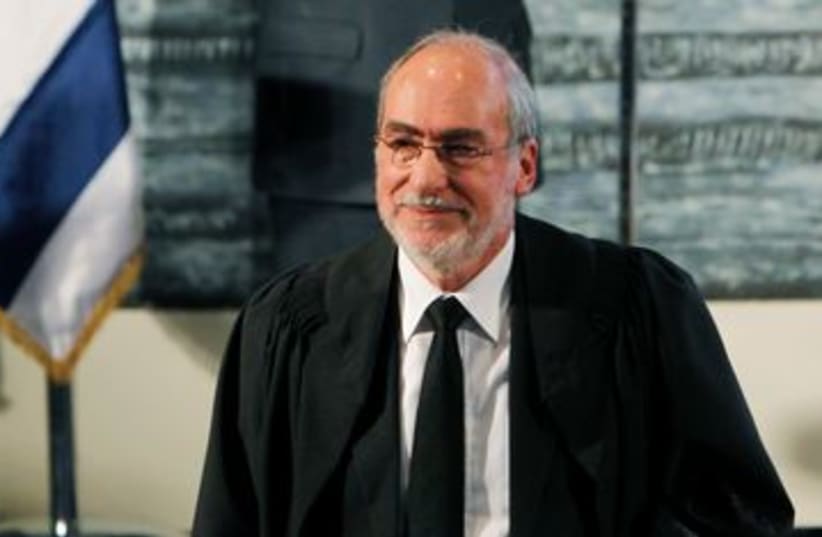
By YONAH JEREMY BOBSupreme Court President Asher Grunis 390 (R)(photo credit: REUTERS/Ronen Zvulun)
In the momentous housing discrimination hearing on Tuesday before a maximum panel of nine justices of the High Court of Justice, presided over by Supreme Court President Asher D. Grunis, one could clearly see two starkly different worldviews at work.The stakes could scarcely be higher, with the future of housing policy in 434 small communities with special characteristics in the Negev and the Galilee, making up almost half of the such places in the country, at stake.At the core of the dispute lay different conceptions of the balance of democracy and minority rights as well as attitudes about judicial intervention.Neither side is claiming that the law in dispute was discriminatory on its face. Nor could they, being as that the law itself has an explicit prohibition against discriminatory practices.Israel, as a country born after race and gender equality were widely accepted, started off with much less open discrimination than many older democracies such as the US, founded when discrimination was legal.Over the years, narrower means of discrimination against minorities have been stamped out by the High Court, including its 2000 Ka’adan ruling striking down open discrimination in communities that were the subject of Tuesday’s hearing.The current law in dispute has been interpreted by many as a way to preserve the status quo of homogeneity in those communities in a legal manner that does not violate the Ka’adan decision.Rather, the arguments about whether to nullify the law or not were more subtle.On one hand were the petitioners, some of the most prominent human rights groups, claiming massive discrimination against Arabs, homosexuals and the disabled.Justice Salim Joubran appeared to take their side.Their worldview was that the proper balance of democracy and minority rights includes a defense of minority rights as its central principle.They have no problem with allowing the system of special communities in the Negev and the Galilee to continue to exist, but their biggest priority is that Arabs, homosexuals and the disabled be accepted into these communities on an equal basis.The fact that the communities may be concerned that their brand and main attraction may fail and become unsustainable if the petitioners succeed in pushing for opening up the communities to minorities, is a lesser concern.In other words, the majority must not only not suppress a minority in centralized government practices and services, but must also sacrifice to ensure that minority rights are not restricted in special contexts.The same philosophy leads to the conclusion that if a law has a discriminatory impact, it is basically just as bad as a law that is openly discriminatory.This philosophy also urges the courts to intervene to prevent discrimination even before it happens, if there is evidence (the court already ruled against a particular community in September 2011 for abusing the new law) of discrimination and if there are indicators that the implementation of the law is being done on a discriminatory basis.In that light and based on past practices, the petitioners warned the court of a dark storm of discrimination just over the horizon that the court could stop before it was too late.On the other side of the equation was the state, the Knesset and, it appeared, four of the justices, including Grunis.Their worldview appeared to be that the balance of democracy and minority rights should focus more on whether open discrimination was taking place.For that reason, over and over again they referred to the law’s prohibition against discrimination in response to the petitioner’s arguments that its implementation was and would be inherently discriminatory in its impact.This stance also holds that protection against discrimination in central spheres of life should not lead to undermining the rights of the majority on more peripheral issues.Promoting specialized communities is considered by many to be a strategic interest of the majority in the country in order to settle the peripheral Negev and Galilee regions.Possibly undermining the viability of these communities by intervening in a way that might strike at their character is viewed as overcompensating and going too far to satisfy minorities.If the law does not openly discriminate, then the bar to judicial intervention based on alleged discriminatory impact will be high.This is why the justices pressed the issue of the extent of concrete cases of discrimination, preferring not to infer conclusions about discrimination from reports of policies which could lead to discrimination, such as demanding that potential residents observe Jewish holidays.Judicial intervention is also something not to do hastily, certainly not because of what might happen down the road.The petitioners seek a bold defense of minority rights combined with an interventionist judiciary, while the state pushed for a more minimal defense of minority rights, applying a more formalist and cautious judicial approach to interpretation and intervention.The particular debate and the predicament of Arabs in Israel is somewhat unique, but the overall debate is not.After decades of success during the height of the civil rights movement in the last century, more conservative approaches to judicial action on minority rights have taken hold in the US as well.Open discrimination is still off-limits, but issues such as affirmative action for increasing minority attendance in universities, which had been solidly accepted, have been chipped away at over time, and majorities have looked for more subtle ways to preserve special privileges without openly discriminating against minorities.Tuesday’s hearing was another milestone in this trend, and unless the justices were trying to fool the public, the law will be upheld for now.The big question now is whether down the road enough communities want to and will abuse the law in a way that can be detected, and whether enough “victims” will come forward at that point.If so, the law may still fall in the future. If not, though it would only entrench the status quo, it would be doing so with new-found High Court approval from a panel of nine justices.This would establish a new constitutional balance of democracy and minority rights in housing.
if(catID != 151){
var cont = `Take Israel home with the new Jerusalem Post Store