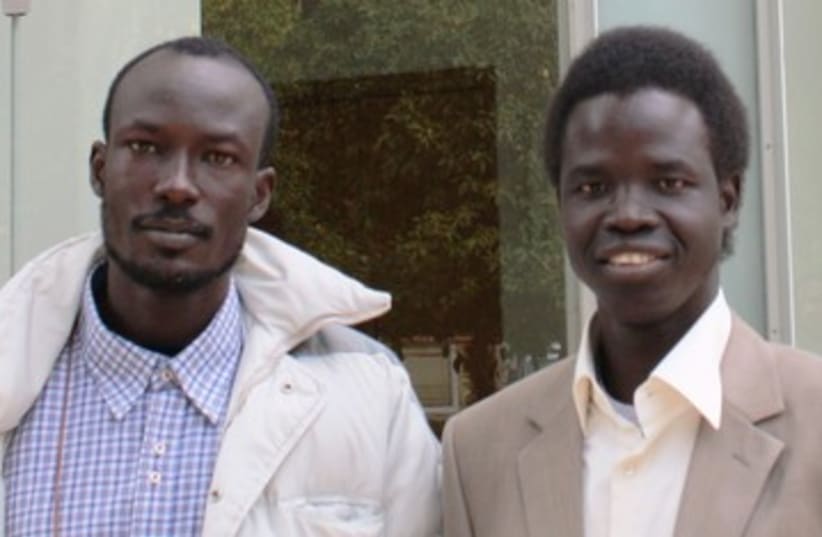
William Akon tries to return to Israel on a student visa after his first deportation, only to be sent back to South Sudan a second time.
By BEN HARTMANGabriel (L), William (R), S.Sudanese students_390(photo credit: Ben Hartman)
A South Sudanese man who was enrolled as a student at the Interdisciplinary Center Herzliya before he was deported to Juba earlier this year returned last week on a student visa, and was deported from Ben-Gurion Airport back to South Sudan, The Jerusalem Post has learned.William Akon returned to Juba in September on a voluntary deportation, after spending nearly five years in Israel. Not long after returning, he and a fellow deportee, former Tel Aviv University student Sunday Dieng, took their savings and moved to Addis Ababa, Ethiopia, where they applied for student visas at the Israel Embassy. They then both decided to stay in Addis Ababa until they received their visas, due to the difficulties and cost of traveling back and forth to Juba.After almost six weeks staying in a hotel in the city, Akon received notification last Tuesday that he had received his student visa, and went to pick it up at the embassy. He then bought a ticket to Tel Aviv leaving the next day and set off to return to his studies in the government program at the IDC, which he did not manage to finish before he was deported.According to Akon’s friends, who could not be reached in Juba on Sunday, last Wednesday he arrived at Ben-Gurion Airport and the Population, Immigration and Border Authority (PIBA) officials at the airport revoked his visa and sent him back on the next flight to Addis Ababa. A friend of Akon’s in Tel Aviv said that in Addis Ababa he did not have the money to buy a ticket back to Juba so he had to spend two days at the airport until he could be wired money to fly back.Speaking to the Post on Sunday from Juba, Dieng said that he returned to South Sudan two weeks earlier, after his money ran out in Addis Ababa. Dieng said that he had spent around $1,600 on hotel stays in the Ethiopian capital, as well as the $600 round trip ticket from Juba. He said that Akon had spent a similar sum, in addition to the $750 ticket from Addis Ababa to Tel Aviv.Dieng said he went back early to Juba where he is now waiting to receive his visa, which he said he was informed by the embassy in Ethiopia this week will be ready for him in the coming days.Dieng said that on Monday he and Akon plan on trying to arrange a meeting with members of the South Sudanese Foreign Ministry, in order to ask for their assistance in sorting out the visa issue.Sabine Haddad, a PIBA spokeswoman, said Sunday that as an “infiltrator” Akon would not have been eligible to receive a legal visa to return to Israel after deportation. Haddad said that she is aware of the incident but that the visa was not given by PIBA or the Interior Ministry. She said that whoever gave it out did so by mistake, and should ask the Foreign Ministry for an explanation.The Foreign Ministry said that while he wasn’t familiar with Akon’s case, the ministry serves as the Interior Ministry’s subcontractor for consular issues abroad. In the case of work or student visas, Israeli embassies and consular offices abroad have the legal right to approve such applications, and use the Interior Ministry computer system to do so, he added.According to Akon, his time in Israel began when he entered illegally by himself in 2007 after spending seven years as a refugee in Egypt. As a child he was abducted by northern Sudanese militia men who sold him into slavery to a family that abused him until he fled three years later. Eventually he made his way to Egypt, and later to Israel.In Israel, Akon enrolled in the government program at the IDC, and when the government made the decision to begin deporting South Sudanese citizens earlier this year, his fellow students at the IDC launched a campaign to prevent his deportation, an effort that eventually failed, and Akon returned to Juba in a willful deportation in September.Speaking to the Post in the midst of the IDC student-led campaign to cancel his deportation, Akon spoke of what he hoped to accomplish if he managed to stay in Israel to attain his government degree.“I could be an ambassador. Why not? I know Hebrew, I know about Israel. I can be an ambassador or diplomat, or work at the Israeli embassy in South Sudan.”
Related Tagsidc
if(catID != 151){
var cont = `Take Israel home with the new Jerusalem Post Store