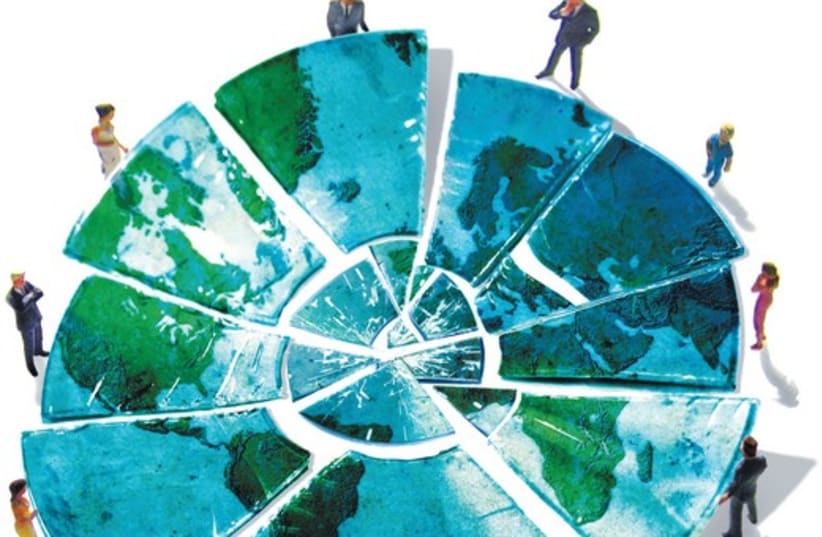
Israel can contribute to every part of the world in one way or another.
By ISRAEL KASNETTPieces of the world 521(photo credit: MCT)
Israel is an anomaly.Thanks to years of immigration from all parts of the world, Israel is one of the most multiracial, multicultural societies in existence. As Abba Eban once wrote, there is a paradox and contradiction in every part of the Israeli experience. Israel is both very old and very young.Israel’s rich historical past gives it a dimension of association and memory which few countries can emulate or contrive.Of all the countries in existence today, Israel is the only one that reveres the same faith, speaks the same tongue and inhabits the same land as it did 3,000 years ago.At the opposite end of the time scale and in contrast to its ancestral homeland title, Israel stands prominently representative of modernity. It has placed itself at the forefront of medical research and technological innovation. It is a world leader in the arts and culture and its political and judicial institutions are testament to its healthy and vibrant democratic nature. It is a country with qualities that set it apart from other nations and societies.Israel’s incredible rebirth has been and remains a fascinating process, bringing together people and ideas from all corners of the earth to share in the rebuilding of the Jewish state. Its culturally rich pool of citizens has a deep understanding of its neighbors, their societies, languages and ways of life.This type of information is useful and can contribute to the development of ties between Israel and countries around the globe. Israel can use its past and present to formulate relationships with countries that have seemingly few similarities.IF, INDEED, Israel becomes more isolated due to passive (or active) Arab aggression followed by European readiness to abandon the Jewish state, it will become necessary to forge closer relationships with countries heretofore ignored when it was deemed unnecessary to build ties with them.Now is the time to forge those relationships.Israel must not wait until it loses support from the West – and that day may come. Rather, Israel must look to the East for additional support. Countries like China and India offer great potential for Israel’s economic future and such a relationship has diplomatic and political advantages as well.Israel should initiate and pursue relationships, no matter how discreet and minimal, with countries such as Kazakhstan, Tajikistan and Kyrgyzstan. Even countries like Afghanistan and Pakistan may look one day to benefit from a discreet relationship with Israel and we should be doing everything to lay the necessary groundwork to facilitate this potential association.It is not greatly far-fetched to assume that economic ties with seemingly hostile countries could eventually develop into deeper relationships. While seemingly unfathomable today, tomorrow could bring a whole new set of political circumstances that would allow such relationships.The discreet building of ties and laying the necessary groundwork today could foster great results should the day arrive in the future.Israel is a leading expert in many fields and can send representatives through academic or social institutions as a way of developing relationships, especially in countries where the Foreign Ministry cannot be directly involved or visible. Academic institutions can certainly bridge the gap in many countries with student exchange and study-abroad programs.Since Israel’s establishment, successive governments have joined a number of international frameworks intended to foster ties and development between nations.Israel joined the European Union’s Framework Programmes for Research and Technological Development in 1994, and is a member of the European Organization for Nuclear Research, the European Molecular Biology Organization and the European Molecular Biology Laboratory. It is also a member of the Bank for International Settlement.In 2010, Israel was invited to join the Organization for Economic Cooperation and Development. Israel is also a member of NATO’s Mediterranean Dialogue forum.As the website of the Foreign Ministry states, “relations between Israel and the countries of Central and Eastern Europe, which were renewed as soon as these countries restored their democracies, are becoming increasingly close, especially in economic matters, culture, tourism, and international cooperation activities. Economic agreements with these countries are of importance, given that many of them are members of the European Union or candidates for future membership... Israel continues to enhance its relations with Central Asian Caucasus states, where there is great demand for Israeli MASHAV aid in the fields of public health, advanced agriculture, water resource management and the fight against desertification.”These are universal issues on which Israel provides extensive knowledge and expertise, and most nations would be willing to formulate ties with Israel if they were given the opportunity – especially if it can be done discreetly. We need only reach out to them.
if(catID != 151){
var cont = `Take Israel home with the new Jerusalem Post Store