In the midst of a national conflict, Jews and Arabs must learn to have empathy for the ‘other’.
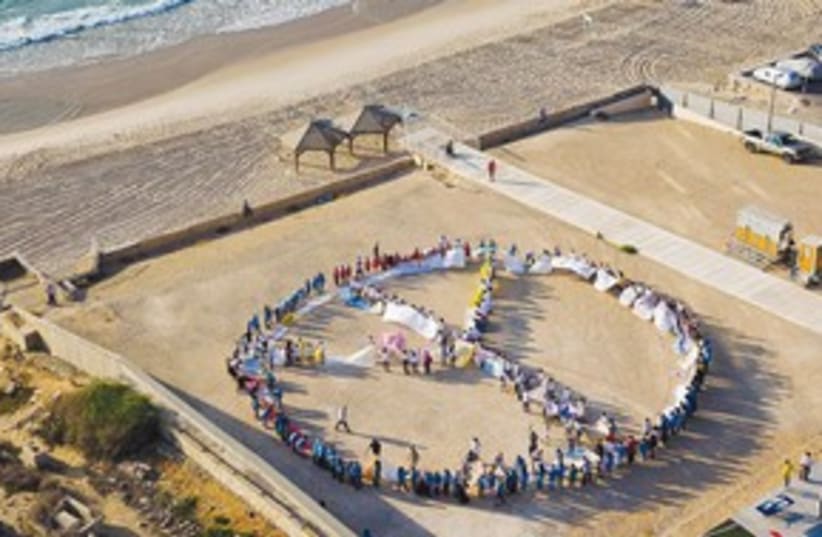
By DAVID NEWMANPeace Sign 311(photo credit: Albatros Aerial Photography)
One of the biggest structural problems which impacts the Israel- Palestine conflict is the fact that the vast majority of us simply don’t know our neighbors. We live in segregated settlements and communities, send our children to separate schools, know very little about the other’s religious or cultural rituals and practices and, worst of all, too few of us speak or understand the language of the other.We don’t really relate to the Arabs/Palestinians (regardless of whether they are citizens of Israel or stateless Palestinians of the West Bank) as equals and we are often dismissive of the fact that they live in worse conditions and receive fewer resources from the state – a situation which in any dictionary would be described as discrimination. This takes place despite our desire to roll out the mantra of how Israel is the only true democracy in the region, a state in which everybody is equal (no, they are not). We do not find any problem with declaring the state to be Jewish and democratic. But how can a state meet these two contradictory objectives, defined in narrow and specific national (Jewish) terms within which all (Jews and Arabs) have equal rights and status.When children and young adults are asked about their concern for human rights, they are very conscious of the need for human rights and equality for women, for the poor, for the gay community and for just about every form of social and cultural group, with one significant exception – the Arab population. Respondents to surveys concerning the rights of minorities often come across as liberal caring members of society, until the survey touches upon the rights of Palestinians or Arabs.Clearly, the conflict is largely responsible. It is impossible to know how people would respond if we did not view the Arabs as, at worst, an enemy whose only aim is to drive us into the sea or, at best, a fifth column which has to be watched and cannot be trusted. Would we be more concerned about the rights of the other if they were to be transformed from a perceived threat into a friendly neighbor? Would we still have a problem with them living in our communities, attending our schools or observing their religious festivals within shared, rather than segregated, public space? Or would we still be subject to a form of Jewish xenophobia, recommending that our neighbors do not rent apartments to them, or that they not be offered jobs in our companies.Respect for the human rights of the “other” must be based on tolerant thinking and respect from an early age. This requires the socialization and creation of empathy for the other despite the existence of a national conflict. This is no easy task as can be seen from the experience of one mixed Arab-Jewish settlement, Neveh Shalom, which has experienced intra-community tensions and misunderstandings over issues relating to the conflict, despite all the best of intentions of both groups of residents to display tolerance and understanding.JEWS AND Arabs rarely get to know each other. In the entire country, there are only five mixed Jewish-Arab schools where children from both communities come together on a daily basis. Of these, one is the bilingual Hagar School in Beersheba.Hagar is a public school supported by the Education Ministry. It has created a venue in which Jewish and Arab children not only mix (each ethnic group makes up 50 percent of the student body) but learn together in an atmosphere of mutual respect. Almost 150 children, from nursery through third grade, attend this school, whose commitment to equality informs every aspect of its educational agenda.To ensure that Hebrew and Arabic are awarded equal status, two teachers, one Jewish and one Arab, are present in every classroom. The idea is to avoid translation. The Palestinian teacher speaks in Arabic and the Jewish teacher speaks in Hebrew. It is well known that language can be both a bridge and a barrier to understanding and cooperation between ethnic groups, and in this case it is used as an important bridge.But language is only one aspect of the pedagogical endeavor. Within this bilingual space, direct contact with the heritage and customs of the different cultures is actively encouraged. From the age of two, the holidays and memorial days of both people are celebrated and observed. On Independence Day, for example, the teachers emphasize the notion of independence and its relation to responsibility, while on both Nakba Day and Holocaust Remembrance Day they underscore the importance of empathy, noting that everyone has experienced some kind of loss and suffering from war, hatred or genocide.The idea is that by the time the children are old enough to learn that there are two conflicting national narratives, both of which will be taught in the higher grades, they already have the necessary emotional and intellectual tools to deal with conflict through dialogue. It is a bottom-up process, as the children and their parents also organize picnics and trips so that the experience of the children is diffused to the parent generation as well.While this does not replace education for human rights, it does serve as the groundwork for creating an empathy toward the other, and an understanding of his/her intrinsic human rights.Without it, meaningful human rights education is either impossible or at least skewed, simply because the student must be able to have empathy for the other, think critically about dominant worldviews and be able to approach issues and processes from more than one standpoint. With this kind of foundation, one can begin the process of a imagining a shared and more hopeful future.The writer is professor of political geography at Ben-Gurion University and editor of the International Journal of Geopolitics.
if(catID != 151){
var cont = `Take Israel home with the new Jerusalem Post Store