Internal contradiction at the heart of the consensus for ransoming Schalit for terrorists renders it likely that the unanimity now surrounding the deal will evaporate soon.
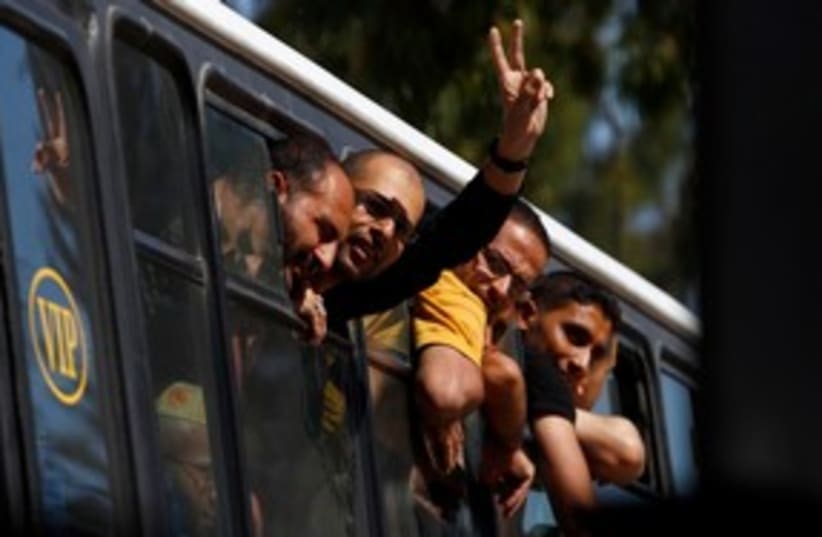
By CAROLINE B. GLICKPalestinian prisoners enter Gaza 311(photo credit: REUTERS)
Gilad Schalit is home. And that is wonderful. The terrorists Israel released in exchange for the IDF soldier held hostage by Hamas for more than five years are running around Judea, Samaria and Gaza promising to return to terror. And that is a nightmare.But so far, the Israeli public is happy with the outcome. Indeed, the polling data on the government’s decision to swap 1,027 terrorists for Schalit are stunning.According to the New Wave poll carried out for Makor Rishon, for instance, 75.7 percent of the public supported the deal and only 15.5 percent opposed it. In a society as rife with internal divisions as Israel, it is hard to think of any issue that enjoys the support of three quarters of the population. But even more amazing than the level of support is that the poll also shows the vast majority of Israelis believe that the deal harms Israel’s national security.Sixty-one-and-a-half percent of respondents believe the deal increases the Palestinians’ motivation to commit acts of terror. Only 23.4 percent disagree.The New Wave poll’s results are in line with the polling data reported by other firms. Down the line, the numbers are consistent: Threequarters of the public supported the deal and two-thirds of the public said it endangers the country. What this means is that two-thirds of the public listened to their hearts instead of their heads in supporting the Schalit-for-murderers swap.How can this triumph of emotion over reason be explained? Israelis are not a society of overgrown adolescents, enslaved by their urges. So what brought a large majority of Israelis to favor a deal they know endangers them? Part of the answer was provided in an article in the Globes newspaper on Monday. Titled “Lucky the kidnapping happened in the technological era” and written by Anat Bein-Leibovitz, it analyzed the five-year advertising campaign that shaped public perceptions about Schalit and built public support for a deal that obviously harms the country.
The Shalmor Avnon Amichai firm ran the campaign to free Schalit. Shlomi Avnon, a partner in the agency, described the goals of the campaign as follows: “The first goal was to generate empathy for Gilad and his family. We did not know when the government needed to make a decision, but we wanted the Schalit family to enjoy wide public support when a decision came. It was clear that Gilad’s return would be at a high price to Israel, and in order to make sure that Gilad would be returned, it was critical that there should be public support to put pressure on the government.“The second goal was to keep Gilad in the public consciousness so that he would not be forgotten…. We attacked on all fronts: emotionally, by comparing Gilad with Ron Arad, and on a security level, by bringing in security personalities who supported his release.“We made a decision that our target audience was the public and not decision makers, because we knew that with decision makers all could be lost….”Avnon and his colleagues marketed Schalit like a commercial product. As advertising executive Sefi Shaked explained, “This was a battle between two brands. One was ‘Bring Gilad back,’ and the other ‘Woe if we free murderers.’ The challenge for the Gilad brand was to maintain awareness of it, to keep going forward….They did much better work than the rival brand, which is a strong brand, but it didn’t do much. They gave it the knockout.”While the PR executives interviewed for the articles are correct in their assessment that the Shalmor Avnon Amichai agency’s campaign was well conceived and professionally executed, the fact is that over the past 20 years hiring PR firms to conceive and implement public campaigns has become standard operating procedure in Israel. And yet, it is hard to think of any such campaign that succeeded as overwhelmingly as the terrorists-for-Gilad campaign did.For instance, the Council of Jewish Communities in Judea, Samaria and Gaza paid a king’s ransom for their public relations campaign against the withdrawal from Gaza and northern Samaria. They mobilized more than a million Israelis to take part in the campaign that lasted for more than a year. And yet, they failed to accomplish their mission.Other campaigns were successful in forcing the government’s hand. But they still didn’t enjoy anywhere near the support levels that the Gilad-for-murderers deal did. The campaigns for the Oslo accords with the PLO, for the withdrawal from southern Lebanon, for the release of hostages or bodies in return for terrorists, and for the withdrawal from Gaza and northern Samaria were all successful. But they were carried out in the face of a divided public.As the polls show, the consensus formed around the cause of Schalit’s release at all costs does not owe to public approval of terrorist-forhostage swaps. So what formed this consensus? In Schalit’s case, the reason that the PR campaign worked so well is because the media and the national security community – the two national institutions that are supposed to be the watchdogs of Israel’s national interests against the advertising executives – opted to behave like lapdogs.Speaking to Globes, the PR executives were unanimous in their judgment that the success of the campaign was due to the media’s total mobilization on behalf of the cause. As Gil Samsonov put it, “The first target audience was the media, which were mobilized, and everyone did their jobs while minimizing the opposition.” Yair Geller added that Schalit is “lucky that the abduction happened at a time when the media are the strongest power…. The media left the government no option not to act.”The executives are correct that the media are the strongest force in Israeli society. Their power owes to the fact that the major media organs are ideologically uniform and therefore act consistently as a pack.It was the media’s overwhelming support for the Oslo process, for the withdrawals from Lebanon and Gaza, and for previous hostagefor- terrorist swaps that forced the hand of the government time after time. It was similarly the media’s opposition to the PR campaign against the withdrawal from Gaza that doomed it to failure.By choosing sides, the media ensure there is no substantive public debate about the controversial campaigns they support. Rather than debate the substance of an issue, the media, together with PR firms, personalize disputes.In the case of the Lebanon withdrawal, the media cast the debate as one between indifferent IDF commanders and concerned mothers of soldiers. The Gaza withdrawal was cast as a dispute between Ariel Sharon, a wise grandfather who loved the country and was democratically elected, and settler zealots who wanted IDF soldiers to die so they could keep their profitable farms and fancy villas. Hostage-formurderer swaps are cast as battles between innocent soldiers and evil politicians who would let them die.In all cases, the threat posed by surrendering to Israel’s enemies is ignored or glossed over.By barring a real debate on the most contentious issues of the day, for the past two decades the media have been able to dictate policy on the most contentious issues facing the country. Still, none of these media victories were won with the consensus support enjoyed by the Schalit campaign.What distinguished the Schalit campaign from those that preceded it was not the media mobilization but the complicity of the IDF, Shin Bet (Israel Security Agency) and Mossad. In all the other campaigns, the security services either opposed the campaigns or stood on the sidelines.In an interview with Haaretz this past Sunday, Col. Ronen Cohen, who recently retired from IDF Military Intelligence, said the IDF never tried to put together an operation to rescue Schalit. In his words, Schalit’s prolonged captivity “was a resounding failure of the IDF…. The IDF never took responsibility for the soldier and did not even set up a team to deal with bringing him back.” As a consequence, the IDF gave the government no choice other than to pay a ransom for Schalit.According to PR executive Geller, the IDF’s abdication of its responsibility to rescue Schalit was influenced by the media’s full mobilization on behalf of the PR campaign. “That [Schalit] was not hurt in a rescue operation is due, among other things, to the high value that the media placed on him.” The IDF was too afraid of media criticism to risk a rescue raid.Even in the face of the IDF’s abdication of responsibility for saving Schalit, the previous heads of the IDF, Shin Bet and Mossad all opposed the swap as dangerous, and so Israel rejected it.But, in the end, the media won out. Defense Minister Ehud Barak replaced the security bosses with successors who agreed to subordinate their professional judgment to the media’s demands. They all adopted the demonstrably false position that releasing 1,027 terrorists would not endanger Israel. This is what enabled the public consensus to form.It is possible that, now that Schalit and the terrorists are free, the media will permit a debate on the wisdom of future deals. For instance, a debate has already begun on mandatory capital punishment for terrorist killers.But there are more pressing issues that need to be resolved today if we want to prevent the public from being manipulated again into adopting positions wholly at odds with reason and the national interest. The first issue is that of the media.Given the media’s unchecked power to repeatedly manipulate public opinion to adhere to its radical ideological agenda, it is essential that the government and Knesset step in and reform the media market. Broadcast licensing procedures for television and radio must be deregulated. Television and radio must be open to competition. Broadcasters should be allowed to broadcast whatever they want whenever they want, and the market should dictate who rises and who falls. This is the only way to protect the public against manipulation, and the government from blackmail.Then there is the IDF. To fix what has clearly become broken in the IDF we must have a serious public discussion about its irresponsible, unprofessional behavior throughout Schalit’s period of captivity. The public must be made aware of the apparent leadership crisis at the top ranks of the IDF in order to force the government to enact necessary changes in personnel and compel serving commanders to change their behavior.The internal contradiction at the heart of the consensus for ransoming Schalit for terrorists renders it likely that the unanimity now surrounding the deal will evaporate soon. But to prevent PR firms and the media from successfully manipulating the public and blackmailing politicians in the future, we must check the power of the media and hold the IDF accountable for its failures today. Otherwise, it is only a matter of time before the public again is convinced to support policies that it knows endanger the country.caroline@carolineglick.com
if(catID != 151){
var cont = `Take Israel home with the new Jerusalem Post Store