From what I hear around the area, once again the reconciliation talks between Fatah and Hamas have re-entered the freezer.
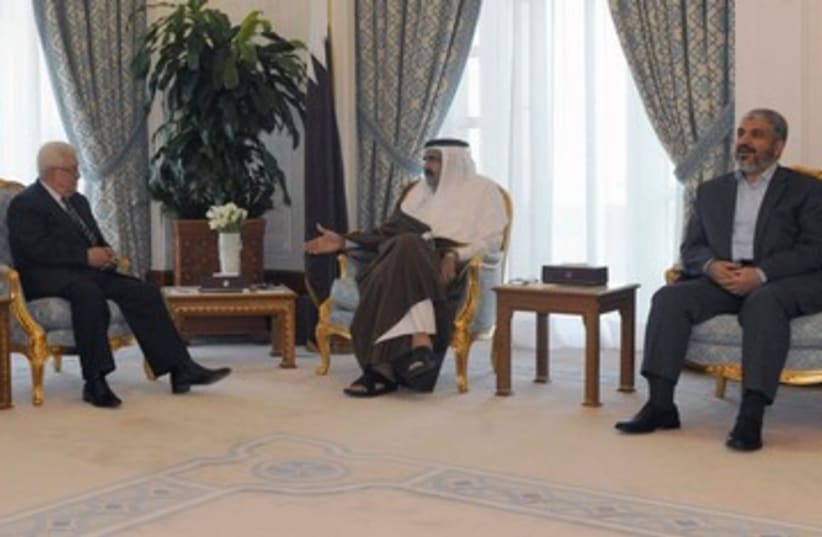
By GERSHON BASKINPA President Abbas meets Hamas chief Mashaal in Qatar 390 R(photo credit: REUTERS/Thaer Ghanaim/PPO/Handout)
From what I hear around the area, once again the reconciliation talks between Fatah and Hamas have re-entered the freezer. Just last week the parties announced that on June 20, Palestinian Authority chairman Mahmoud Abbas and Hamas leader Khaled Mashaal would be announcing a new transitional government supported by both movements without any direct participation or representatives of either. The task of the transitional government was to prepare new elections for president of the Palestinian Authority, the PA Legislative Council and the Palestinian National Council of the PLO.From the perspective of almost all Palestinians, it is not natural or good that the Palestinian house is divided with completely different regimes ruling the two separated Palestinian territories. All Palestinians want unity and wish for the dispute between the two main movements to be settled. On the other hand, it is almost equally unnatural for these two movements to function together under one roof.On the ideological level, the national movement, the PLO headed by Fatah, has come to terms with settling for a Palestinian state on 22 percent of the land between the Jordan River and the Mediterranean Sea, based on the June 4, 1967 lines with agreed upon territorial swaps with Israel, a negotiated agreement for two capitals in Jerusalem, including Jewish sovereignty over the Western Wall and the Jewish Quarter of the Old City, and according to the Arab Peace Initiative, an agreement on a just solution to the refugee problem. This is the plan that the PLO submitted to the international community when they requested that the United Nations recognize the State of Palestine, not more, not less.Hamas ridiculed President Abbas and the PLO for submitting such minimalist demands to the international community. From the perspective of Hamas, all of the land between the river and the sea belongs to the Palestinian people, and while the most important Hamas leaders have said that their strategic political plan is to achieve statehood in the 1967 borders, the main difference between Hamas and Fatah is that the latter speaks about a full and comprehensive peace treaty with the State of Israel while Hamas refuses to recognize Israel or to negotiate.There are Israeli officials in the security/ intelligence community, as well as in the Prime Minister’s Office and the Foreign Ministry, who think Palestinian unity is essential in order to seriously engage the Palestinians in peace talks. There are others in the same establishments who believe that Palestinian unity would be backtracking.There are elements of truth in both arguments – neither of which are particularly relevant, because the actions of the Israeli government, more than anything else, clearly signal to the Palestinians that Israel is not ready to talk real peace on any terms that any Palestinian could accept.If there are no genuine peace negotiations with the Palestinians, eventually the unity talks will succeed because there is such compelling logic for unity within the Palestinian house when they must all face the reality of the developing bi-national reality in the West Bank and the continuation of the siege on Gaza.Palestinians are losing ground (literally) and their failure to create enough support in the international community to impose a compromise on Israel leaves them to confront the deteriorating status quo with no alternative political strategy developed. Palestinians will not accept to live under continued Israeli control devoid of political rights including the right of self-determination.They don’t wish to return to another round of violence. There does not seem to be enough energy within the society right now to generate a real mass movement of refusing to cooperate with the occupation through non-violent civil disobedience. The national movement’s leadership has not joined the call of the international solidarity movement with Palestine for a general boycott of Israel, but they do support a boycott of Israeli settlements.But at the same time some 26,000 Palestinians work in settlements and are building settlement houses, because the PA does not have the resources to offer them alternative employment and salaries to support their families.The current situation is not natural and cannot continue forever. Eventually there will be a strategic change. That change might come from elections, it may come from the current leadership deciding that it cannot or does not wish to rule anymore. It may come from the streets when the young people decide that they will no longer accept the status quo.It will come in one form or another, if Israel does not take the initiative to act in its own interests and make real peace with the Palestinians, turning the prime minister’s slogan of “two states for two peoples” into a reality.There has never been a decision in Israel by the government, not this government or any previous government, that the State of Israel is committed to the solution of two states for two peoples to end the Israeli-Palestinian conflict.That government decision is not dependent on a Palestinian partner or a Palestinian recognition of Israel as a Jewish state. It is a sovereign decision of a sovereign state and would send a clear message to the Palestinians that there might actually be a partner in Jerusalem.The PLO has adopted the two states for two peoples policy and their Declaration of Independence of Palestine written and passed in 1988 states it quite clearly.The Palestinian unity talks probably fell apart now because of US pressure on President Abbas to give one last chance to negotiations with Israel. He does not believe that Prime Minister Binyamin Netanyahu is serious about making peace. A serious Israeli peacemaker would not declare a policy of building 10 new settler houses outside of the settlement blocs for every one the Supreme Courts declares is illegal. This does not give any signal to the Palestinians, the Arabs or to anyone that Israel is interested in making peace.It is most unfortunate that even with such a large coalition and political stability, Israel’s outstretched hand is not seeking a handshake of peace with the Palestinians, but instead is carrying government decisions to take more of their land. The writer is the co-chairman of IPCRI, the Israel Palestine Center for Research and Information, a columnist for The Jerusalem Post, a radio host on All for Peace Radio and the initiator and negotiator of the secret back channel for the release of Gilad Schalit.
if(catID != 151){
var cont = `Take Israel home with the new Jerusalem Post Store