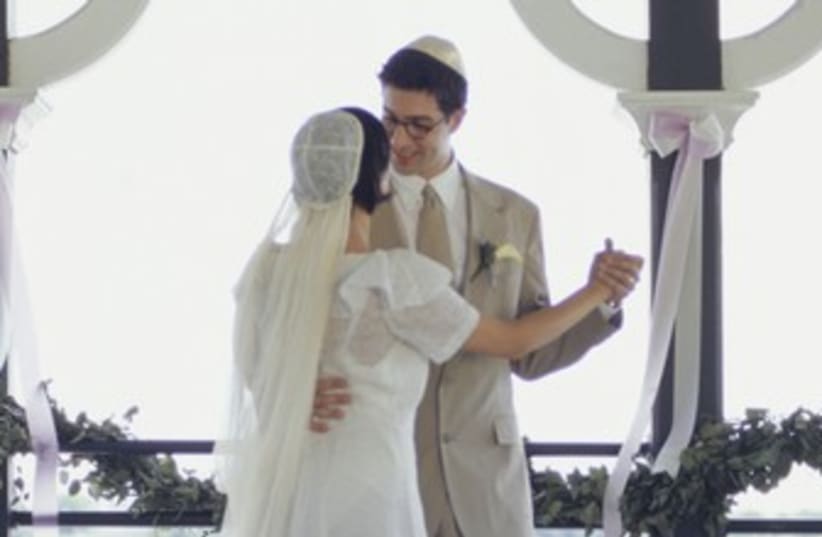
Bedecked in white, striking bride made her way down aisle, each step drawing her closer to the wedding canopy.
By MICHAEL FREUNDGeneric Jewish wedding, couple dancing 370(photo credit: Thinkstock)
Last Thursday evening, hundreds of guests milled about, chatting amiably as they awaited the start of the joyous ceremony.Bedecked in white, the striking bride made her way down the aisle, each step drawing her closer to the wedding canopy where her groom stood smiling broadly.As a light breeze stirred the air, the wife-to-be circled her intended seven times in the traditional manner, her eyes closed in concentration as she uttered a silent prayer.After the rabbi guided the young couple through the rituals that would culminate in the forging of their matrimonial bond, a glass was shattered to recall the destruction of the Temple in Jerusalem. Cries of “Mazel Tov” rang out, which were hastily followed by blissful and energetic dancing, as the guests pushed forward to take part in the celebration.From New York to London to Tel Aviv, it is a scene that has become fairly common, as a new generation comes of age and fashions the next link in the chain of Jewish destiny.But this was no ordinary Jewish wedding.What made it unique was that it took place in Warsaw.That’s right: Warsaw, the Polish capital. Less than seven decades after the Germans and their henchmen murdered over 90 percent of Poland’s three million Jews, the city is once again witnessing a revival of Jewish life.The once unthinkable has now become reality: there is a minyan three times a day at Warsaw’s Nozyk synagogue, and a well-stocked kosher store offers a wide array of items. There is even a kosher falafel stand that has opened near the synagogue. If gastronomy is any guide, Warsaw’s Jews are definitely on the upswing.The city also now boasts a number of Jewish social, cultural and educational institutions.Indeed, the wedding last week was held in the courtyard of the Lauder Morasha school, a Jewish day school that was established in Warsaw by the Ronald S. Lauder Foundation in 1994.Prior to the Holocaust, the school building had housed a Jewish senior citizens’ home. Its halls now echo with the sounds of Jewish children learning Hebrew and singing Jewish songs under the guidance of Polish-born Rabbi Mati Pawlak, who serves as director.The freshly-minted groom, Maciej Kublinski, who goes by the Hebrew name Chaim, embodies the revitalization of Jewish life that is taking place.After visiting Israel with his grandmother in 2000, Chaim decided to delve more deeply into his Jewish roots. In 2003, he joined the Polish Union of Jewish Students and became an active member.A critical turning point for him was his participation in a 2008 seminar on Judaism organized in Krakow by Shavei Israel, the organization that I founded and chair. He later attended Shavei’s annual summer seminar in Jerusalem for Polish Jewish youth in 2010, which further strengthened his commitment to Jewish life and learning.Four years ago, Chaim started attending services at Warsaw’s synagogue, and he now studies in the kollel there which is headed by Rabbi Yona Simons.Chaim also teaches at the Lauder Morasha school and works as a youth counselor and educator for the Jewish Agency for Israel and the Joint Distribution Committee. His new bride, Katarina, who originally hails from Slovakia, has been living in Poland since 2010, pursuing a master’s degree in developmental economics. Together, they will now begin to build a new Jewish home.The miracle taking place in Warsaw – and that is truly what it is – is largely thanks to the efforts of one very dedicated man: Polish Chief Rabbi Michael Schudrich, who has been working in the country for nearly two decades, devoting himself to rebuilding Jewish life.Where others saw only devastation, he saw opportunity, a chance to salvage something from amid the ashes.All across Poland, there are untold thousands of people who have been discovering, or rediscovering, their Jewish roots in recent years, much like Chaim. Known as the “hidden Jews” of Poland, many of their forebears were forced to conceal their Jewish identity because of Nazism and Communism.With the fall of the Iron Curtain, and the changes that have taken place in Polish society, it is now much easier for people to “come out of the Jewish closet” and explore their heritage.To be sure, anti-Semitism remains a significant problem in Poland, and no one is under any illusions that Polish Jewry will once again recoup its pre-war glory.But the Jewish people have an obligation to reach out to Poland’s “hidden Jews” and help them to recover their birthright. After nearly being snuffed out by Hitler and his henchmen, and then quashed by Stalin and his surrogates, the indestructible Jewish spirit somehow managed to survive.Many Jewish organizations are now hard at work on the important issue of restitution of Jewish property in Poland. But the restitution of Jewish souls is no less crucial, and more resources need to be directed to this effort.As I stood and watched Chaim and Devora’s wedding in Warsaw, I suddenly felt as if I was catching a glimpse of a profound and undeniable truth. However bleak our situation might be, and regardless of the challenges we face, let no one have any doubts: the Eternal One will never abandon His people Israel.The writer is chairman of Shavei Israel (www.shavei.org), which assists lost tribes and hidden Jewish communities to return to Israel and the Jewish people.
if(catID != 151){
var cont = `Take Israel home with the new Jerusalem Post Store