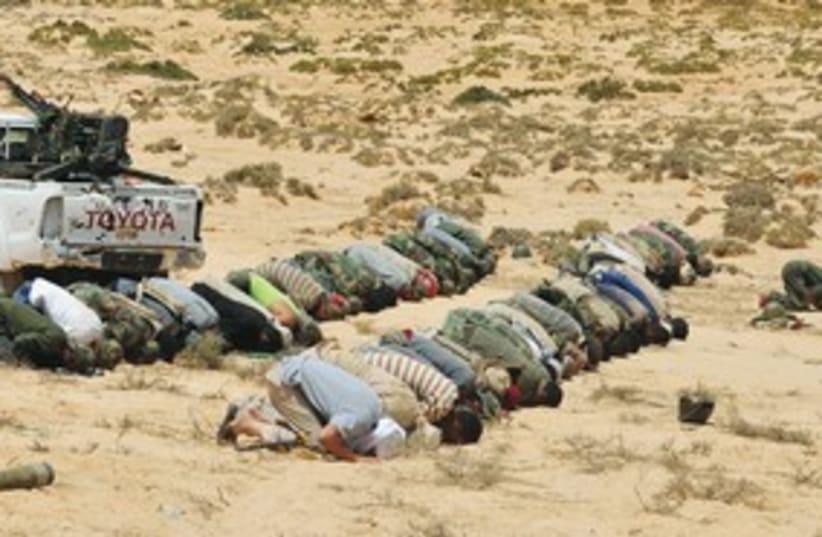
Islamist involvement in the revolution does not bode well for Jews and Israel.
By ALEX JOFFELibyan rebels praying 311(photo credit: REUTERS)
There are reasons for Jews to view the fall of Muammar Gaddafi with satisfaction: A bizarre and dangerous enemy of the West and Israel is on the verge of defeat, and the Libyan people may be on the threshold of freedom. But, as in Egypt, the second Arab Spring in Libya looks like a mixed blessing. One test will be the manner in which the new government treats the Jews and Israel.Libya is, historically, a place of conquest and revolt.Jews arrived there long before the Arabs, much less Islam: Ptolemy I is reported to have settled Jews in Libya in 312 B.C.E., and more Jews arrived 150 years later. The Libyan Jews of Tripolitania in the west and Cyrenaica in the east became rural farmers and craftsmen and urban aristocrats.As Romans, Christians, Arabs and Islam swept over Libya and North Africa, the Jews remained. With the coming of Islam, it appears that the Jews of the coast were dispersed to the interior. Their numbers were increased by refugees from Spain and Italy, and they suffered or prospered under various Muslim rulers.
The Italian conquest of Libya in 1911 initially brought the Libyan Jews equal rights, but those rights were eroded by Italy’s subsequent alliance with Germany and the imposition of the Racial Laws of 1938. During World War II, control of North Africa shifted back and forth between Italy and Britain. With every British reverse, the Jews’ situation deteriorated. Thousands were deported to brutal labor and internment camps in the desert.The British liberated the country in late 1942, but the result was a new phase of persecution that led to the Jewish community’s demise. In 1945, Muslim pogroms killed hundreds of Jews and destroyed their homes, shops and synagogues; British occupation forces stood by. On the verge of Libyan independence in 1951, Prime Minister Mahmud Muntasser was frank: He could see “no future” for Jews in Libya. Between 1949 and 1951, some 30,000 Libyan Jews left their ancient home for Israel.With the rise of Arab nationalism and the permanent state of war against Israel, the remaining 8,000 Libyan Jews were systematically stripped of their rights as Libyan citizens. They were barred from having passports, visiting Israel, and serving in public office. Jewish schools and communal organizations were closed. Jews were banned from obtaining the nationality certificates required for engagement in commerce, and in 1961 the government sequestered the property of Jews who emigrated to Israel.After the Six-Day war, a series of pogroms culminated in the outright expulsion of Libya’s remaining Jews.As it was across the Arab and Muslim world, for Jews, Libya’s first “Arab Spring” as an independent state was a sad and familiar story. Initially, the sudden ascent of Muammar Gaddafi seemed familiar as well. The official story is that Gaddafi, a member of a small, Arabized Berber tribe, was raised in a tent. As with many lowerclass tribesmen, he found his path to power in the military.And, as with other tribesmen like Saddam Hussein and Hafez Assad, who seized power across the Middle East in the age of Arab nationalism, he found Jews and Israel to be a useful obsession.The strongmen inspired by Gamal Nasser regarded the historic defeats of 1948 and 1967 as epic humiliations. In the name of restoring their honor, they turned their societies into police states in which their tribes were pre-eminent.In this context, the military coup led by Captain Gaddafi in 1969 was routine.But Gaddafi was different. Unlike his fellow tyrants, he fancied himself a revolutionary mystic. At first, his “philosophy” was a kind of Islamic socialism. But it meandered over the decades from Arabism to Islam to Africanism. His choice of enemies was eclectic. He turned against Anwar Sadat of Egypt and Prince Hassan of Morocco when those countries made peace with Israel. When the PLO began negotiating with Israel in 1995, he expelled tens of thousands of Palestinians. But he also fought border wars with Chad, Tunisia, Algeria and Niger. His support for terrorism was equally wide-ranging and mercurial. His agents blew up American military personnel in Germany, supported the IRA, killed a British policewoman in London, and in 1988 blew up Pan Am flight 103 over Scotland. Gaddafi feuded with Arafat but supported the PLO and Black September with millions of dollars annually.Even Gaddafi’s attitude toward the Arab-Israel conflict appears to have changed, slightly. In a 2009 editorial, published in The New York Times, he called for a one state solution, but gave it a characteristic twist with the name “Isratine.” His was the standard formula, complete with the ‘right of return’ for Palestinians – and thus by definition announcing his intention for Israel to be destroyed.Gaddafi was, to the end, the picture of a cartoon villain, with the wild hair, the flamboyant uniforms, the Amazonian guards and the endless monologues. The astonishing thing was that this very model of a megalomaniacal, narcissistic tin-pot dictator was regarded as anything but. Such are the power of oil, the threat of terrorism, the marvel of theatricality and the fascination of educated Westerners with the strange ways of the East.With his regime all but gone, hopes are running high that the new government will create a democratic Libya.There have been reports of Libyan Jewish businessmen sounding out the rebels about recognizing Israel. But the prominent role of Islamists in the rebellion is not a promising sign, and there is little evidence that Libya’s new leaders will be any more inclined towards Jews or Israel than Gaddafi was. One small harbinger is the changing narrative surrounding the rich crazy uncle of the Arab world: As Gaddafi’s regime began to falter, stories began to circulate that his grandmother was Jewish.And so Libya enters a new era. For months Gaddafi’s weapons and stolen Libyan cars have filtered into Egypt, Sinai and Gaza. What will become of his heavy and unconventional weapons is unknown. Other signs portend ill. The Egyptian military sounds more Islamist by the day. The Muslim Brotherhood and other groups are growing bolder in their demands.Islamists are surging in Tunisia, birthplace of the Arab Spring, and waiting in the wings in Algeria, Morocco and Jordan. A sad, realpolitik view is that this second Arab Spring is quickly leading to a cold, bitter winter.It would be especially bitter if Gaddafi ended by being missed as the devil that we knew.Alex Joffe is a research scholar with the Institute for Jewish and Community Research. This article was first published by Jewish Ideas Daily (www.jewishideasdaily.com), and is reprinted with permission.
if(catID != 151){
var cont = `Take Israel home with the new Jerusalem Post Store