Media Comment: Israel’s media, human rights coverage
The media’s subjective treatment of human rights issues is illustrated by the usual characterization of the haredi, or ultra-Orthodox, as a parasitical social element.
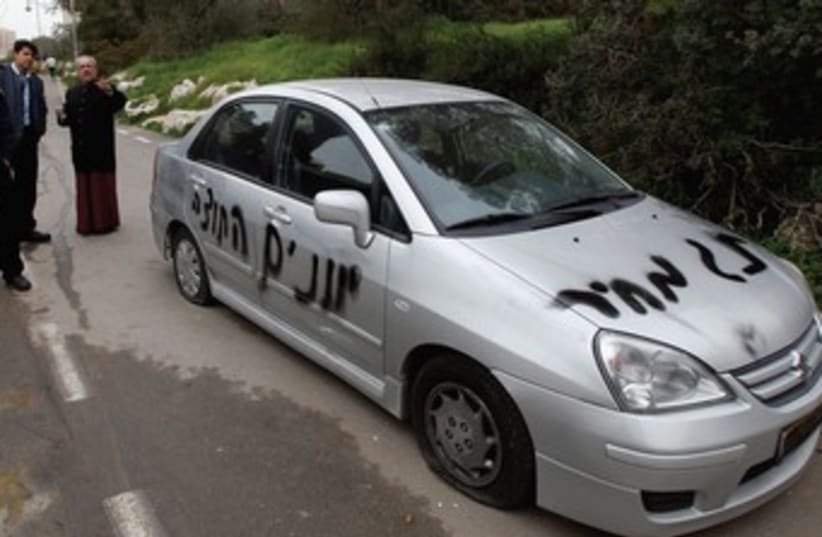
By YISRAEL MEDADPrice Tag at the Monastery of the Cross in Jerusalem 370(photo credit: REUTERS)
Israel has a broad human rights agenda serviced by a plethora of groups whose work should be covered by the media. One problematic camp, however, is the National/Religious/Settler section of Israel’s society.While very active in many civic frameworks and human rights efforts and with its own legitimate human rights needs, media coverage of its activities is not commensurate and its media presence is minimal.Unlike the media’s relation to left-wing human rights organizations, the frame of reference for the right-wing human rights work is colored with exclusionist terminology, unreliable reporting and is portrayed as either unimportant or worse, as part of the “problem.” The right-wing human rights camp is not in the picture. Why ? In this age of new and digital media tools, we are informed that the human rights issue is a major player exploiting what is termed “quasi-journalism.” As explained by Carroll Bogert, a director at Human Rights Watch, this is a conscious aping of the communications style of the media “in order that what we produce looks more like journalism... we’re moving into the media business.”Does human rights work justify the manipulation of journalists? Or do media people permit themselves to be so manipulated due to personal preferences? Human rights is very much a media topic, and interests not only the media but serves elements within the media, from the reporter to the rewrite editor, the interviewer, the presenter, the camera-person and so on, by allowing them to insert their preferences into the news.Does this lead to unfair framing, unethical behavior and editorial subversion? Bogert was proud that her press releases are meant “to look like a wire service story, so that when it arrives in the inbox of a wire service reporter, it moves seamlessly into the mainstream media.”Here in Israel, in too many cases, that effort and that technique is less than necessary when it comes to left-wing human rights groups and useless when practiced by the right-wingers.For example, the human rights of Jews living across the so-called Green Line not only are not given a fair hearing in the media but are consistently portrayed in a most biased fashion. Their stories are not properly mediated as the media’s filters are political, instead of social, cultural or economic. The difficulties they suffer are hardly ever considered by the media as a matter of human rights.The B’tselem organization, the Israeli Information Center for Human Rights in the Occupied Territories, is broadly recognized by the media. Yet this so-called human rights organization does not really concern itself with Jewish human rights issues. With B’tzelem, it is the Arabs who have have human rights issues.Rarely are any of the anti-occupation groups ever pressed or challenged on their concern, or lack thereof, for Jewish human rights, not to mention the unethical use by the mainstream media of edited video clips supplied by them.Another symptom of the skewed interests is the consistent ignoring and minimalizing of human rights violations committed by Arabs in areas under the jurisdiction of the Palestinian Authority. These include honor killings, jailing of journalists, torture of prisoners, as well as anti-Semitic incitement.In the media, you will not find any left-wing “extremists,” only right-wing “extremists.” Leftwingers are always “peace activists.” Is the Honenu legal aid group for Jews whose human rights may have been violated granted equal media access? Which is better known – B’tzelem or Orit Struck’s Human Rights Organization of Judea and Samaria? A favorite of our media is “price tag” violence. Time and again, the media message is that this is in fact “settler violence,” a gross negative generalization of over half a million people. The facts are not too important. On October 9 this year, even the Alternative Information Center (not a right-wing NGO) reported: “Israel’s police commander of the West Bank... [revealed]... most “price tag” attacks are conducted by young people, even children, who don’t live in the West Bank.”So, not only was any rabbi arrested for allegedly inciting this violence ever put on trial or found guilty, their release was shunted aside in the media.A DIFFERENT aspect is the human rights of children. In Israel, the media is able to force-feed our children questionable content such as unrestrained sexual permissiveness, nudity, swear words, drug scenes and violence outside the regulated watershed hour. This is a purposeful sexualizing and traumatizing of our children.A third example of the media’s subjective treatment of human rights issues is the usual characterization of the haredi or ultra-Orthodox as a parasitical social element.The fact that for example the summer before last the great “cottage cheese revolution” was initiated by a haredi does not change the mantra.Haredi avoidance of army service is very much a media theme, yet the avoidance of service among the cultural icons of music, dance, literature, sports and fashion is relegated to editors’ rejection lists. Why would a reporter seek to malign his comrades in Israel’s second state, Tel Aviv? We need only recall the three Kol Yisrael broadcasters and editors Chanan Naveh, Carmela Menasheh and then show host Shelly Yacimovich in the late 1990s. As admitted by Naveh (and corroborated elsewhere by Menasheh and Yacimovich), in a 2007 Haifa University media conference, “[We]... pushed in every way possible the withdrawal from Lebanon... we took it upon ourselves as a mission – possibly not stated – to get the IDF out of Lebanon... I have no doubt that we promoted an agenda of withdrawal... I’m not apologizing...I am very proud that we had a part in getting of our sons out of Lebanon.”The human rights of one side of the ideological divide suffers not from an inability to tell the story, as may happen, but an unwillingness predicated on the prejudicial approach of the media. This is the heart of the political-ethical morass we face here in Israel and how the media views, conceptualizes and produces for the media consumer.The media is not simply a conduit for stories of human rights matters but possess their own power, which they actively use, together with the new-found force of human rights activists who have created a new “platform,” to borrow New York University’s NYU’s Meg McLagan’s terminology, for the production, circulation and distribution of colored human rights news.That platform, I suggest, is the Three Cs; Cooperation, Collaboration and Collateralism (in its definition as “uniting in tendency”). In Israel, there is no real media pluralism. The media interlock in Israel prevents the public from evaluating their sources of information.These thoughts were presented recently in a Bar-Ilan University meeting entitled Broken Mirrors Conference on Human Rights Organizations, the Media and Israel. The issue is not simply one of broken mirrors, however. It is much more appropriate to think of it in terms shattered glass in the newsrooms, reflecting itself in the form of uncontrolled and inadequate supervision.Even the ombudsmen, the media regulators and the ethical review boards or the press itself do not see a need to destroy the media bias against the human rights of certain political and cultural groups in Israel’s society.The writer is vice-chairman of Israel’s Media Watch and the above was edited from remarks presented at to the Bar-Ilan University, October 31, 2012.
if(catID != 151){
var cont = `Take Israel home with the new Jerusalem Post Store