Unfortunately, our media seems to be rather lazy. Bad headlines always sell well.
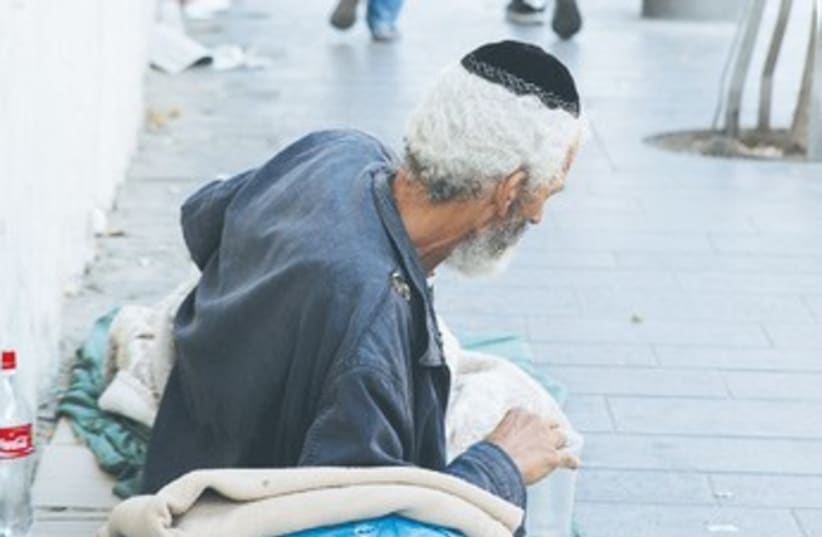
By YISRAEL MEDAD, ELI POLLAKPoverty in J'lem 370(photo credit: Marc Israel Sellem)
This week some news outlets, such as Israel Radio, tried to create a public agenda based on the annual report of the Adva NGO. The report, authored by Dr. Shlomo Svirsky and Etti Connor-Atias, is sensational. For example, the headline at the NRG website was: “The Adva report reveals: An increase in the social gap in Israel. According to the report, the income of the top 1 percent increased by 27% as compared to 8% only for the sixth decile, between the years 2003 and 2010.”The Walla and Srugim websites had similar headlines.What is the real news in the report? The authors claim that in 2011, the income of the top 10% of households shrank by 7.4%. Most of the reduction was at the top 1% of income, where income shrank by 20%.Good news? Not really. The authors claim that the central reason for the reduction was losses in the financial markets.To prove their point that the gap is asocial they regurgitate the statistics for the years 2003-2007, which one might have thought is “old hat” and not really worth reporting.Adva, though, has some additional important insights.For example, It claims that Israel’s potential for stable growth over long periods of time is severely hampered due to the lack of a political agreement with the Palestinians.Indeed this statement makes sense. Adva’s agenda is to further a “more decent division of the resources of Israeli society.”It is funded in part through the New Israel Fund.Dr. Shlomo Svirsky is described in Wikipedia as a “social activist,” as one of the “leaders of the class related Neo Marxist sociology” which has developed at Haifa University.His main thesis is that the Ashkenazim control the financial resources, while the Sephardi community is held at arm’s length from the financial control centers.Another leader of Adva is Prof. Yossi Yona, who is number 20 in the Labor party’s Knesset candidates list. Yona was also involved in the “social protest” of 2011.Adva describes itself on its website as “a non-partisan policy analysis institute whose mandate is to examine Israeli society from the perspective of equality and social justice.”This is probably as reliable as its report. Yet even the IBA’s Israel Radio relates to its data seriously. After reporting the “bad news” they interview MK Amir Peretz, who of course uses the data to lambast the Likud and the present government.The fact that on the same day a November reduction of the unemployment rate to 6.7% was reported by a reliable source – Israel’s Central Bureau of Statistics – did not really change the message.PROFESSIONAL REPORTING is never easy, but special care is called for in an election period.For example, the election law is very clear when it comes to publishing public opinion polls during the 60-day period preceding election day. Any media outlet publishing a poll must provide background data such as who ordered the poll, what the makeup of the population polled is, and the percentage of people polled who refused to answer. In this way, the public can decide for itself whether the pollsters are professional or biased.The left-wing media review NGO Keshev has successfully petitioned the Central Elections Committee to take steps to upholding this part of the law, noting that Yediot Aharonot and Ma’ariv violated it.The same principle should be equally applicable to any organization which publishes reports. It is quite clear that the Adva report was fodder for left-wing politicians. But had our media been professional, the report would have been a non-starter. In fact, even outside of the election period, the media should be more careful in its handling of “research” by NGOs.Latet is a very different kind of NGO. Its goal is to fight poverty. Its work in the field is exemplary and has helped many, many people. But even in this case, the media should be much more circumspect.As an opener to the annual Sderot social conference, Latet publicized its annual “Alternative Poverty Report.” Alternative, since it is meant to provide breadth and a complementary view as compared to the one published by the National Insurance Institute.Its headline was “2012 is turning out to be the worst ever year for poor children in Israel,” a rather strong statement.In its abstract they claim that 10% of the children of supported families had to go out and beg during the past year because of the financial crisis in their homes. This is a worrisome increase compared to only 3% in 2011. Twenty-seven percent of the children had days in which they had no food.Such a report brings about headlines in the major new outlets and an onslaught of bitter criticism against the “cruel” government that allows such a situation not only to develop but also to sustain itself. Yet the data and the conclusions seem to be flawed.As reported by Eran Bar-Tal from Makor Rishon, Latet’s report is quite problematic. It did not carry out a thorough survey of the population but rather it asked families who are supported through Latet to provide answers to a questionnaire.It does not provide information as to the true makeup of the families. Do working families who are under the poverty line work full-time or part-time? There is no proof of Latet’s accusation that the poverty status in Israel is a direct result of neoliberal government policies.AT THE end of the day, Latet is an organization with a mission, which is to combat poverty. Its mission does not mean that its “research” is gospel and that the data it presents is unimpeachable.The media should certainly report Latet’s activities when they are newsworthy, but its research should not be treated as if it were truth that Moses brought forth on Mount Sinai. The same is true for any information provided by NGO’s, including Israel’s Media Watch.Latet’s interest in putting poverty on the national agenda is not necessarily purely altruistic. Latet has employees, salaries have to be met and donors have to be kept satisfied. If poverty is reduced by the government, then NGOs targeting poverty have less justification for asking for contributions from the public.This is the essence of the concept of conflict of interests, of which the media should always beware.Unfortunately, our media seems to be rather lazy. Bad headlines always sell well.Finding out that they don’t hold water makes the journalist’s life more difficult. But especially during an election period, when poverty becomes an issue in the election campaign, the media should be much more responsible. Sadly, too often they aren’t and in some cases one wonders whether the negligence is not politically motivated.The authors are, respectively, vice chairman and chairman of Israel’s Media Watch (www.imw.org.il).
if(catID != 151){
var cont = `Take Israel home with the new Jerusalem Post Store