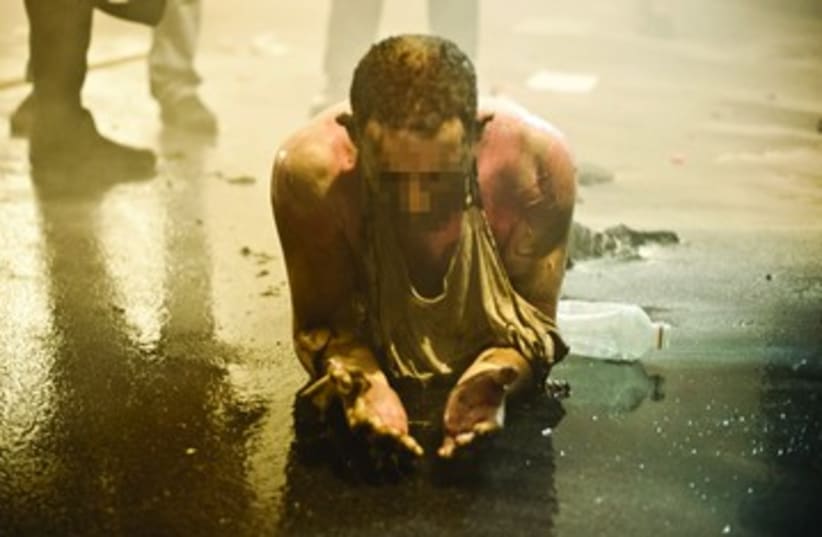
Silman is described by many as being successful businessman for a time, who became bankrupt due to cruelty of bureaucrats.
By YISRAEL MEDAD, ELI POLLAKSelf-immolator Tel Aviv fire protester Moshe Silman 390(photo credit: Asaf Kliger)
Moshe Silman is a tragic figure. He is described by many as being a successful businessman for a time, who became bankrupt due to the cruelty of bureaucrats. His personal and business assets were all lost to his debtors. He claimed that the National Insurance Institute caused his financial downfall and he did not have enough money to demand what he felt was his in court. His repeated requests for help, whether they involved a waiver of court fees, an increase of his national insurance benefits due to illness or a request for housing aid, went unheeded by the various agencies.Every story has two sides and when one delves deeper, it appears that a State Comptroller’s Office document does not justify Silman’s claims against the National Insurance Institute. But whatever his mistakes may have been, and there seem to have been many, this was a man in anguish who with forethought decided upon a radical step – to immolate himself in public in an apparent attempt to commit suicide. It appears he understood that such an act would provide ample ammunition for his friends who were attempting to demonstrate for social justice, and indeed this was the case. His self-destructive and thus immoral act was political.The letter he wrote prior to his suicide attempt left no doubt as to his motivation.He pointed a finger specifically at the prime minister and the finance minister, hurling at them the Hebrew epithet “nevelot” – despicable scoundrels.In the days following his act, the papers and broadcast media had a ball, all on account of Mr. Silman. Instead of discussing the weather and the expected electricity stoppages, they had a real issue on their hands. The headlines were huge. “The tragedy” blared Israel HaYom. The Ma’ariv webpage had a special “Moshe Silman” entry, which guided the user directly to all of the latest “hot stories” about the man and his issues. Kol Yisrael’s Reshet Bet anchor Arieh Golan used Silman’s tragedy to pitch in his two cents of criticism on Israeli society.Rabbis for Human Rights activist Rabbi Idit Lev became a media star, recounting Silman’s tragic affairs and how she tried in vain to help him over the past few years.The media also made sure everyone knew that in the ensuing, rather small demonstrations, one of the chants was “We are all Moshe Silman.” One of the harshest criticisms of the Left – and the media – against nationalist camp protests during the intifada was that “settlers are dancing on spilled blood,” by which they meant that the terror victims’ deaths were being cynically exploited to further political aims. And now? They have been dancing on Silman’s blood with tragic consequences.Four additional people have already attempted to emulate him. We needed a courageous politician – who also worked as a journalist in the past – opposition leader Shelly Yechimovich, to remind us all that “suicide is an extreme and terrible act and should not serve as an example and inspiration to young people and adults alike, and must not be regarded as the symbol of social protest.” In fact, the journalists’ ethics code instructs us that care and sensitivity are needed when reporting on a suicide and that one should not publicize the method used.The media is not always so diligent in reporting on politically motivated suicide.On Sunday, Israel HaYom said Silman’s case was “an unprecedented act.” However, the paper’s own reporter, Emily Amrousi, took pains the next day to remind us that this was certainly not unprecedented in Israel. Yelena Bosinova, for one, also committed suicide for political reasons. She thought that this was the appropriate expression of her deep dissatisfaction with the uprooting of the Jewish presence in the Gaza strip and the northern Shomron during the disengagement of 2005. Amrousi noted that Bosinova’s act had no impact whatsoever, yet at the same time, Silman was already being compared in the press with Mohamed Bouazizi, who ignited the Arab Spring by setting himself alight in Tunisia. Yet even Amrousi seems to have forgotten that another person, Baruch Ben- Menachem, committed the same suicidal act a short time after the expulsion from Gaza –also to no avail and without serious media attention. It is then not surprising that Natan Zehavi of FM 103 radio did not even know about these two suicides.Why the difference in relating to the two sets of suicidal acts? Why is Silman’s suicide considered by many in the media as heroic while that of Bosinova and Ben-Menachem are nonexistent? The Israel Broadcasting Authority’s Oren Nahari, who did note on Channel 1 that the Gush Katif suicide by fire drew far less attention from the media, suggested that the reason was the political purpose of the act. But is he right? Is it only due to the identification of the media with Silman’s cause and their well-documented antipathy to settlers and their supporters that underlies the different coverage? The media is not the sole actor in the public opinion square. One can assume that the many organizations who have gotten behind the demonstrators, such as Rabbis for Human Rights and others supported by the New Israel Fund, were active in providing the journalists with lead stories, background color and so on. Although they too paid lip service to the Jewish ethics that abhor suicide, it would seem they did make good use of the case to further their cause.This was not the situation with Bosinova and Ben-Menachem. The religious Zionist community has been taught that the end does not justify the means. Its moral makeup forbids it to use the tragedy of others to further its own causes, no matter how just that cause may be. There were no settler organizations or other right-wing organizations that attempted to use these tragic acts to further their cause.At the end of the day, suicide is suicide is suicide. Too many within the media aided and abetted Silman, albeit after the act.They are responsible for the fact that others are trying to follow in his footsteps. But the media’s gurus, such as former Supreme Court justice Dalia Dorner, who presides over the Israeli Press Council, did not take the moral high road. Dorner did not call for an urgent meeting of her council to discuss the media ethics in this case and provide moral and ethical guidelines to prevent such coverage in the future. As we have stressed in this column time and again, accountability is a foreign word when it comes to the media.The authors are vice chairman and chairman of Israel’s Media Watch, www.imw.org.il.
if(catID != 151){
var cont = `Take Israel home with the new Jerusalem Post Store