As individuals, we might exist without collective memories – but we would
no longer exist as a people.
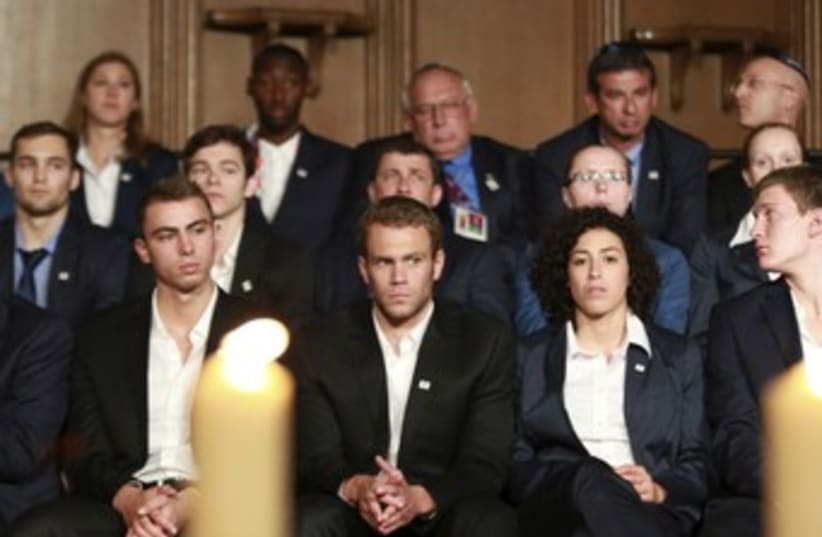
By LIAT COLLINSIsraeli olympians at Munich memorial 370 (R)(photo credit: REUTERS)
Forgive and forget. It was a basic tenet of my British upbringing. Throughout my life it clashed with the much deeper engrained Jewish commandment: Zachor! Remember! The difference was never more evident than in the controversy surrounding the request by the families of the 11 Israeli athletes killed by Palestinian terrorists at the 1972 Munich Olympics for a moment’s silence at the opening ceremony. Just one minute.The International Olympic Committee probably felt it had addressed the problem by holding a contemplative time-out in the festive ceremony to reflect on the loved ones lost by those in the stadium.The images that flashed across the big screens included victims of London’s 7/7 bombings and the late father of Danny Boyle, the director of the opening ceremony. The slain Israelis remained nameless and faceless – as if they had died of natural causes at a ripe old age somewhere far removed from the Olympic Village.For the average Israeli, the gesture fell so flat it lay imperceptible on the ground where it was trampled on throughout the remainder of the parade-cumparty.The tribute-that-wasn’t should have fallen short of its goal for any decent, thinking person, but in an age in which political correctness rules, it suited the touchy-feely inclusiveness that dominates the Western world’s outlook. It’s similar to marking Holocaust Day but dedicating it to any group that has been the victim of ethnic attack, not to the Shoah – the attempt to not only eradicate Jews around the world but also to erase all signs of their culture and existence.In Israel, Holocaust Remembrance Day is marked by two minutes’ silence – and the names of the six million are read out, one by one, for hour after hour, because remembering them – and promising to do all we can to stop such genocide happening again – is the least we can do. On Remembrance Day for fallen soldiers, too, we stand for two minutes to recall the victims of war and terror who are no longer with us. We do not have Memorial Day sales and barbecues.Restaurants and places of entertainment close for the evening, or hold special commemorative events.Many a tourist has stood silently, no less from the shock of seeing the country come to a standstill as from sympathy.The Talmud teaches that when you save one life it is as if you saved the entire world. The loss of one life, conversely, is the loss of an entire world. Ask anyone who has suffered a bereavement. Ask the widows, children, friends and relatives of “The Munich Eleven.”They didn’t want their loved ones remembered as part of a show – to make the world feel good; they wanted their loved ones remembered because when they were cut down, part of the Olympic spirit and values died with them, and no measure of collectively singing “Hey Jude” will ever bring it back.A SEPARATE memorial ceremony for the victims of the Munich Olympics was held on August 6 – a highly respectable event which took place in the impressive setting of London’s Guildhall. Organized by the London Jewish community, the Israeli embassy and the National Olympic Committee of Israel, you might have missed coverage of the event unless you knew to look out for it – which probably suits the International Olympic Committee just fine.It was attended by some 500 guests, including the British prime minister, who spoke at a reception before the ceremony began; the deputy prime minister; the leader of the Opposition; the Mayor of London; Israel’s Minister of Culture and Sports Limor Livnat, and Jacques Rogge, the head of the International Olympic Committee, who has taken the brunt of the criticism for the committee’s failure (yet again) to hold a minute’s silence for the murdered athletes.“Shame on you, IOC,” Ankie Spitzer, widow of fencing coach Andre Spitzer, told Rogge. “You have forsaken the 11 members of your Olympic family.You discriminate against them only because they are Israelis and Jews.”Another widow, Ilana Romano, whose husband, Yossef Romano, went to the Munich Games to compete as a weightlifter and instead was borne home in a coffin, told Rogge that he had “submitted to terrorism.”Mick Davis, chairman of the Jewish Leadership Council and of the United Jewish Israel Appeal, told the gathering: “I once heard Elie Wiesel say that the opposite of love is not hate. The opposite of love is indifference.“We are assembled here this evening because we are not indifferent. We are not indifferent to the terrible events of Munich 40 years ago.“And no matter the passing of time, we lament and deplore the silence, and apparent indifference of others.“Jewish history has taught us that to remember requires a positive act. That same history has also taught us that to fail to remember is to be complicit.”Remembering is encoded in our DNA. We are commanded in the Bible to remember what Amalek did to us as we left Egypt – “us,” of course, reflecting another typically Jewish trait. It’s hard for even a secular Jewish Hebrew-speaker to refer to those who left Egypt in the Exodus in the third person. For there is also that commandment to tell our children, in every generation, the story of those miracles that took us out of slavery and set us on the way to the Promised Land. On Purim, we are also commanded to blot out the name of Haman, the evil adviser of ancient Persia who sought to destroy the Jewish People.We remember because the collective memories make us who we are. As individuals, we might exist without them, but we would no longer exist as a people. The 5,000-year-old chain would be broken.If you don’t pass the memories on – the good and the bad – they die out with those who kept quiet.My old-fashioned school also taught the value that to err is human and to forgive Divine. Terrorism, however, is not “human error.” That Israelis watched the Olympics while keeping an eye open on threats from both North and South, and today’s Persia, should not have been natural.Those who refuse to see the connection between the murder of the Israeli athletes at Munich and the deaths in the London bombings in 2005, or the victims of 9/11, leave the way open for future nefarious attacks.An ancient proverb ascribed variously to the Beduin and the Chinese postulates that a man who sets out on a quest for revenge should dig two graves, one for the person he seeks to kill and one for himself.When Jews say the name of a fallen soldier, terror victim, or victim of anti-Semitism, instead of the traditional “May their memory be for a blessing,” we say “May God avenge their blood.” Sometimes, indeed, living and enjoying life is the best form of revenge, although there is something to be said for the quote (erroneously) attributed to Gen. Norman Schwarzkopf, on those harboring terrorists: “I believe that forgiving them is God’s function. Our job is simply to arrange the meeting.”If you forget the past, you not only bury a person but you wipe out the memory of an entire community.And if we don’t remember the innocent victims, nobody else will.The writer is editor of The International Jerusalem Post. liat@jpost.com
if(catID != 151){
var cont = `Take Israel home with the new Jerusalem Post Store