Savir's Corner: The European Union and the peace process
The real aspiration to become “European” has to be in the development of a regional approach for the Middle East.
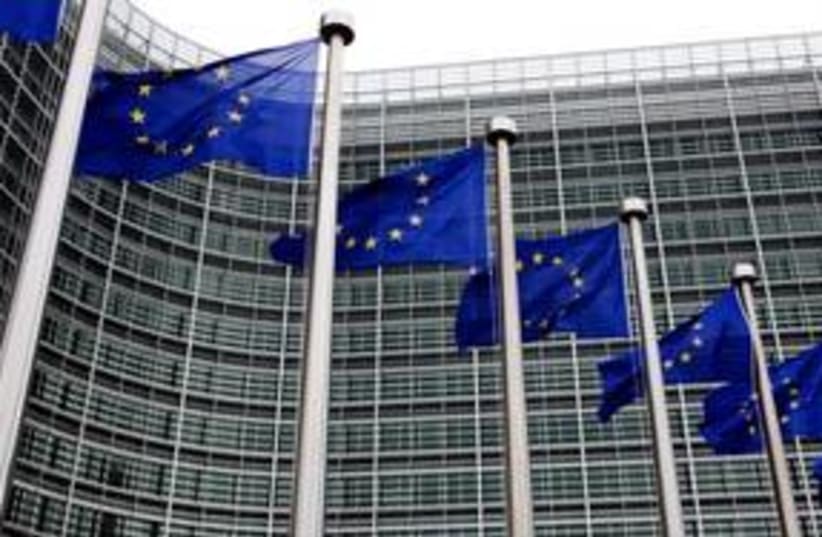
By URI SAVIREuropean Union flags in Brussels 311(photo credit: Thinkstock/Imagebank)
Who would have believed only 65 years ago that the main international support in last week’s French presidential election President Nicolas Sarkozy – Charles de Gaulle’s successor – would be the chancellor of Germany?For centuries war and antagonism characterized Franco-German relationships, coming to a climax with the Nazi occupation of Paris. And yet there is probably not a single Frenchman or German who believes that war between these former foes is realistic in the foreseeable or distant future.The countries have not changed; what was transformed was the socioeconomic and political framework in which they act – known as the European Union, whose founding fathers were indeed mostly French and Germans. They drew the right conclusions from the outcome of World War I, the Treaty of Versailles, and decided that post-World War II Germany, despite the crimes and atrocities of the Nazi regime, would not be punished and humiliated. A new peaceful Europe, west of the Soviet Union, should be inclusive and interdependent. This was the beginning of what can be defined as the most stable and constructive regional peace arrangement.It began with the steel and coal pact in 1956 that integrated these important industries among Western European countries in accordance with the visions of Jean Monnet, Robert Schuman, Walter Hallstein, etc.This turned in 1960 into the European Economic Council with six members – France, Germany, Italy, Belgium, the Netherlands and Luxembourg – in a free trade zone, with a free movement of people, as well as good economic cooperation in a multitude of areas.Then with the end of the Cold War, the demise of the Soviet bloc and the reunification of Germany, with the Maastricht treaty in 1993 the European Union was born, which today includes 27 member states, leading to a joint economic zone, a joint currency, and in Brussels a joint executive and legislative that has a major bearing on economic policies, cooperation and foreign policy of a new Europe.And today, despite deep economic crises, and despite anti-Europe voices in some of the countries (primarily in the United Kingdom) Europe is an entity still to be admired. It has a sense and practice of common responsibilities, and comes to the rescue of its weaker members, such as Greece and Portugal, defines joint foreign policies, is a leading world power with 500 million inhabitants and 20 percent of the world’s GDP, and most importantly it is for the younger generation a shared land of cooperation and exchange, including among its educational institutions. A young German may start his/her studies in Berlin, continue in London in English and conclude in Paris in French.War in Europe for this youngster, as for the others, is out of the question, maybe for the first time in European history.Much can be learned from European regionalism, in terms of regional peace-making, in the Middle East.Europe is aware that strategically its stability and well-being are and will be very much influenced by the war-and-peace issues in the Middle East. The conflict in our region is perceived as a great potential danger to Europe, due to its proximity on one side and vast Muslim population in most European countries on the other.The European Union, through its tireless committed leaders of its diplomacy, the EU high representative Catherine Ashton, is active in talking to the parties with the view to encourage them to start direct negotiations (as reflected in the Quartet initiative last October). On the basis of the EU principles for a settlement, that are expressed in a multitude of EU council resolutions: “Our goal remains a just and lasting resolution to the Israeli- Palestinian conflict, with the State of Israel and an independent democratic, contiguous, sovereign and viable state of Palestine, living side by side in peace and security and mutual recognition, with Jerusalem as the future capital of the two states.” The EU also endorsed the Obama Middle East vision and the American position opposing settlement expansion in the West Bank and east Jerusalem.Since 1993 the EU has been economically very supportive of the Palestinian Authority and has in the last year earmarked 300 million euros for the Palestinians.The EU also is backing democratization and economic development in the Arab Spring countries, through its “Spring Program” providing support for “democratic transformation, institution building and economic growth in the wake of the Arab Spring.” In 2011 the EU allocated 350 million euros for this purpose.The EU Middle East policy is a balancing act between the views of its members and between us and the Arabs, and is manifested in important economic help and diplomatic initiatives headed by Ashton.Yet in my view, especially given the great importance of Europe to the region and Israel, the EU is not engaged in what would be its most important contribution to the region, and that is simply to adapt gradually the EU’s own model of peaceful coexistence and development and regional institution building to the Middle East, aiming, in parallel with the political process, at a Middle Eastern or Mediterranean regional framework.Why not develop with time a pact for tourism and water (not for steel and coal), why not attempt to establish a Middle East financial mechanism (as in Europe) or a council of ministers or a Middle Eastern parliament, municipal cooperation, youth exchange, etc.?Some of it is attempted by the Euro-Med framework, by which Europe initiated a regional process in the Mediterranean area, but with limited success and not as a central tenet of its policy. Most senior European interlocutors with whom I have raised these concepts have brushed me off with “You in the Middle East are not mature enough.” But neither was Europe when it began its regional journey in the Fifties. I am afraid that Europeans deep down believe that their “Europe” is too good for the rest of the world, definitely for the Middle East, and therefore don’t play their strongest card when it comes to our region. There is a need for a transformation in the role the EU plays in our region.A policy change is desired on all sides – for Europe to export its model, for the Arabs not to be overimpressed with rhetorical pro- Palestinian positions, and for us to understand that, after the US, Europe is our most important partner, and together with it, and our Arab neighbors, we can start building, in parallel to the bilateral peace process, a regional institutional development approach.When we say that we need to become “European,” we often mean it from a cultural and economic perspective. The real aspiration to become “European” has to be in the development of a regional approach for the Middle East. The writer is the president of the Peres Center for Peace and served as Israel’s chief negotiator of the Oslo Accords.
if(catID != 151){
var cont = `Take Israel home with the new Jerusalem Post Store