Will Netanyahu-Liberman alignment make a difference?
Think About It: I have difficulty seeing this alignment leading to complete union between the parties. On the contrary, I would not be surprised if in the course of the 19th Knesset the united parliamentary group will split.
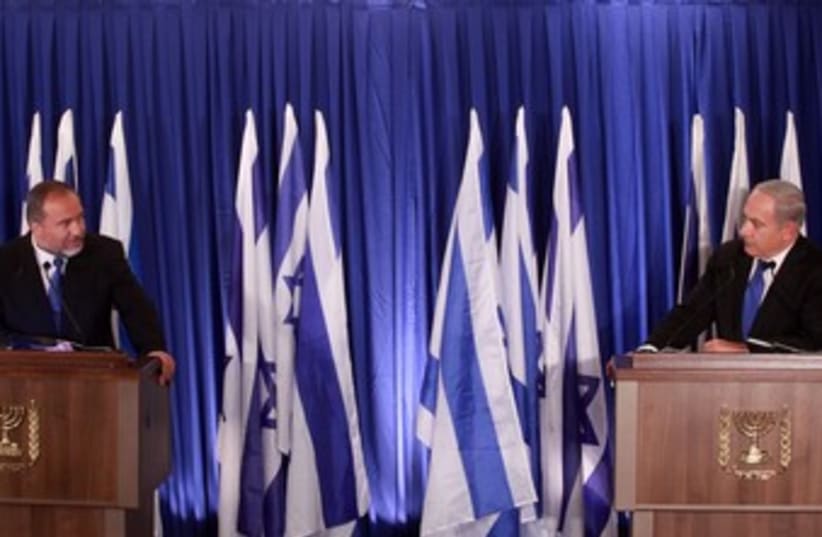
By SUSAN HATTIS ROLEFLiberman and Netanyahu 370(photo credit: Marc Israel Sellem/ The Jerusalem Post)
Since the first Knesset was elected in 1949, its parliamentary groups have been characterized by instability.On the one hand there is an inclination for parliamentary groups to split or lose individual members in the course of a Knesset’s term, and on the other hand there is an inclination for parliamentary groups to unite.The new alignment between the Likud and Yisrael Beytenu is a clear example of the latter. However, leaving aside the truism that Israeli politics can only benefit from a reduction in the number of parliamentary groups and the creation of stable political blocs, one must try to understand what this move is really all about.Why did Netanyahu decide to unite forces with Liberman for the coming elections? Will the two parties benefit politically from this move in the short run, and is there any chance that they will unite in the longer run? Does it really change the political map in Israel? Will it last?None of the opinion polls conducted before Thursday suggested that anyone but Netanyahu would be able to form the next government after the elections, even though they all show the Likud weakening compared to earlier polls, and some even compared to the results of the previous elections.Though Netanyahu has had a solid coalition behind his current government, his own parliamentary group numbered only 27 MKs, which meant that he had to depend heavily on his coalition partners, and spend much of his time juggling their often contradictory demands. With a larger parliamentary group, at least in theory he would have greater control over his agenda.Why only in theory? Because it very much depends on whether that parliamentary group, no matter its size, is united and disciplined, and as will be argued below, it is not at all certain that the Likud-Yisrael Beytenu parliamentary group will be more manageable than the current Likud parliamentary group, which is characterized by prominent backbenchers with minds and agendas of their own, that have not always tallied with those of Netanyahu.If what Netanyahu really wants is to stand at the head of a larger parliamentary group in the 19th Knesset, and his conclusion is that he cannot achieve this if his party runs alone, why did he chose Yisrael Beytenu rather than Kadima, most of whose members are former Likudniks, from its more moderate, liberal, pragmatic and pro-rule-of-law branch? Last May Kadima joined the coalition, and it looked as if Netanyahu and Shaul Mofaz might join forces.Unlike the alignment with Yisrael Beytenu, an alignment with Kadima would have changed the balance between the political blocs to the benefit of the Right. Only Netanyahu has the answer to the question why that did not happen.What effect will the new alignment have on the combined number of seats that the Likud and Yisrael Beytenu are likely to receive in the next elections? Experience indicates that after an alignment is formed, in the following elections the united list usually receives fewer seats than the two former parties received separately in the previous elections.For example, when Gahal was formed toward the elections for the 6th Knesset (1965) its components – the Herut Movement and the Liberal Party – each had 17 seats. In the following elections Gahal received only 26 seats. The same result was attained in the elections to the 7th Knesset. Of course, this does not mean that in the longer run a united list will not prosper.Though some optimists (or pessimists, depending on what side of the political spectrum you are on) have forecast that the new Likud-Yisrael Beytenu alignment might receive as many as 50 seats, compared to the current 42 of the two parliamentary groups together (27 and 15 respectively), my guess is that the new alignment will receive less than 40 seats.There are many reasons to believe that at least the Likud side of the alignment is going to lose support in several sectors, and it is not clear where new supporters can be drawn from.There are several reasons why some traditional Likud supporters are expected to desert. Firstly, the departure of Communications Minister Moshe Kahalon, though executed in a very gentlemanly manner, is liable to push quite a few Sephardi voters to Shas, which has become more attractive to them since Aryeh Deri rejoined its leadership. These voters are also likely to feel alienated by the major increase in “Russians” in the united list.Many religious voters of the Likud are also likely to be put off by the anti-religious components of Yisrael Beytenu’s ideology, and to opt for the new National Union-New National Religious Party alignment. In addition, many Feiglin supporters among the settlers might become fed up with all of Netanyahu’s maneuvers, which they suspect are designed to shunt their representatives to the sidelines, and also opt for the national-religious alignment. Finally, some liberal Likud voters might shift their votes to Yair Lapid or what remains of Kadima.As to the future, my guess is that the united Likud-Yisrael Beytenu list is not going to be characterized by harmony.On the contrary, there are many reasons to expect disharmony due to personal tensions and power struggles, different emphases on issues, and differences in political culture and orientation, though I expect that several members of Yisrael Beytenu, such as the daughter of veteran Likudnik David Levy, Orly Levy-Abecassis (who established an impressive parliamentary record in the 18th Knesset) are likely to feel quite at home with the Likudniks.In short, I have difficulty seeing this alignment leading to complete union between the parties. On the contrary, I would not be surprised if in the course of the 19th Knesset the united parliamentary group will split.As to the question of whether the new alignment will lead to a major change in the political map, since I do not see a similar alignment being created at the moment on the Center- Left, largely due to egos and substantiated doubts as to whether such an alignment could change the basic balance between the right-wing-religious and center-left-Arab blocs, my answer is negative.In short, if I am not mistaken: much ado about nothing much.The author is a former Knesset employee.
if(catID != 151){
var cont = `Take Israel home with the new Jerusalem Post Store