The very fact that Delhi Police did conduct an earnest investigation and did publish the results thereof, even if tardily, is most welcome.
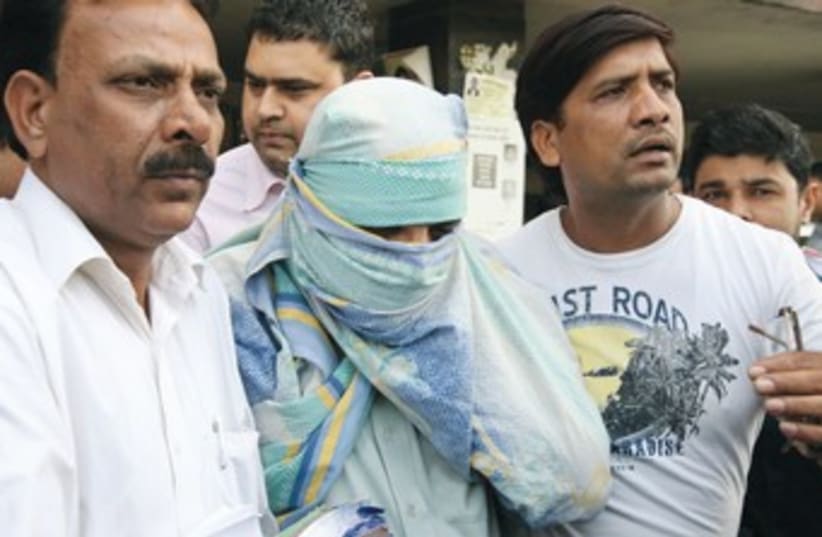
By JPOST EDITORIALNew Delhi terror arrest 370(photo credit: REUTERS)
Better late than never! India has officially declared that Iranians were behind the February 13 booby-trapping of an Israeli Embassy car in New Delhi that seriously wounded Tali Yehoshua-Koren, the wife of the defense attaché.Israel blamed Iran right off. There is no mystery about who the Mideast’s primary sponsor of state terrorism is and who is most driven to inflict pain on Israeli civilians.But what we know and what others are willing to acknowledge are not necessarily one and the same. Official India was initially discomfited and loath to point fingers, much as is more recently the case with Bulgaria.Then as now, foreign governments and purportedly independent observers ask how Israel knows and with what proof it substantiates its claims.This, however, is not an instance of individual felony, where the identity of any perpetrator has to be established beyond all reasonable doubt. Terrorists often play cat and mouse games, adopt mutating identities and shirk responsibility to confound pursuers and world opinion alike.Moreover, foreign governments frequently prefer not to name names (even when they know them) in order not to arouse the ire of a terrorism-inclined entity whose capacity for vendettas is a notorious deterrent.Therefore, the very fact that Delhi Police did conduct an earnest investigation and did publish the results thereof, even if tardily, is most welcome. This is more than was the case elsewhere, and more than might be expected of most so-called non-aligned nations.Israelis remember the March 17, 1992, car-bombing at the embassy in Buenos Aires. This atrocity took the lives of 29 and wounded 242. It became Argentina’s worst terror attack until July 18, 1994, when a van loaded with 275 kg. of explosives was detonated in front of the AMIA Jewish Community Center, located in a densely packed section of Buenos Aires. The lives of 85 innocents were claimed and many hundreds more were injured.The horror notwithstanding, Argentine investigations were marred by gross ill-will and/or incompetence (then-president Nestor Kirschner branded them a “national disgrace” in 2005). However, eventually even the lethargic investigators agreed that Iran/Hezbollah masterminded the carnage. Indeed, in 1999 an arrest warrant was issued against Hezbollah senior commander Imad Mughniyah, who himself died in a 2008 car-bombing in Damascus.Considering the outright obstructionism in Argentina, India needs to be commended both for conducting a credible investigation and for making its findings public.A delegation of senior Delhi Police personnel is reportedly bound for Tehran to confront their Iranian counterparts with the evidence uncovered, request further information and seek the extradition of five men and a woman suspected of committing the crime. Indian court-issued documents have been transmitted to the Tehran authorities.It takes woefully little imagination to hypothesize about the dismissive and denigrating reactions with which these Indian approaches will be greeted in Iran.All this is not simple for India. For one thing, its Prime Minister Manmohan Singh is scheduled to travel to Iran for the Non-Aligned Movement (NAM) summit on August 30-31. Iran nuke ambitions, and the sanctions imposed upon it, make that visit altogether problematic, to resort to understatement.Now, Indian-Iranian relations are all the more complicated by the fact that India’s law enforcers have just formally cited Iran’s Revolutionary Guard as having plotted and commissioned the only foreign-instigated terrorist plot on Indian soil apart from Pakistani outrages.To avoid even more embarrassment, perhaps India ought to rethink its participation at the summit. The reputation of all NAM members is hardly enhanced by pandering to Iran. Clearly, as the Delhi attack demonstrated, there are no holds barred for Iran. All nations are endangered by its sponsorship of terrorism, NAM states not least among them.If the Indian premier does not change his travel plans, his country will find itself walking a tightrope – trying to strike an impossible balance between its duties to international law and its fear of an aggressive neighbor. Instead, India ought to do the right thing and absent itself from the Tehran sham even if Indian PMs haven’t missed a single NAM summit since 1979.
if(catID != 151){
var cont = `Take Israel home with the new Jerusalem Post Store