Despite their convergence at the 'Post' conference, the divergent approaches presented by Liberman and Livni provide two very different visions for voters to ponder when they go to the polls next month.
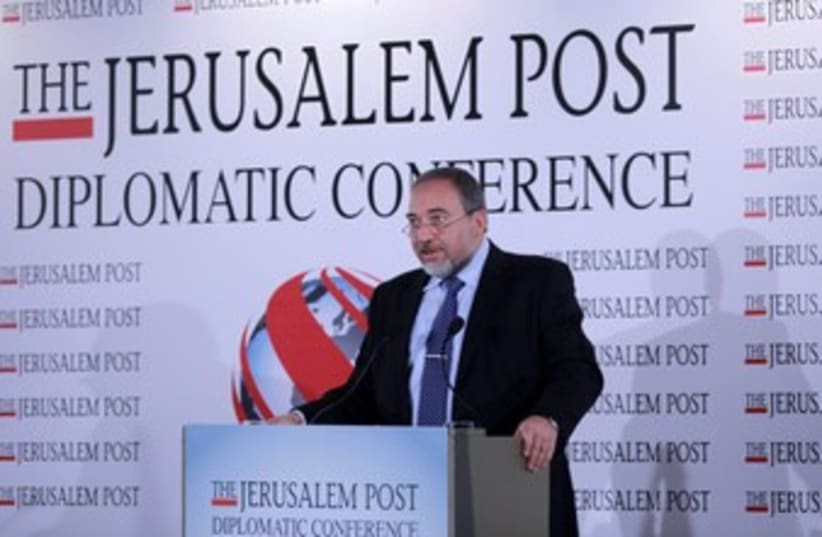
By JPOST EDITORIALAvigdor Liberman 370(photo credit: Marc Israel Sellem)
In his characteristically blunt manner, Foreign Minister Avigdor Liberman did not mince words when he accused the international community of abandoning Israel on Wednesday, just as it did the Jewish people during the Holocaust.“Expressions and promises of commitment to Israel’s security from all around the world remind me of similar commitments made to Czechoslovakia in ’38,” Liberman said. “My sense is that all the promises and commitments to Israel’s security are mere words.”True, it is election season. Liberman’s comments, however, carried particular resonance because he did not utter them in Hebrew at a political rally of his right-wing Yisrael Beytenu party. He said them in decent English in the sober setting of the Daniel Herzliya hotel at a gathering of ambassadors and attachés from around the world at the first Jerusalem Post Diplomatic Conference.“When push comes to shove, many world leaders will be willing to sacrifice Israel without batting an eyelid in order to appease the radical Islamic militants and to ensure quiet for themselves,” the foreign minister added.“We are not willing to become a second Czechoslovakia and sacrifice our vital security interests.”Liberman’s comments came in response to the harsh condemnation of Israel by European foreign ministers earlier in the week over its new housing plans in the E1 area over the 1967 Green Line and close to Jerusalem.“Despite clear announcements by Hamas leaders that they will never accept or respect any agreement with Israel and their intention to destroy the State of Israel, the Europeans decided to place pressure only our side,” Liberman declared.He voiced strong opposition to any chance of Israel returning to the pre-1967 lines, warning that this could place Judea and Samaria in a similar situation to that of “Hamastan” in the Gaza Strip.“What will happen the next day?” he asked.His harsh words of frustration were followed by the much softer tone of former foreign minister Tzipi Livni.Although they didn’t listen to each other’s speeches, it was almost as if they were playing “good cop, bad cop.”Livni, who is running at the helm of a new center-left list – The Tzipi Livni Party – tried to woo the diplomats by stressing the importance of the bonds between their countries and the Jewish state.“It is not a favor to Israel to keep and to preserve Israel’s security needs. It is and should be part of the understanding that a secure Israel is in the interest of the international community as well, and not just our own interest. Part of our need is to have the world’s support for our security needs in this tough neighborhood,” she said.“Not everyone is against us and not everyone is anti- Semitic,” she added. “It’s true that there is criticism over the current policy, but this must be separated from the support of Israel as a state.”Livni rejected the parallel Liberman had drawn with the Shoah.“The comparison between Israel’s situation today to the Holocaust is disrespectful, wrong and completely unacceptable,” she said. “The situation of Israeli citizens today is in no way similar to the situation of European Jews from that time.”She argued that it was in Israel’s interest to resume talks with the Palestinians immediately on a two-state solution.“Restarting negotiations will not only preserve Israel’s values as a Jewish and democratic state, it will also shut the floodgates and give Israel back its legitimacy to take military action when we are called on to protect its security interests,” she said.“Now that the Palestinians won in the UN, you should tell the Palestinians to relaunch negotiations with Israel,” she urged the ambassadors. “Maybe there is a chance now.”Liberman and Livni touched not only on issues affecting voters in the January 22 election, but also on Israel’s relations with Europe, the US and the rest of the world.They employed contrasting approaches, but they both addressed the same deep well of frustration over international criticism and a desire for international support.They appealed to the ambassadors as representatives of a nation still seeking peace with its neighbors at a time when it is countering an unprecedented campaign of delegitimization and genocidal threats from enemies such as Hamas, Hezbollah and Iran.Despite their convergence at the Post conference, the divergent approaches presented by Liberman and Livni provide two very different visions for voters to ponder when they go to the polls next month.
if(catID != 151){
var cont = `Take Israel home with the new Jerusalem Post Store