Israel must realize that it gains little by negotiating with the striking prisoners.
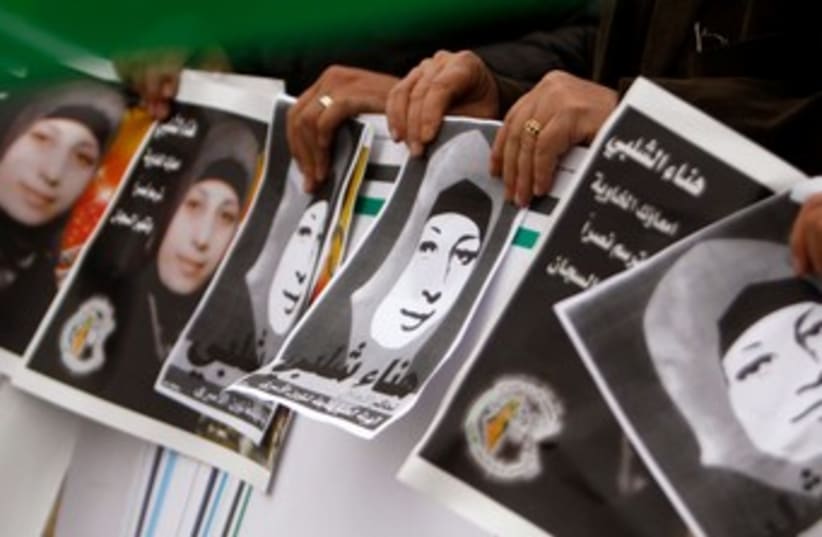
By JPOST EDITORIALPalestinian protesters hold pictures of Hana Shalabi 370 R (photo credit: REUTERS)
In mid-April several dozen Palestinians began a hunger strike that has since grown to include almost 2,000 Palestinian prisoners. The prisoners demand not only an end to the practice of administrative detention, but also increased family visits and an end to solitary confinement. Although recent reports indicate that a negotiated solution may come soon, it has generated widespread international interest.On May 4, Amnesty International issued an “urgent action” announcement, declaring that “two Palestinian hunger strikers’ lives are in danger.” Amnesty called on its supporters to write to Israeli government officials demanding the release of six specific prisoners who were being held in administrative detention and had not yet been charged. Amnesty further requested that Israel “ensure that all detainees on hunger strike are allowed regular, private access to independent doctors, families and lawyers, treated humanely, and not punished in any way for their hunger strike.” The European Union’s office in Jerusalem also announced that it was concerned about the hunger strikers, particularly those being held in administrative detention.While the international community has focused on the issue of administrative detainees, the actual hunger strike affects a much larger segment of the prisoner population. According to recent data, there were around 322 prisoners under administrative detention in the beginning of April, and that number has not changed dramatically. The use of administrative detention or other types of detention of terror suspects without charging them is not a uniquely Israeli method. Under UK law, suspects may be detained for up to 28 days.Columbia Law School Associate Prof. Matthew Waxman, an expert on law and national security, has noted that the argument in favor of administrative detention “generally begins with the notion that exclusive reliance on prosecution, along with its usual panoply of defendant rights and strict rules of evidence, cannot effectively, expeditiously or exhaustively remove the threat of dangerous terrorists.”In addition, the Israeli Supreme Court in 2008 noted that the “purpose [of the law] is to protect state security by removing from the cycle of hostilities anyone who is a member of a terrorist organization... in view of the threat that he represents to the security of the state and the lives of its inhabitants.” One of the laws on administrative detention applies to Israeli citizens just as it does to Palestinians in the West Bank.The hunger strike being carried out by the Palestinians should be viewed in its context as a political tool, much as Gilad Schalit was used as a bargaining chip to obtain the release of Palestinian prisoners. The discovery of this new tool in the struggle was made after Islamic Jihad activist Khader Adnan was released from detention after a hunger strike earlier this year. Hana Shalabi, another Islamic Jihad hunger striker, was released by Israel to the Gaza Strip on April 1. This led directly to the expansion of this method of protest among Islamic Jihad members and then among Palestinian prisoners in general. Now the West Bank is festooned with images and cartoons related to the strike and some Palestinian factions have threatened violence if any of the strikers die as a result of their choices.The false dichotomy that Israel is faced with is the assumption that simply because Palestinians are protesting, their claims must be legitimate. But are they? In 2011, Ma’ariv reported that prisoner Haytham Battat was regularly updating his Facebook page and that another prisoner had posted photos of lavish meals. Prisoners had cellphones and seemed to enjoy a “lavish” lifestyle.The fact that some Palestinian prisoners in Israeli jails are subject to solitary confinement is also not exceptional. Many Jewish prisoners are placed in solitary confinement, including Hagai Amir, the recently released brother of the assassin of Yitzhak Rabin, who spent much of his time in prison in solitary confinement. That some Palestinian prisoners have been punished by this method of imprisonment is not remarkable, in the Israeli or international context.Israel must realize that it gains little by negotiating with the striking prisoners. Too many concessions to these strikers will encourage this method of “resistance.”
if(catID != 151){
var cont = `Take Israel home with the new Jerusalem Post Store