Bishops from this region have distorted both church teachings and the facts to sully Israel, while the Vatican has remained silent.
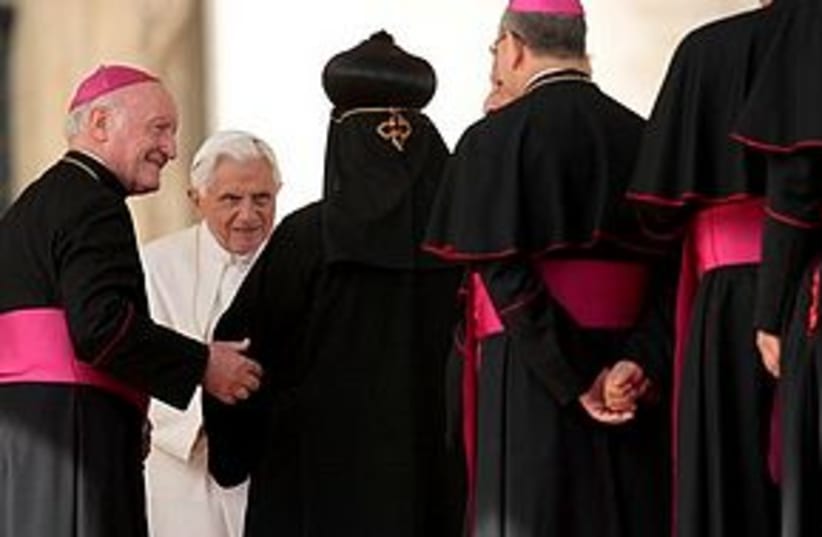
By JPOST EDITORIALpope at vatican(photo credit: Associated Press)
In the name of radical Islamic-inspired nationalism, Mideast Christians of all denominations, including Catholics, have faced devastating persecution for their religious convictions. From the Gaza Strip and Egypt to Iraq to Turkey, Christians have been murdered, had their churches burned to the ground and their holy books destroyed, and have been demoted to secondclass citizens exposed to libels and exploitation by Muslim neighbors.Ostensibly with the purpose of addressing these injustices and stemming the tide of a dwindling Christian population in the Mideast, Pope Benedict XVI convened a special Vatican Synod in Rome, composed of about 200 bishops mostly from Muslim countries. Yet these bishops hijacked the synod and issued a statement Saturday that all but ignored the plight of Catholics living in Muslim lands while singling out Israel’s “occupation” for special castigation.One of the synod’s leaders, Greek Melkite Archbishop Cyril Salim Bustros, even reiterated anti-Semitic theological positions that contradicted official Catholic positions as stated in Nostra Aetate, a groundbreaking interfaith document drafted in October 1965 during the Second Vatican Council that radically revamped the Church’s previous negative views of the Jewish people.Rabbi David Rosen, the American Jewish Committee’s International Director of Interreligious Affairs, has now called on the Vatican to issue a clear repudiation of Bustros’s “outrageous and regressive comments.” We firmly join him in that call.IT IS an undeniable fact that the bulk of Christian persecution in the Mideast is perpetrated in the name of radical Islam.Open Doors, an organization that tracks attacks on Christians, regularly compiles a global “persecution index.” North Korea has topped the list for many years.However, of the top 10 countries on the list, eight are Islamic and three – Iran, Saudi Arabia and Yemen – are in the Middle East. Egypt and Iraq are also listed in the top 20. The “Palestinian Territories” is ranked 47, cited primarily as a conflict zone and also in part due to the strife suffered by all Gazans, Christians included, as a result of the destruction caused by Operation Cast Lead.Open Doors takes pains to note, however, that even before the offensive, which was directed at Hamas terrorists, not Christians, “Many [Christian] believers had already left, pressured by the growing influence of radical Islam...”SO, IF radical Islam is the principal persecutor of Christians in the Mideast, why was Israel singled out? Apparently, by bashing Israel, Arab Catholic bishops as a persecuted minority in the Mideast are attempting to go out of their way to prove their loyalty to their Muslim brethren.This is a common socio-psychological phenomenon among Jews in response to anti-Semitism. Some British Jews, for instance, have been known to become more British than the Brits. Some of the most adamant communist ideologues in anti-Semitic Bolshevik Russia were Jews.So, too, Arab Christians have attempted to emphasize their ethnic and cultural loyalties above their religious affiliation, not only out of strongly heartfelt emotional ties to the Arab people, but also as a way of neutralizing religious tensions.When secular Pan-Arabism was still in vogue, this tactic was much easier to pull off. Christians such as Popular Front for the Liberation of Palestine founder George Habash, who was of Greek Orthodox background, could join forces with Muslim terrorists under the banner of Palestinian nationalism.However, with the rise of Wahhabism, the Muslim Brotherhood, Al-Qaida, radical Shi’ism and other extremist Islamic movements, Arab Christians have had an increasingly harder time integrating into their respective societies. In a push to garner favor among Muslim extremists, the temptation among the bishops to revert to pre- Nostra Aetate anti-Semitic Catholic theology is evidently irresistible.We can muster some understanding, if not empathy, for Mideast bishops’ disingenuous and ultimately self-defeating behavior, which will only perpetuate the persecution of Christians by kowtowing to Muslim extremism. We cannot, however, excuse the Vatican for allowing itself to be hijacked.Bishops from this region have distorted both church teachings and the facts to sully Israel, while the Vatican has remained silent, in the process turning a blind eye to Christian suffering.Pope Benedict XVI still has a chance to distance himself from the synod’s declarations and make it clear that Bustros’s comments deviate from Church teaching. That is the right and necessary thing for the pope to do – not just for Jewish-Catholic relations, but also for the sake of the Middle East’s persecuted Christian minority.
if(catID != 151){
var cont = `Take Israel home with the new Jerusalem Post Store