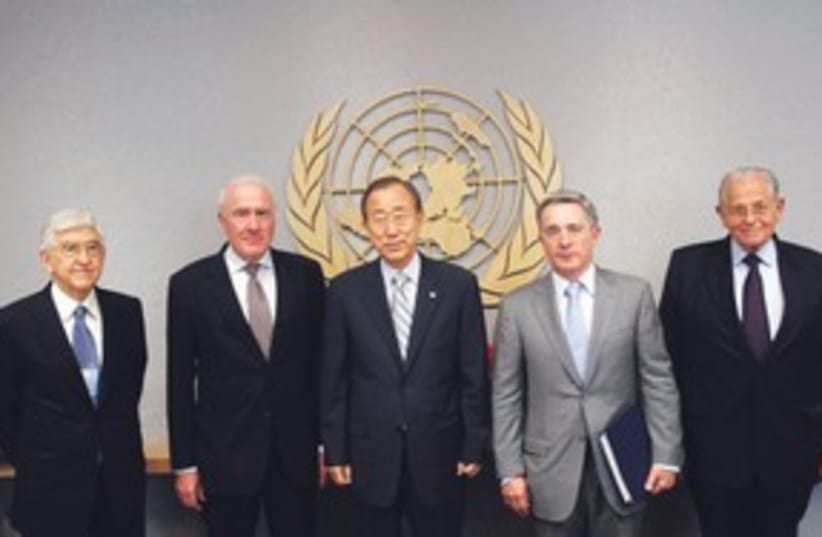
Some positive developments, including Israel’s cooperation with the UN’s flotilla inquiry, have helped improve UN-Israel ties of late.
By EFRAIM CHALAMISHUN Flotilla Committee 311(photo credit: Associated Press)
Israel and the United Nations have significantly improved their relationships over the past few months. In July, Prime Minister Binyamin Netanyahu had a very positive meeting with UN Secretary General Ban Ki-Moon. Also, Israel recently decided to participate in the UN commission inquiry into the Turkish flotilla incident. Moreover, The UN peacekeeping force in Lebanon firmly confirmed that the Lebanese military attack on the Israeli force on Israel-Lebanon border earlier this month was a clear violation of multilateral agreements since Israel operated on its own soil.Observers wonder if these events represent a meaningful strategic change or an opportunistic ad hoc approach. Although time will tell, a couple of important oberservations can be shared at this point with regards to the positive sequence of Israel-UN events and their future direction.First, the Israeli government managed to differentiate between the various bodies of the UN. In the past, Israel had an absolute rejectionist approach towards the United Nations, fighting the legitimacy of the institution itself and presenting its flaws and rather blind negative approach towards the Jewish state.Nowadays, the government is promoting its legitimate membership status by enhanced participation in more balanced UN forums, such as the Economic and Social Council, while still presenting a hawkish approach towards hostile and onesided forums, including the Human Rights Council in Geneva. Israel’s cooperation with Ban Ki-Moon’s inquiry panel on the flotilla incident, while attacking the Human Rights Council’s own fact-finding mission, proves the realistic attitude of its decision makers.SECOND, THE United Nations itself changed its core approach to the Middle East conflict. The UN has experienced a serious identity and legitimacy crisis in recent years as a result of ethical fiascos, failed structural reforms, such as the one in the Security Council, and various attempts to create a competitive and more transparent forum in the form of a union of democracies.As a result, the UN Secretariat has made a lot of efforts to increase governments and NGOs participation and gain legitimacy. The UN’s efforts to respond to the anti-Israeli bias and to avoid one-sided commissions are part of the ongoing improvements in the relationships between the parties.Third, the United States, Israel’s closest ally at the UN through its veto power at the Security Council and its economic and military superpower position, had to adjust itself to the rising economic and political power of emerging economies. The recent Brazilian attempt to broker a deal and solve the Iranian nuclear crisis is an example for the new order of multilateral powers.The now-limited US impact forces Israel to work closer with the UN and its numerous members.Finally, it is necessary to differentiate between the silent and consistent majority at the General Assembly in New York, which frequently supports anti-Israel resolutions, and the UN leadership and its various agencies. These institutions appreciate the contribution of Israeli diplomats and experts to their humanitarian and economic operations. They are also well aware that their ability to contribute in a meaningful manner to the Middle East conflict can only be done through constructive cooperation with all sides involved and not by automatic voting on meaningless resolutions. The leadership of the UN has mentioned that publicly in many forums.Globalization of technology and human forums makes political isolation impossible. Israel has recently realized that despite its weaknesses and strong internal anti-democratic influences the UN is, in fact, an important multilateral institution that shapes public opinion worldwide, even if does not do so the way sovereign governments do. Israel will have to continue investing the right political and financial capital in order to further develop this new approach. Bringing the Israeli voice to the institution and collaborating with its economic and development agencies are just some of the ways to build much needed Israeli credibility.The United Nations is far from perfect. Yet, Israel cannot afford ignoring the UN given the current political climate in the Middle East. Recent changes in the relationships between the parties have started showing fruitful results. It may be the right time for Abba Eban’s “Um Shmum” legacy to be re-examined.The writer is an international law scholar and practitioner and the Permanent Representative to the United Nations of the International Association of Jewish Lawyers and Jurists.
if(catID != 151){
var cont = `Take Israel home with the new Jerusalem Post Store