The first step to remaking Zionism in the future is learning what Zionism meant in the past.
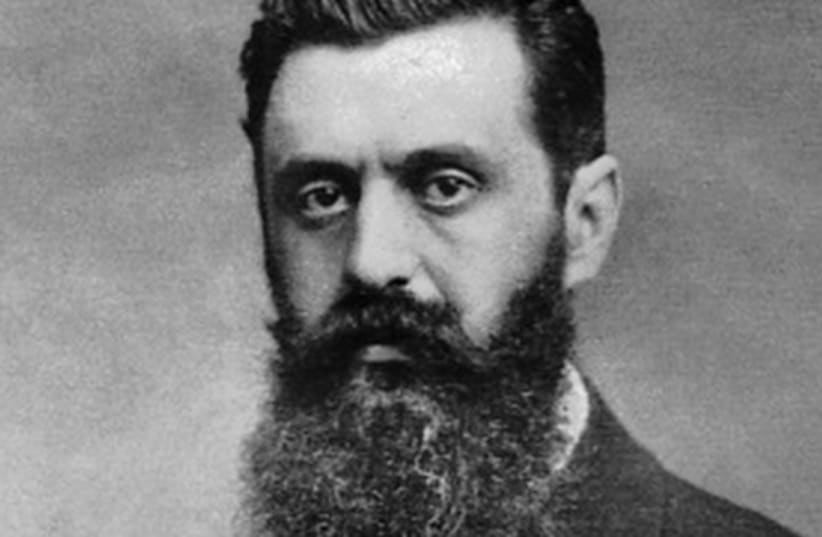
By ALEX JOFFEHerzl(photo credit: Cortesy)This article first appeared in Jewish Ideas Daily and is reprinted with their permission.There has never been agreement about Zionism. Not only is the idea of Jewish nationalism controversial, the very word “Zionism” arouses unique passions, as a recent controversy highlights. It was recently reported that the Jewish Federation of North America had dropped the word “Zionism” from a planning document. In a vehement denial, the Federation clarified that this was not so: it was merely a single individual on a subcommittee who proposed dropping the phrase “Zionist enterprise.” The proposal, the Federation emphasized, went nowhere.So, the word Zionism, uniquely among terms related to nationalist movements, arouses attacks and defenses. But is “Zionism” even a useful or relevant term in the 21st century? And what does the answer to this question say about the state of the Jews and the Jewish state?The term Zionism was invented in 1890 by Nathan Birnbaum in his periodical Selbstemanzipation! (Self- Emancipation!) to describe a national-political movement for the restoration of Jews to “Zion.” The term was popularized by Theodor Herzl, then used to characterize movements ranging from cultural to labor-oriented, from religious to secular.The plasticity of the term is not just a modern phenomenon. The term “Zion” appears in the Bible over 100 times. It referred originally to the Jebusite fortress in Jerusalem conquered by David, then to a hill in Jerusalem. Most commonly, it was a synonym for the land as a whole, especially in exilic times. Israel and Judah were the names of the biblical-era kingdoms of the north and south, respectively, one destroyed by the Assyrians in 722 BCE and the other by the Babylonians in 586 BCE. But, unsurprisingly, the exilic authors – like Birnbaum and his successors – found “Zion” a more encompassing term to describe the national movement, since it blends the religious, territorial, and national dimensions of the aspiration to restore Jewish sovereignty.Zionism was among the last European-based nationalist movements. It had odd features, including the fact that it was based initially only in a Diaspora. Even stranger was its success: A Jewish national home was created. The name “Zion” was rejected, and the state was named Israel; but the term for the national movement, Zionism, has remained. Thus the neologism invented to describe a national movement was retained after the nation-state was successfully created under a different name. The term Zionism is now an anachronism, only slightly less so than “self-emancipation.” But what could possibly take its place?Most national movements do not have associated neologisms. There is no specific term for Brazilian nationalism, at least one known in the broader world. The Breton nationalist movement – Emsav – and Kemalism, the “six-arrowed” national ideology of Mustafa Kemal Ataturk, the father of modern Turkey – are equally unknown outside their countries’ borders. But Zionism is known globally, and reviled globally.Since the beginning, Zionism’s enemies have made a uniquely concerted effort to wrest control of the term from its proponents, to besmirch the brand. The infamous 1975 United Nations General Assembly resolution declaring that “Zionism is racism” was the culmination of over two decades of patient Soviet propaganda, eagerly consumed and amplified by the Muslim, Arab and non-aligned worlds.Since then, Zionism has become the paradigm of “extreme nationalism,” imperialism and “settler-colonialism” in the eyes of intellectuals and activists alike. The term “Zionist entity” so favored by Palestinian and Arab spokesman is an explicit statement that the idea and reality of a Jewish state are illegitimate. To defend Zionism is, in some circles, to defend an almost mythically evil concept.Attacks on Zionism are thus clarifying. Enemies of “Zionism,” as a term and a concept, attack not just the actual state of Israel but the aspirational aspect of Jewish nationalism and Jewish sovereignty. That is, it attacks the very idea of a Jewish state as illegitimate, not simply the manner in which the state conducts itself. If such attacks were founded in uniform opposition to all nationalism, they would at least have some consistency and intellectual foundation – but, of course, they are not.It should be said simply that attacks directed solely at Zionism and not at any other national movement are anti-Semitism. When Jewish – not Breton or Turkish, Irish or Iraqi – nationalism is deemed illegitimate and the actual state of Israel condemned to extinction in the name of “historical justice” or some other Orwellian euphemism, this is an especially pure example of anti- Semitism.So, too, is the relegation of Jews to a permanent Diaspora and, thus, perpetual minority status. Whether or not such condemnations come from Jews is irrelevant. Jews need not live in Israel or even support Israel, but to deny the idea of a Jewish state is to deny Jews their past and future.The sad reality is that defending the term Zionism – not “Israelism” or some still newer neologism to describe the Israeli nation-state, as opposed to the Jewish nation – defends the past and future of the Jewish people, history and aspiration as well as the present reality. Equally sad is that Zionism must always be on the defensive, always responding to yet another attack or lie, always patiently explaining Jewish history and Jews’ rights to a state in their own land.But there is another prospective dimension. All national projects are works in progress. The term Zionism must be retained; but the content is continually reformulated, consciously or not. The challenge is to make the process of reformulation conscious and explicit.Israelis hotly debate Zionism as it relates to culture, to the religious-secular divide, to Arab minorities, and much more. But the term has not been much debated by American Jews, many of whom caught between their knee-jerk defenses and embarrassed evasions, or even vicious attacks, and whose understanding of the diversity of Zionist movements and the state of Israel is minimal or, worse, shaped by their enemies or equally ignorant media.The opportunity is to reinvent Zionism and reclaim it as a proud description of a multifaceted concept that now, fortunately, has a state of its own. The first step to remaking Zionism in the future is learning what Zionism meant in the past.
if(catID != 151){
var cont = `Take Israel home with the new Jerusalem Post Store