Netanyahu has adopted a more flexible stance, bringing him much closer to Kadima’s centrist views.
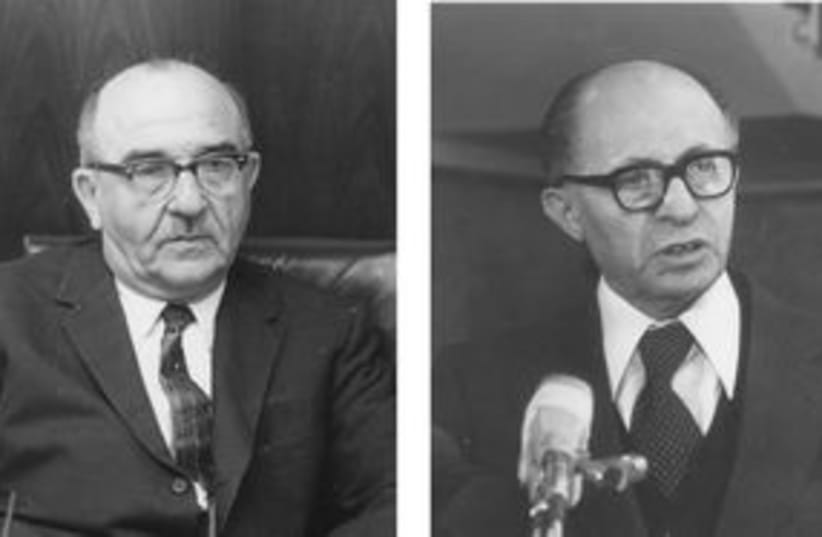
By TZAHI HANEGBILevi Eshkol and Menachem Begin 311(photo credit: File)
In March 2009, about a month after the elections for the 18th Knesset, Binyamin Netanyahu, the candidate who had been charged by the president with the task of forming a new government, stood at a strategic crossroads: Should he establish a pragmatic, centrist government with Kadima and Labor, or a right-wing government, with the religious parties and Labor?Netanyahu’s instinct was clear: to establish a coalition with Labor’s Ehud Barak and those he saw as his “natural partners” – those who had recommended that the president give him the opportunity to form a government. But Netanyahu had a problem. Barak was facing sharp opposition from within his party; it was by no means clear that the Labor Party would participate in the coalition.Netanyahu was not thrilled with the prospect of standing at the head of a “classic” right-wing coalition, whose parliamentary room for maneuver would be limited and whose diplomatic room for maneuver would be nonexistent. Therefore, he turned to Tzipi Livni, the head of Kadima, and suggested that the two of them authorize their respective confidants to discreetly examine the parameters and principles for possible coalition cooperation.Livni placed that responsibility on my shoulders, while Netanyahu appointed Gideon Sa’ar, then the head of the Likud faction (and today the education minister). After just 48 hours of secret discussions and meetings between Sa’ar and myself, with constant consultation with Netanyahu and Livni, it became apparent that the objective differences that divided Kadima and the Likud were bridgeable.Netanyahu was wise enough to recognize that Livni, who had skillfully led negotiations with the Palestinians as foreign minister in the previous Olmert government, would have to play a central and dominant role in those peace negotiations in the new government too. Livni, for her part, did not deny that, according to Israeli tradition, ultimate authority in the diplomatic process rests with the prime minister – a tradition that was reflected under the Olmert government as well.Netanyahu made generous offers to Kadima regarding the staffing of senior government positions. Livni displayed a pragmatic approach regarding the sensitive topic of prime ministerial rotation, although she correctly asserted her right, as head of the Knesset’s largest party, to serve as prime minister for a substantial proportion of the government’s term.On an array of other issues as well – including the coalition’s diplomatic platform, electoral reform and the delineation of authority between the prime minister and his deputy – breakthroughs were achieved. Our working model was based on the coalition agreement that enabled Yitzhak Shamir and Shimon Peres to maintain a relatively stable partnership between 1984 and 1988, including the fulfillment of an unprecedented agreement allowing for the prime ministership to be rotated halfway through the term.Shamir and Peres overcame a vast, profound ideological gulf and bitter personal rivalry, and found a way to work together harmoniously. It seemed reasonable to hope that Netanyahu and Livni, two leaders characterized by rational thinking, would be able to find the common ground in which to garner the support of the Israeli mainstream.Based on the preparatory work performed by Sa’ar and myself, Netanyahu and Livni agreed to open an indepth, detailed dialogue on diplomatic matters. But then a development occurred that reshuffled the cards: Labor’s Barak managed to attain his party’s support for joining a Netanyahu-led government. Netanyahu was spared the choice between a unity government and a right-wing government. Now he could have his cake and eat it too: He could avoid a rift with his partners from the right, and he could build a partnership with the opposing camp, which was seen as being more left-leaning than Kadima.Thus ended the effort to establish a Likud-Kadima coalition. It was my sense that neither of the two party leaders involved mourned the failure. Netanyahu preferred Barak as his number two, because he understood that the Labor Party head had already come to terms with the possibility that he would not return to the prime minister’s seat. Livni felt there was no real value in partnering with the Likud anyway, in light of her skepticism over Netanyahu’s willingness to offer bold concessions to the Palestinians.On March 31, 2009, Netanyahu presented his government to the Knesset and it was approved.DURING THE 20 months that have elapsed since then, there have been two important developments: First, Netanyahu has adopted a more flexible stance, bringing him much closer to Kadima’s centrist views. Even if this is only tactical flexibility, designed to widen his room for maneuver with the American government, it is nonetheless a highly important shift. Second, the Labor Party, including Ehud Barak, has recognized that without substantive diplomatic process, its remaining in the coalition is likely to end its relevance among moderate voters.The combination of these two developments leads one to conclude that Netanyahu, if he truly wants to proceed in the diplomatic process, as he so fervently declares, will lose his current coalition. If he capitulates to his partners on the right, he will lose the Labor Party, and then his shrunken coalition will be living on borrowed time.This is the time to renew the dialogue between Kadima and the Likud. This is the time to examine – with genuine, serious intentions, and not as part of “blame game” tactics – whether the time that has passed since the previous failed attempt has reduced or enlarged the capacity of the leaders of the two largest parties to operate side by side to advance Israel’s interests.Levi Eshkol and Menachem Begin did it before the Six Day War; Shamir and Peres did it to successfully combat rampant inflation and the painful consequence of Israel’s ongoing presence in Lebanon; Sharon and Peres did it to defeat the second intifada. Now, it’s Netanyahu’s and Livni’s turn.The writer is a former Kadima MK.
Related TagsLevi Eshkol
if(catID != 151){
var cont = `Take Israel home with the new Jerusalem Post Store