A counter-lobby of Israelis must exert even greater pressure on Netanyahu to realize the two-state solution.
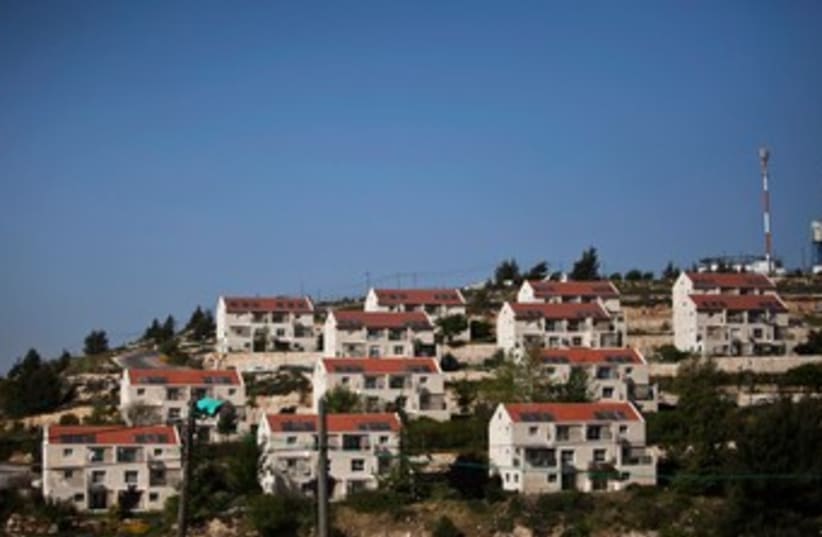
By TAL HARRISUlpana outpost near Beit El 370 (R)(photo credit: REUTERS/Nir Elias)
The events surrounding last week’s Knesset vote on the illegal Ulpana outpost seemed like a vindication of Israeli democracy for many of its citizens. The Supreme Court ruling to evacuate 30 families living on Palestinian land was upheld, as was the notion that Israel’s democracy and the rule of law can exist side by side with its expanding presence in the West Bank.This is fiction.While Prime Minister Binyamin Netanyahu’s forceful opposition to the law did perhaps indicate that he was willing to take on the extremists within the settler movement when the rule of law was at stake, his reasons for doing so gave away his true agenda.“The solution we found strengthens settlements and preserves the rule of law,” said Netanyahu, directly after the vote.And in case anyone doubted the truth of the first half of his statement, he promptly announced the construction of 300 new settlement units in Beit El, before almost trebling that number to 851.The “solution” has indeed strengthened settlements, as well as the extreme political bloc that promotes them. It has also fundamentally damaged the rule of law and Israel’s hope of a truly democratic future.Netanyahu’s thinking is echoed in the general public’s attitude. A poll commissioned by OneVoice and published last week found the general public’s attitude echoed Netanyahu’s thinking. A majority of 64 percent of Israelis opposes illegal outposts in the West Bank (although there is no such thing as a legal settlement according to 100% of the international community). However, only 41% of Israelis think they present a risk to the future viability of the two-state solution.There is a profound cognitive dissonance at work here. The twostate solution is the only way to secure Israel’s democracy for future generations.Equally, the greatest threat to that solution is continued settlement expansion on land earmarked for a Palestinian state in any future agreement.While Israeli democracy would indeed be greatly tarnished by the government running roughshod over a Supreme Court ruling, it would be crushed forever by the closing of the window of opportunity for two states.Many Israeli politicians continue repeating the mantra “Jewish democracy” to describe the type of state many Israelis want, but at the same time, they acquiesce to facts on the ground that would require an impossible choice between those two values.Without a settlement freeze, millions of Palestinians residing in cities and villages where settlement construction encroaches heavily on their lives would either have to become citizens of Israel (much like the Palestinians of ’48) or else remain stateless forever. The first option results in an unworkable binational state that is no longer Jewish. The latter means an immoral and certainly undemocratic regime of apartheid.The pressures Netanyahu endures from the increasingly powerful lobby of the extreme right have left him trying to muddle through by following the court order on illegal outposts, but at the same time not confronting the real challenge of Israeli democracy, presented by his own policy of settlement expansion.Meanwhile, a growing number Palestinians have lost hope regarding the two-state solution, and demand instead equal rights as citizens of one state west of the Jordan.A counter-lobby of Israelis must exert even greater pressure on Netanyahu to realize the two-state solution. As suggested by Professor Alan Dershowitz’s latest article in The Wall Street Journal, Israelis need to join in a sustained campaign across the country that calls for a settlement freeze. This would not only serve to restart negotiations with the Palestinians, it would also ensure that when talks resume, there is enough belief among them in the possibility of achieving a viable state.The alternative makes the debate of last week on illegal outposts a marginal issue, facing as it does an obvious need for Palestinian civil rights, either as citizens of a yet-to-be-established Palestinian state or as citizens of a binational Israel. This is the real choice for Israelis: settlements or democracy. Israel cannot have both.Tal Harris is executive director of OneVoice Israel. The OneVoice movement leads parallel grassroots efforts in Israel and in Palestine toward the solution of two states for two peoples.
if(catID != 151){
var cont = `Take Israel home with the new Jerusalem Post Store