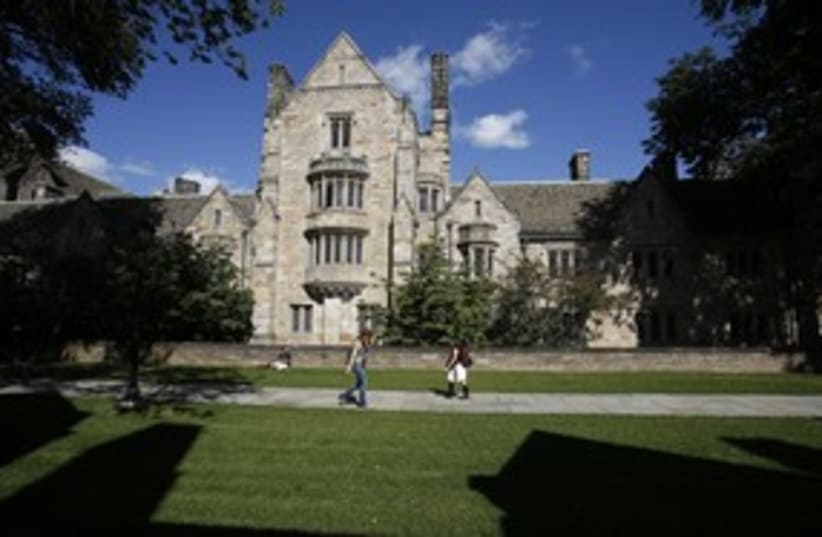
We don’t want to simplify the political discourse at Yale.
By DANIELLE BELLA ELLISON, URIEL EPSHTEINYale University(photo credit: REUTERS)
‘I’m from France.” That statement doesn’t bring up any political implications – no arguments, no heated debates, no existential questions. Yet “I’m from Israel” elicits a rather different response. This simple act, stating your country of origin, should not evoke controversy, yet if you’re Israeli, it often does.In reaction to this phenomenon we set out to gauge how controversial Yale students believe Israel to be. To be honest, we had an agenda. We wanted to show that Yalies viewed Israel no differently than they viewed any of our other democratic allies. There is a perception that college students, particularly those at Ivy League universities, hold Israel in a negative light, and support weakening or even severing ties with the Jewish state. It was crucial, we believed, to investigate whether this was true at Yale.When considering US foreign policy, people generally think along two different tracks: moral and strategic. There is a perceived divide between these two schools of thought. Acting morally may not be in America’s best interest, while acting strategically may not necessarily be moral. This is a problem that everyone, from foreign policy experts to Yale freshmen taking an Intro to International Relations course, face on a daily basis when thinking about the US’s role in the international community.Our friendship with the Israeli people does not pose any such conflict. There is a natural amity between Americans and Israelis based on our mutual appreciation for the moral considerations of democracy, freedom and equality. There is also an alliance between our two peoples based upon mutual strategic interests and goals. Contrary to popular belief, Yale students, and particularly student leaders, agree.As we mentioned before, we did have an agenda: we wanted to demonstrate this understanding. We set out to speak to Yale students across the campus, from all different political, ethnic and national backgrounds. We engaged a wide variety of Yalies, including student leaders from a myriad of political, cultural and community service groups. It was important to us that we learn the opinions not only of those involved in politics or journalism, but also those who are cultural organizers or community volunteers in areas unrelated to foreign policy.The response we got was unexpected. Though there was a broad range of opinion on both American and Israeli policies, Yalies expressed surprising consensus on one issue: the US-Israel relationship.There were many different ideas about how to promote peace in the Middle East, but central to all of them is a strong bond between Israel and the United States. We don’t want to simplify the political discourse at Yale. In fact, political divisions at Yale don’t end with membership in one of the two major political parties, as there are no less than seven parties in the Yale Political Union. Clearly, many people hold divergent and nuanced views about everything, ranging from Israeli settlements, to Palestinian refugees, to the challenges posed by both people’s national aspirations.Such differences were clearly visible when students gathered for a dinner with Israel’s deputy ambassador to the UN. For three hours they engaged one another, and the Israeli ambassador, on countless issues pertaining to the Middle East. Over the course of many such discussions, it has become clear that a broad range of Yale leaders agree that despite the many layers and complications that the region is famous for, America’s involvement is crucial to achieving peace.These same Yale students recognize the threat to peace posed by the Iranian government’s drive for nuclear weapons. While there may not be consensus over the specific action America should take, many students believe that just standing back and allowing the Iranian regime to build a weapon of mass destruction would be a dangerous abdication of responsibility.The Iranian ambition to acquire nuclear weapons does not merely menace Israel and its Arab neighbors; it threatens US security and broader global stability. Therefore, Yalies understand the importance of US efforts to halt this drive.While we were pleasantly surprised by the general agreement over certain principles relating to America’s role in the Middle East, these issues still evoke heated debate across Yale’s campus. But amid this debate, the bonds that bring together the Israeli and American peoples remain strong. Uriel Epshtein is studying International Security at Yale University, and is an outgoing president of Yale Friends of Israel. Danielle Ellison is studying Political Science and Economics at Yale University, and is the incoming president of Yale Friends of Israel.
if(catID != 151){
var cont = `Take Israel home with the new Jerusalem Post Store