Fewer and fewer people in the US are listening to the news on radio, paying for a newspaper and getting caught up through TV. More are becoming informed via either a free or inexpensive online source.
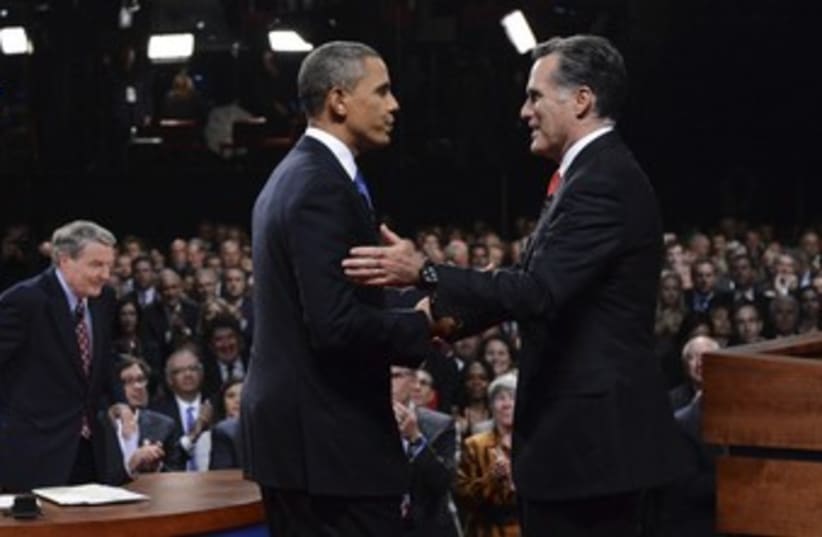
By JEREMY RUDENUS President Obama with Mitt Romney at debate 370 (R)(photo credit: reuters / pool)
It’s mid-October and in the United States, as in every year, the baseball season will soon be coming to an end with the World Series just around the corner. Most non-Americans I know have a hard time grasping the sport’s appeal. The slowness of the game and lack of action for most of the nine innings is something which, I have come to realize, is an acquired taste.One of the things baseball and most American sports excel at in particular is the use of statistics. Everything, and I mean everything, is judged and recorded for the ages.Nothing goes unaccredited. Everything is boiled down to numbers to be analyzed again and again by sportscasters, the press and, of course, the fans themselves. Anyone who’s ever been involved or even heard an argument between two avid baseball followers with opposing opinions knows exactly what I’m talking about.What do these numbers actually mean? There are many opinions in that debate. The one I am particularly fond of is credited to famed announcer Vin Scully, who’s been calling baseball games for the Dodgers since 1950. Scully knew what he was talking about when he said “Statistics are used much like a drunk uses a lamppost; for support, not illumination.”It’s mid-October and in the United States, as in every election year, the campaign season will soon be at an end with Election Day just around the corner. The parallels between baseball and the upcoming elections don’t just end with timing. They carry over into the use of statistics as well. We call them polls and they are not necessarily used to illuminate the current situation but to support the many interests which see the numbers as their lifeblood.To get a better idea of this method, let’s take a look at the recent fallout from the first presidential debate between President Obama and Mitt Romney.Based on what I’ve read since the debate took place, the overwhelming consensus is that Mr. Romney came out on top. But does his victory translate increased voter support? The answer is yes, no and maybe. It all depends on who your news source is.Surely no one is writing that the debate hurt Mr. Romney’s chances of becoming the next US president, but as far as substantially increasing his chances of winning the election, the jury is still out. What’s important though is that we need to be aware of the fact that a close race, or at least an appearance of one, is in many people’s interests. Let’s go through the list:1. The press needs to fill columns; TV newscasts need to fill time with interesting stories from the campaign trail. If there’s no interest in the election because it is a foregone conclusion, that’s not going to happen.2. Pundits and analysts also need numbers which they can base their opinions on – even if there are other numbers to contradict what they are saying. Deciding on which half of the glass to notice is a big part of the pundit/analyst job description.3. It’s obvious why the Romney camp needs the close race. They are the underdogs and are trying to be one of the few candidates to beat out an incumbent president. The more encouragement – the more morale for the troops and money for the war chest.4. The Obama camp also needs the perception of a close race. With the elections less than a month away, they cannot be seen as confident, even if they are ahead.5. Perhaps the biggest fear of both parties is if their voters become confident that the candidates don’t really need their votes and end up staying home. Constituents must be convinced that their vote is crucial, and the perception of a close race will do that.This relationship between the news media and the political campaigns has been around for a long time. The players have changed but the game has remained the same, in one form or another. All that might be changing though, much to the dismay of media and news executives.First of all, some of the reporters themselves have been grumbling about the campaigns’ treatment of the press. Some senior correspondents have gone on record saying the camps are manipulative and too scripted. Once there might have been a give-and-take attitude, but that seems to have changed.Another trend, which I find quite alarming, is the use of anchor clips in campaign ads. For example, the Obama campaign used video from a segment by NBC correspondent Andrea Mitchell to counter a statement made by Mitt Romney. This is after the Romney campaign used Tom Brokaw in one of their ads. These were both done without the network or reporter’s permission.Is it possible that the campaigns are seeing the media more as tools to get their message out than a key player in the entire process? It’s very possible and some recent surveys might shed some light on why.In recent weeks, two surveys about the news media have been published which are probably causing some sleepless nights in the industry. The first was published a few weeks ago by Gallup, showing that a whopping 60 percent of Americans do not trust the mass media to report the news accurately. Improving credibility is no easy task, but another study showed that there has been a major shift in the way Americans consume news.For the first time, more people are getting their news from online sources than from either radio or print newspapers. The number of TV news viewers is also declining. This is particularly true of the 18-29 age demographic with only 34% of those polled watching any TV news. That’s a 15% drop since 2006.Based on these studies, fewer and fewer people in the US are listening to the news on radio, paying for a newspaper and, surprisingly, getting caught up through TV. In any event, these media are not trusted by the majority. More are becoming informed via either a free or inexpensive online source.This is not a fad. It is the trend and the fact that younger people are leading the way, thanks to new technologies, must act as a wake-up call to everyone producing news. Innovate, deliver a quality product, establish (or re-establish) credibility and do it on the cheap, otherwise on the road to irrelevance will be a short one.Jeremy Ruden is an independent media consultant and a former producer at the Fox News Channel in New York. Jeremy@jeremyruden.com
if(catID != 151){
var cont = `Take Israel home with the new Jerusalem Post Store