Mofaz is by no means a perfect candidate, but he at least came up with a peace plan and, regardless of its merits, presents a basic political platform to achieve peace.
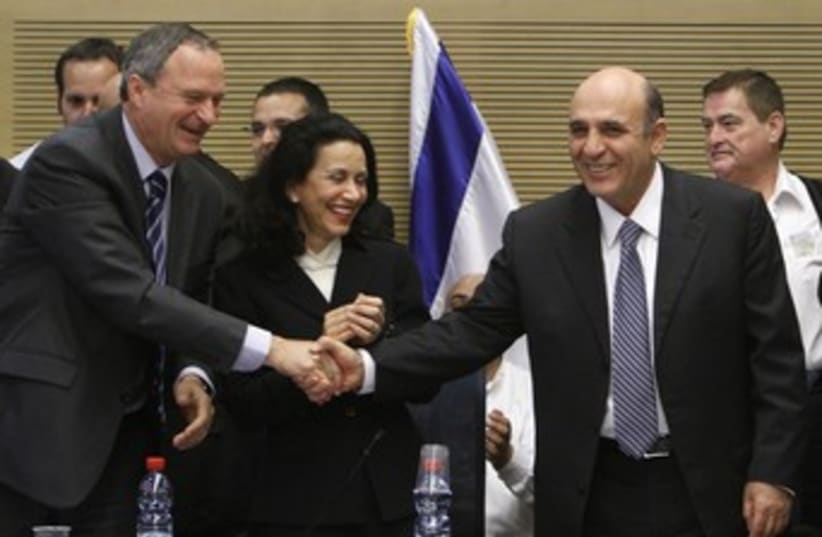
By ALON BEN-MEIRShaul Mofaz, new Kadima leader(photo credit: Marc Israel Sellem)
With Shaul Mofaz’s victory in March in the Kadima Party’s leadership contest, and recent political developments, the fractious nature of Israeli politics once again haunts what remains of Israel’s peace camp. Mofaz is by no means a perfect candidate, but he at least came up with a peace plan and, regardless of its merits, presents a basic political platform to achieve peace. At a time, however, when the Palestinian conflict places Israel in real danger of losing its national Jewish identity and its democratic nature, its centrist and left-of-center political parties should unite and form a partnership that could provide a serious alternative to the Likud-led ultra-nationalist coalition of Prime Minister Binyamin Netanyahu.Unfortunately, all Israeli politicians are driven by blind personal ambitions. I do not believe that there is a single issue in connection with the Palestinian conflict that Labor, Kadima and even Ehud Barak’s Independence party could not agree on to move along a unified political agenda to solve the Israeli-Palestinian conflict.What prevents them from doing so are personal struggles over who should occupy this or that post and what prerogatives they may or may not be able to exercise.Jealousy over the titles of “party leader” and “prime minister” has manifested itself in outgoing Kadima chairwoman Tzipi Livni’s decision to considering the establishment of a new party, and in television TV anchorman-turned-politician Yair Lapid’s new party, Atid (Future), in which, Lapid insists, no serving politician will be allowed, “only new people with new ideas.” Shelly Yacimovich, the Labor Party leader, commented that Mofaz’s victory makes her a “significant alternative” to Netanyahu.Moreover, not only do these so-called “leaders” have huge egos, they are also suspicious and distrustful of each other. Lapid does not talk to Livni or to Yacimovich, the latter having accused him of having Ehud Olmert, the corruption-charged former prime minister, as his political consultant.Moreover, they have also been outright dishonest with people as each one of them is trying to hijack last summer’s social protest by Israeli youth over the high cost of living. In newspaper headlines, one can read that Mofaz would lead Israel’s protest this summer, Lapid is leading an anti-government campaign entitled, “Where is the money?” and Yacimovich initiated serious socioeconomic legislation only after the Israelis took to the streets.The real test for these leaders, who are capitalizing on the demands of the Israeli middle class, is to publicly condemn the expansion of the settlements and the added expenditures of hundreds of millions of dollars by the military to protect the settlers.To overcome Israel’s debilitating political party structure, there is an urgent need to support the creation of a single party consisting of the Left and left-of-center parties. The leaders of Kadima, Labor, Atid and others should group their blocs of supporters to create a single party – something that is not unprecedented in Israel’s political history.The creation of the Labor Party itself in 1968 was only made possible by the merger of similarly-minded Mapai, Ahdut Ha’avoda and Rafi parties based on the commitment to a two-state solution.Mofaz, Yacimovich and Lapid are intelligent enough to recognize the reality that it is security and the continued occupation of Palestinian territories (rather than socioeconomic issues) that distinguishes the political Left from the Right.For these leaders to campaign on something other than the Israeli-Palestinian conflict is to risk compromising the Center’s internal logic by gathering points of disaffection from the Left and Right instead of presenting a cohesive, distinctive political alternative. This is the lesson that they learned from the late Yitzhak Rabin, who wished to fundamentally change Israel, and campaigned in 1992 on peace and managed, thanks to his willingness to rely on largely non-Jewish parties, to form a clear majority of at least 61 seats in the Knesset.National interest must prevail and override any personal ambitions or party gains, and a single party is the only chance to garner significant electoral support that can seriously challenge the Likud-led coalition that currently has a majority of 63 seats and could further increase its presence if the Left and left-of-center parties remain in disarray.Surprisingly enough, the sole politician who recognized this reality cannot run for elections. Former Mossad head Meir Dagan had the courage and vision to acknowledge that Israel should accept the 2002 Arab peace initiative, which demanded Israeli withdrawal from the occupied territories in return for full peace and normalized relations between Israel and the Arab world, and for good reason.In Dagan’s words, “We have no other way, and not because [the Palestinians] are my top priority, but because I am concerned about Israel’s well-being and I want to do what I can to ensure Israel’s existence.”Right now, the Sunni Arab world is far more eager to make peace, not because of its love of Israel but rather through its hatred of Iran. True, the Iranian nuclear program is a serious threat to Israel, but the greater threat to Israel is the colonization of the West Bank. If Israel persists in its current path, it will neither remain democratic nor maintain its Jewish identity, nor ensure its national security as the Palestinians might very well abandon the two-state solution and opt for one state while focusing instead on acquiring equal political rights.That said, regardless of what peace plans any of these parties come up with, they will not work unless the political leaders demonstrate a real understanding of the critical need to change Israelis’ and Palestinians’ public perceptions of each other.This has, and continues to be, the prerequisite for any peace agreement. Part and parcel of any political agenda by any party is to have a plan on how to involve the Israelis and the Palestinians publicly in the peace process and realize the concessions needed to reach an agreement. Indeed, every conflicting issue between the Israelis and the Palestinians has a psychological and emotional dimension that must be mitigated by changing the public narratives on both sides.Even when Israel and the Palestinians have come close to an agreement, as in the 2000 Barak-Arafat negotiations and the 2008 Olmert-Abbas negotiations, they still failed to deliver because neither the Israelis nor the Palestinians were publicly prepared to make the required concessions.What is absolutely critical at this stage is for these parties to prepare the public by encouraging think tanks, NGOs, universities and synagogues to engage in public debate to seek a solution to the conflict only through peaceful means while encouraging the Palestinians to do the same.The Netanyahu government is charting a clear path towards disaster and it must be stopped before it is too late. This can be done only through forming one party comprised of centrist and left-of-center parties. Mofaz, Yacimovich and Lapid do not have much time to lose.Secure in the knowledge that he would win another term because of the current charade of the Left and left-of- center parties, Netanyahu might well call for early elections. This is particularly attractive as he currently enjoys a perplexing popularity and is preparing to pass a law in the Knesset to allow Israeli citizens living overseas to vote in the next election.Unless the leaders of these parties act immediately by coalescing around one party and abandon, in the name of national interests, their personality-driven ambitions, they risk becoming politically marginalized while jeopardizing Israel’s very existence. The writer is a professor of International Relations and Middle Eastern Studies at the Center for Global Affairs at New York University.
if(catID != 151){
var cont = `Take Israel home with the new Jerusalem Post Store