For more than 50 years I have been trying to predict what judges would do and I admit it is an uncertain enterprise at best.
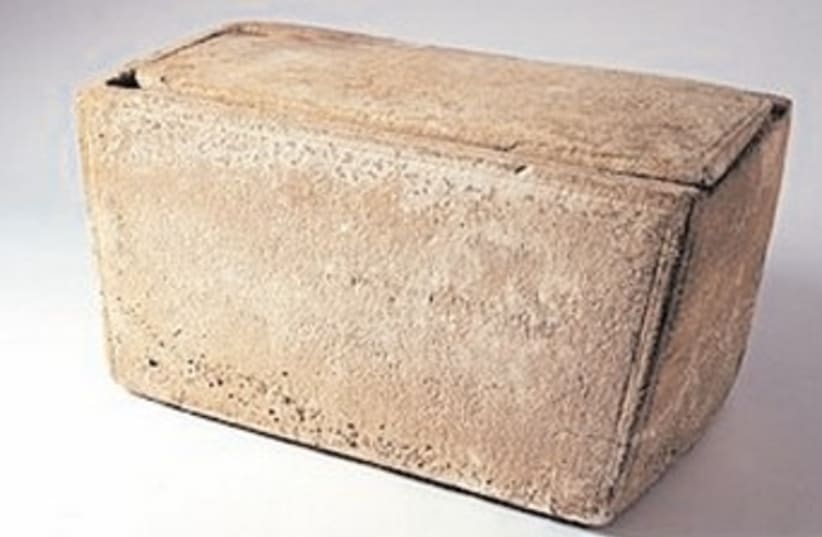
By HERSHEL SHANKSburial box 370(photo credit: Wikimedia Commons)
Oops! Sorry. Is that the way criminal indictments are initiated? It seems so in the case of Rafi Brown, who for many years had been chief conservator at Jerusalem’s Israel Museum, later became an authorized antiquities dealer and subsequently closed his shop and became a private conservator, often based in Switzerland.Brown was one of the original defendants in the “forgery trial of the century,” recently dismissed by the judge after a five-year trial. But Brown wasn’t one of the vindicated defendants.Although he was one of the original defendants, the government long ago dropped him from the case.He was originally indicted for involvement with the alleged forgery of a famous seal impression of the prophet Jeremiah’s scribe, Baruch ben Neriyah (Jeremiah 36), among other things, one of the prize possessions of the Israel Museum.The dismissal of the indictment against Brown was little noticed at the time. But it was a tip-off to those who follow these things closely as to how casually and irresponsibly this case has been handled. Imagine what it means to a man like Brown (to say nothing of his professional standing in the community) to be indicted for involvement in a forgery.Oops! Sorry.The judge recently threw out the forgery charges against the remaining two defendants in the case. His 547- page decision repeatedly shows how off-handedly this case has been treated by the government.Can you imagine putting on the stand one of your chief witnesses – who claims to have seen the James Ossuary inscription (“James, son of Joseph, brother of Jesus”) without “the brother Jesus” – without first inquiring of your witness where and when and how he saw the inscription, only to find on his cross-examination that he saw the inscription for a few seconds at most and, in any event, he could not read the Aramaic even if he had seen it, although it contained his own name, Joseph.This was not the only embarrassment.Take the government’s chief scientific witness, Tel Aviv University professor Yuval Goren. The government knew that conservator Orna Cohen had said she had seen original ancient patina in the word “Jesus” despite the government’s contention that it was a modern forgery.Apparently, neither the government nor Goren focused on this “insignificant” bit of ancient patina until Goren was asked about it on cross-examination. He asked to be excused so he could look at the inscription itself and came back admitting that indeed it was there, although perhaps the forger, he said, used an ancient scratch (with ancient patina) as one of the strokes of the letter which he forged.The government also violated another basic rule in this case. As framed by the American humorist Will Rogers, “When you find yourself in a hole, stop digging.”For more than 50 years I have been trying to predict what judges would do and I admit it is an uncertain enterprise at best. But in this case Judge Aharon Farkash gave plenty of indications where he was coming out; the government, however, perversely refused to accede to his admonitions.AS EARLY as 2008, the judge invited the prosecution to drop the case, telling the prosecutor: “Not every case ends the way you think it will when it starts. Maybe we can save ourselves the rest.”The prosecution refused to take the judge’s advice. Subsequent suggestions from the bench were met with the same obstinate response.Even after the judge’s decision, the Antiquities Authority would not admit defeat. At a hearing on the punishment that should be imposed on Oded Golan, owner of the James ossuary who was convicted of the minor offense of trading in antiquities without a license, prosecutor Dan Bahat (not the well-known Jerusalem archaeologist of the same name) sought to reargue the case, insisting the artifacts were fakes and should not be returned to the defendants.“The judge seemed unimpressed,” one observer wrote.Recently, Dr. David Jeselsohn, the internationally respected antiquities collector, a major contributor to the Israel Museum and founder of Bar-Ilan University’s Jeselsohn Epigraphic Center of Jewish History, posted a blog stating: “This trial would not have taken place were it not for the fact that the [Israel] Antiquities Authority acted imprudently, senselessly, foolishly and, regrettably, with malice. Yes, with malice.”Dr. Jeselsohn expressed the view that “the Antiquities Authority should express its full apology and reimburse him [Robert Deutsch, one of the two defendants who remained in the case] for the damages he sustained as well as learn a lesson for the future. If they are not forthcoming, the authorities responsible for the activities of the Antiquities Authority, including the minister in charge and the Archaeological Council, should draw their conclusions in light of all that transpired and the total loss of confidence in the Antiquities Authority.”As one leading professor from Yeshiva University emailed me: “Jeselsohn is straight-on right.”The writer is an attorney formerly with the US Department of Justice and is now editor of the Biblical Archaeology Review.
if(catID != 151){
var cont = `Take Israel home with the new Jerusalem Post Store