IAGS’s Gal Luft: Better Place all-electric example "very instructive" but "not yet mature," with "many uncertainties."
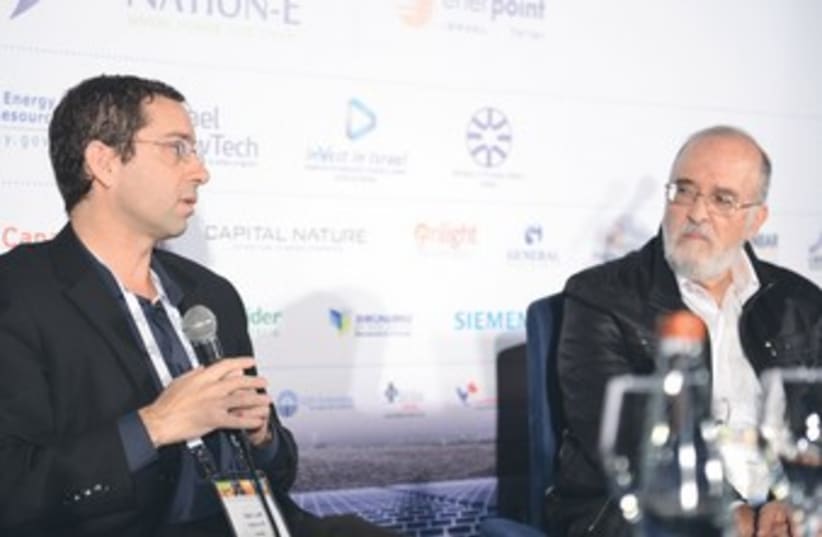
By SHARON UDASINDr. Gal Luft 370(photo credit: Aran Dolev)
While electrification of the motor vehicle market should be a long-term goal, the automobile industry should be focusing in the more immediate term on popularizing natural gas-based liquid fuel mix options, an energy security expert contended.“I think we need to be a little more realistic and understand the pace of penetration of new technologies, how it really works,” said Dr. Gal Luft, executive director of the Washington- based Institute for the Analysis of Global Security (IAGS). “I think the Better Place example is very instructive to sort of level expectations with realities. We should be very careful about trying to predict how consumers are going to behave.”Luft was speaking at a session called “Energy Security through Fuel Choice” on Wednesday morning, at the second of the three-day Eilat- Eilot Fifth International Renewable Energy Conference and Exhibition in Eilat.Electrification, Luft stressed, will be vital to the long-term survival of the auto industry, but as the market has thus far reflected in the case of Better Place, the consumers are not yet prepared to adopt the technology across the board – as it is “not yet mature” and has “many uncertainties,” according to Luft. This is not to say, however, that customers should remain dependent on gasoline in the short term, he explained.Running a car on a natural gas-based product would allow a driver to spend the equivalent of $20 per barrel of oil, in comparison with paying the approximately $100 per barrel of oil price available to them at the moment, according to Luft.“We should have this progress toward electrification – it’s very important – and invest where we need to invest,” he said. “But we should not neglect the nearterm solutions that allow us to use a $20 a barrel equivalent of fuel today, tomorrow, next week.”The best way to accomplish this near-term solution of readily allowing customers “fuel choice” and breaking the “virtual monopoly” on fuel is by rapidly introducing natural gas-based fuels in liquid form to the market, Luft explained.Such fuels can enter a car in the exact same way as gasoline, and can include combinations of gasoline with methanol, GTL (Gas to Liquids) and other products.“We are a liquid fuel society,” he said. “There is a near-term solution and there is a longterm solution. And we cannot sort of sit there and wait for the long-term solution.”By sitting and waiting for the long-term solution to pan out without attempting the more immediate-term fixes, countries like Israel are putting them at geopolitical security risks, Luft stressed.“For Israel, if we could advance some replacement for oil and mainly for transportation, I would sell it even for nothing – to free the rest of the world from the influence of the holders of that oil that may be here in the Middle East, and are up against us,” said Itzik Ben- Israel, director for the National Council for Research and Development.Israel is completely dependent on oil to run its cars, the same oil from which its hostile Middle East neighbors derive their power, according to Ben-Israel.These geopolitical concerns mentioned by Ben-Israel, however, are “happening right in front of our eyes while we are waiting for the utopian solutions of electrification,” Luft warned.In order to push fuel choice forward, Israel should be following the example of the United States National Security Council, which is encouraging the legislation of an “open fuel standard,” Luft explained. This simple piece of legislation would say that an automobile dealer cannot sell a new car in the US if it is certified to run on gasoline only.“We don’t tell the auto dealers what technology to choose, but they have to offer some sort of fuel option to the consumer,” Luft said.The cheapest way for car manufacturers to comply to this would be to offer cars that are flex-fuel and can run on any combination of gasoline and methanol or ethanol – a measure that US House of Representatives and Senate members support in a bipartisan manner, according to Luft.Electric vehicle legislation in the US has been problematic, as the government provides tax incentives of $7,500 when a customer purchases an electric vehicle – but only for the first 200,000 units per manufacturer.A similar rule applies to cars sold in China and Europe, Luft said. In order to advance the electric car market, the price of the now very expensive batteries needs to come down dramatically in order to offset the need for subsidies, he explained.“The clock is ticking very fast, which is why I think that from an economic standpoint, anything that does not require subsidy or tax incentive has a much better chance of winning the political game than things that rely on having subsidization,” Luft said.An open fuel standard is therefore “the most important building block” and should become a global standard, according to Luft. This standardization, however, cannot start in Israel as “Israel alone cannot shape the global manufacturing in vehicles,” he said.“It happened once in history, and that was Better Place, and I don’t think it panned out too well,” Luft continued. “I don’t think that any auto-maker will build a car for the Israeli market any time soon after the Better Place experience. We have to go through the two big markets – the Chinese market and the US market.”If the US and China encourage methanol use, only then will this fuel be able to truly take off in Israel and elsewhere, he explained.“I’m second to none in the support of electrification, but it’s important to understand the difficulties here.”
Related Tagsbetter place
if(catID != 151){
var cont = `Take Israel home with the new Jerusalem Post Store