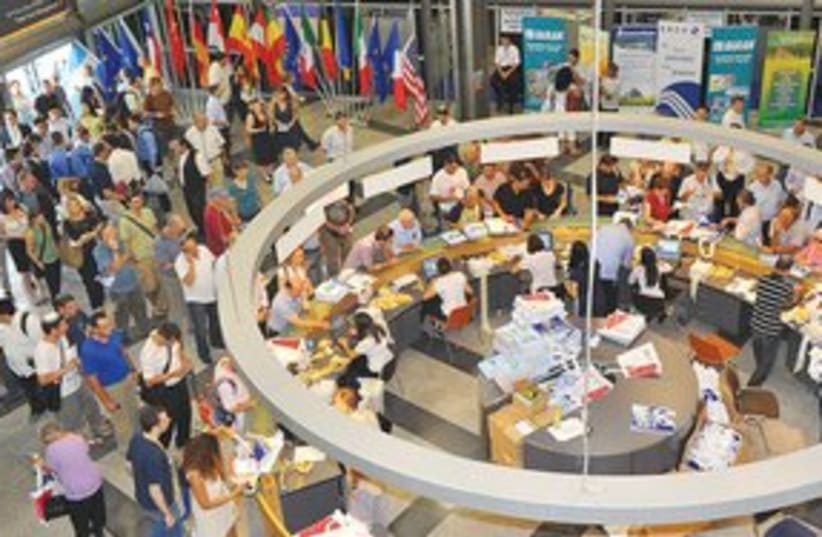
CleanTech 2013 provides a hub for the int'l exchange of renewable energy ideas and stresses advancement in water technology.
By SHARON UDASINcleantech exhibition_311(photo credit: Mashov Group)
While continuing to provide a hub for the international exchange of renewable energy ideas, this year’s enormous CleanTech 2013 Exhibition will have an added stress on the global advancement of water technologies, according to its president.This year’s global Clean- Tech convention – the 17th International Summit and Exhibition for Renewable Energy and Water Technologies, Recycling and Environmental Quality, Infrastructure and Green Building – will be held in Tel Aviv on Tuesday and Wednesday, run by the Mashov Group.Access to clean and plentiful water, necessary for the operation of almost all renewable technologies – as well as all basic life functions – needed to be at the forefront of CleanTech this year, explained exhibition chairman, Prof. Avner Adin of the Hebrew University.Adin chairs the Environmental Sciences Department and also heads the Water Treatment Technology section of the Soil and Water Sciences Department at the university’s Faculty of Agricultural, Food and Environmental Quality Sciences in Rehovot. A former president of the Israeli Water Association, Adin is also founder, chairman and chief scientist at global water treatment technologies firm Adin Holdings Ltd.“Looking at previous CleanTech conferences, I immediately realized that the water issue has not been emphasized enough,” Adin told The Jerusalem Post, in an interview at his Rehovot office last week.“After all, water is involved in almost all technology used for cleantech. Water itself is something that we need to take care of, to avoid polluting, to preserve as part of the environment. I felt that the water topic has been a bit neglected,” he said.While a second annual and likewise gigantic conference – WATEC: Water Technology and Environment Control Exhibition and Conference, of which Adin is on the board – focuses on water technologies, it focuses mainly on Israeli water technologies and displaying these to a global audience, Adin explained.CleanTech, on the other hand, is more of a symbiotic forum for international companies and scholars to exchange ideas and technologies, rather than simply learning about Israeli innovation, he added.“CleanTech is a more eclectic conference that deals with all aspects of the environment, including water, clean energies, clean transportation, wind energy, air pollution prevention and other aspects,” he said.“It’s also international – we want to become more and more international, not only in order to help Israeli industries, but to help the region and the globe by being also exposed to technologies and know-how.”Adin is also eager to see a convention that examines “the interrelationship of industry, academy and government.”One of the forums at the exhibition that Adin said he was most looking forward to was the Water-Energy Nexus Symposium, which explores “the inevitable tie between water and energy to natural resources that are scarce.”“I think this is a connection that has to be studied and strengthened,” he said.In addition to Israel’s Energy and Water Minister Uzi Landau, some of the keynote speakers at this conference will include Dr. Glen Daigger, president of the International Water Association, and Prof. Menachem Elimelech, director of the Environmental Engineering Program at Yale University.Looking at the world of cleantech innovation as a whole, Adin pinpointed Germany as a forerunner tackling environmental issues, as well as Japan, Canada and China.“CleanTech is open not only to countries that are leading, but it’s also open to countries that are just beginning, or want to have a cleaner environment and cleaner water,” Adin said.“This is actually a meeting point for the more advanced and the less advanced countries. This is where the business also meets. This Clean- Tech is looking to enhance cleantech by making it more attractive for business. This is where the people who have the know-how can do business with people who do not.”
if(catID != 151){
var cont = `Take Israel home with the new Jerusalem Post Store