Critic: Provide data to prove it’s "revolutionary."
By SHARON UDASINJammer 370(photo credit: REUTERS)
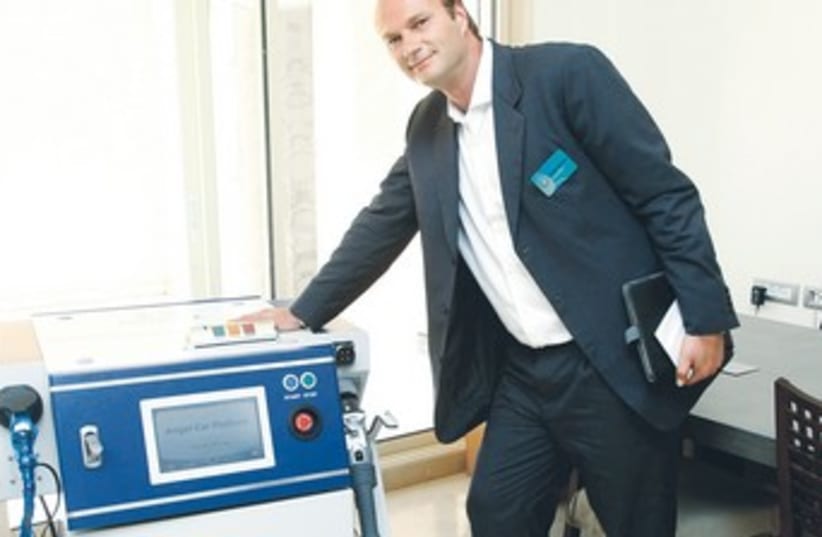
In the poolside backyard of his sprawling Herzliya Pituah home on Monday, German- Israeli businessman Daniel Jammer launched a smart and constantly communicative energy storage and production system that he feels could be an answer to Israel’s – and the world’s – burgeoning energy shortage problems.Jammer was launching the “Energy Bank” of his company Nation-E, a smart grid and energy storage system several years in the making at his firm. The company announced in February its intention to open a global service center in Netanya, where it hopes to be monitoring 1-gigawatt per hour worth of energy storage internationally within the next five years.“I would like to start with a revolution,” said Jammer, Nation-E’s president, owner and founder.Picking up a standard, AA battery, Jammer explained that the technology in such storage mechanisms is already a century old.“But the world is changing,” he said, now holding an approximately 50 by 30 centimeter computer chipset board – an inside slice of one of his Lithium-ion batteries.“This is smart energy.”The lithium-ion battery storage system would allow homes, hospitals, utilities and other institutions to produce renewable energy from photovoltaic solar panels and wind turbines on-site and store the unused surplus, with the possibility of selling quantities of the generated electricity back to the national grid, according to a company presentation.Meanwhile, a communications system would allow the storage battery to communicate through smart, web-based technology with the grid and any other batteries on the same network to see what supplies are available when – and always ensure a backup available to the consumer, whether an individual, a hospital or a nuclear power plant.While regulations do not yet exist for Israeli homes to directly use the renewable energy that they produce – instead, the energy from home solar panels and wind turbines gets sold entirely at the moment to the grid – Jammer thinks that in the future, such policies will change, as they already have in other countries.In the meantime, according to Jammer, the system can still serve as an integral backup mechanism to utility companies or other mass institutions like hospitals and military operations.“All the world is facing severe energy problems,” Jammer said. “Our world today is breaking apart. After Fukushima so many things happened, people are changing, politics are changing, minds are changing,” said Jammer, referring to Japan’s nuclear power plant disaster in 2011.While the system comes in various sizes, the energy storage unit in Jammer’s basement was about 1.25 meters high by 1 meter wide in depth, and had a storage capacity of 6.7 kilowatts per hour. With the system costing the customer about $2,500 to $3,000 per kilowatt-hour capacity, an average-sized home’s system would cost around $8,000 to $10,000, explained Nation-E CFO Andreas Stamatiou.By employing such a storage and monitoring system, Israel would be able to save millions in energy costs each year as well as significantly reduce its carbon dioxide emissions, according to Stamatiou.The company also introduced its Angel Car mobile charging system for electric cars, a charging apparatus that can be installed on the backs of all types of service vehicles – service trucks, planes, boats, and others – that can provide an instant recharging station for stranded automobiles. In addition to providing power to cars that have run out of charge, such a mobile station could provide off-grid energy charging for Unarmed Aerial Vehicles that monitor the nation’s borders, the company said.While the intention of putting renewable energy installations on people’s homes and into the national grid is very positive, much of the energy can get lost if it is not used as soon as it is produced, Jammer explained.“If we do not manage it, if we do not distribute it at the right time, if we do not store it, it is wasted,” he said.Around the world, people are producing power through renewable sources and wasting the surpluses that cannot be used immediately, agreed Dr.Gal Luft, executive director of the Institute for the Analysis of Global Security, a Washington- based think tank focused on energy security. Luft met Jammer at a conference in Las Vegas on energy security about four years ago.“We have to do better with what we have,” Luft said.A bank such as that of Nation-E can save the electricity, however, by providing a storage system that can communicate with other batteries smartly connected on the Nation-E network, Luft explained.Countries across the globe, like Israel, are coping with electricity shortages and end up needing to buy diesel generators to make up for their losses, something that would occur much less frequently by using a storage and smart meter combination system, according to Luft, who called the use of diesel generators “shameful.”Jammer said that his company’s technology is ready to be commercialized, and he said that specific pilot programs are already ongoing in Kansas City and San Diego. He hopes to get an official pilot program going in Israel soon, but first has to acquire the necessary government approvals, which he said he expects to complete next month.“Our technology is ready, ready to be commercialized, ready to be shown to the market and implemented into the grid,” Jammer said. “I’m absolutely optimistic that our government here is going to understand the importance, the benefit and the actual need of our system.”While ambitions for achieving mass storage and communications systems for energy are certainly valuable, one industry expert expressed a bit of skepticism about the ENation system.“Storage of the energy is both the most problematic and promising issue in this industry,” he said, noting, however, that there are people developing these types of technologies all over the world.Although it is very positive that Jammer is keen to get involved in the industry, the expert said that more technical data must be revealed from the company, by scientists and engineers and not just by businessmen.Without detailed scientific and technical information, such a platform might remain the work of “dreamers,” the expert explained.“In theory he is saying what everybody knows – that it has to be battery technology and communication technology.But we want to see the data sheet,” the expert said. “We need to see what’s new about it. Where is the revolution here?”
if(catID != 151){
var cont = `Take Israel home with the new Jerusalem Post Store