Rabbis will be debating whether a vehicle one merely sits in and drives solely with brain activity can be used on Shabbat.
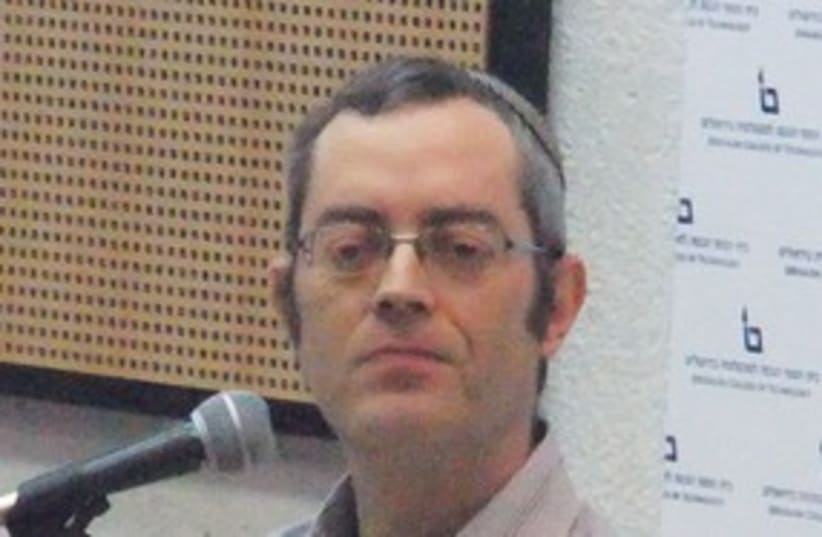
By JUDY SIEGEL-ITZKOVICHDror Fixler 311(photo credit: Courtesy)
As the interface between brain and machine moves from science fiction to reality, rabbis will be debating whether a vehicle one merely sits in and drives solely with brain activity can be used on Shabbat.This intriguing thought was discussed on Thursday by Rabbi Dr. Dror Fixler, an electrooptics engineer at Bar-Ilan University in Ramat Gan, who was one of the speakers at Thursday’s 18th Torah and Science Conference of the Jerusalem College of Technology, Yeshiva University in Israel and BIU.The all-day conference, which attracted around 200 men and women, was hosted by JCT president Prof. Noah Dana-Picard, a leading theoretical mathematician who heads the colleges for religious young men and, separately, young women, who study engineering and related subjects.Fixler showed a recently released clip of a “proof of concept” vehicle that has a person inside who merely thinks of how to maneuver it. The vehicle drives itself safely, turning corners, slowing down and giving more gas. While this is “not something one should do at home,” the Autonomos company successfully tested the proof-of-concept car a few months ago, said the BIU engineer.The person wears a special cap with 16 sensors on the surface that trains the car computer by examining the human brain’s electromagnetic signals.Merely by pointing to the left and the right, the human is able to teach his movements to the computer without saying a word; from them on, the vehicle could maneuver through an empty section of a Berlin airfield with no problem except a short delay between thinking and the computer carrying out the mental demands.Fixler said that the issue of the brain thinking and action – which could or could not be approved by rabbis as permissible Shabbat activity – could raise halachic arguments. Even though the person does not take any physical action to manipulate and move the car, just thinking about it could be forbidden on Shabbat, he said.But there are those who could contend that just thinking does not constitute a “melacha” – prohibited activity on Shabbat that was necessary for the construction of the Tabernacle taken by the People of Israel through the desert after the Exodus from Egypt. There are 39 such types of “work” and their subcategories that cannot be performed on the Sabbath.The discussion would discuss whether an bionic artificial limb that is moved with brain pulses – which is much closer to actual use than think-only cars – or a bionic eye that could enable the blind see – could be used on Shabbat.Fixler noted that even without seeing something work such as a remote control it could be argued that the tool was under the user’s control without actually being observed as doing something; it is much more complicated if only the brain is in control, he said.The BIU engineer noted that these unbelievable developments are the accumulated experience and knowledge of 40 years of brain science, but while bringing improvements by serving society, they can also spark intense arguments among rabbinic arbiters about when and if they can be used.
if(catID != 151){
var cont = `Take Israel home with the new Jerusalem Post Store