US ambassador: Water, rehabilitation efforts can bring regional peace.
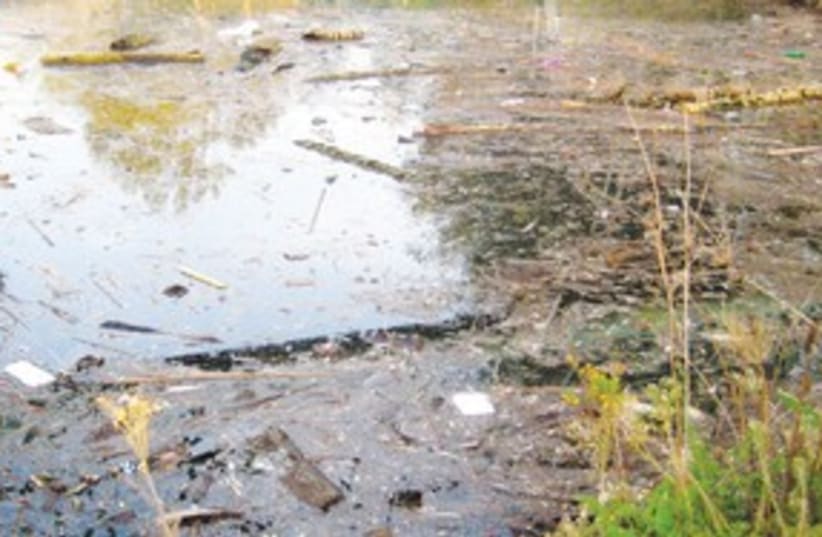
By SHARON UDASINsouthernmost 'clean' part of Jordan River_311(photo credit: Sharon Udasin)
Just a few kilometers south of the Yardenit baptismal site, plastic soda bottles blanket the southernmost “clean” section of the Jordan River, while below, raw sewage trickles into a saline brook gushing from an adjacent pipe.A stench overpowers the nostrils of passersby, as the wastewater from nearby communities makes its way into the Jordan River, just south of the Kinneret (Sea of Galilee).RELATED:Beit She’an’s sewage may end up in Jordan River “This used to be a great river that had great environmental benefits for the whole region and has great historical significance and religious significance for people of three religions,” US Ambassador Dan Shapiro said.Shapiro was on a tour on Tuesday led by the multinational Friends of the Earth Middle East of rehabilitation sites along the river as well as the Jordan River Peace Park in Naharayim, which is under Jordanian sovereignty.At Yardenit, where about 600,000 Christians dunk their heads for baptism annually, the water is still entirely clean, and there is a family of beavers and numerous catfish, according to staff members.Just to the south, however, is an entirely different story – there, the river has lost 50 percent of its biodiversity, and a willow tree would not be able to survive on the riverbanks due to the extreme salinity, Friends of the Earth Israel director Gidon Bromberg explained.But not all is grim, he said.A rocky walk away from Alumot Dam, the river-turned-sewage-pit, is a construction site, where in a year the Bitanya wastewater treatment plant will arise, followed by a desalination facility, Bromberg said.“The good news is at the end of next year there will be no sewage flowing from the Israeli side,” he told The Jerusalem Post, in a follow-up interview Wednesday.The treatment plant will absorb the raw sewage currently flowing into the river, while the desalination plant will take in the brine being extracted from the Kinneret, which is now pumped straight into the Jordan River. The facilities are taking shape from a total investment of NIS 400 million, through the combined budgets of the government and the Jordan Valley Regional Council.“We will no longer be dependent on expensive drinking water [for irrigation],” council head Yossi Vardi said during the tour.The two plants will produce a total of about 20 million cubic meters of water for agricultural use annually, Vardi said.“It’s encouraging to know that within a year that dam will be removed, the water will begin to flow again,” Shapiro said. “That’s a major step in the path toward rehabilitating this river.”The water flow from the Kinneret to the Jordan River, which was once 1.3 billion cubic meters annually, has now dwindled to nothing, according to Bromberg. The Jordanians and Syrians have caused a similar problem by building dams and side tributaries on their stem of the Yarmouk River, which also once flowed into the Jordan.While the Environmental Protection Ministry and the Water Authority have collectively pledged to restore 30 million cubic meters a year – “a first drop and an important drop” – this is hardly enough to restore a healthy river, which would require about 400 million to 600 million cubic meters, Bromberg said. To accomplish, commitments of 220 million cubic meters from Israel, 100 million cubic meters from Syria and 90 million cubic meters from Jordan would be required, according to a Friends of the Earth report released last year and funded by the United States Agency for International Development.“We know that this is not going to happen overnight – it’s difficult for Jordan and we have no impact on Syria,” Bromberg told the Post. “We’re calling for each country to return a portion of what they took.”As far as sewage is concerned, however, Bromberg said he has gotten word that USAID is helping Jordan move forward with a sewage treatment plant on its side of the river, which is laden with poor communities where “every home has a hole in the ground” to collect personal sewage. In the West Bank, the Japanese government has just committed to build a treatment plant for the Palestinian Authority in the particularly problematic city of Jericho, according to Bromberg.“There’s good progress on all sides,” he said. “The fact that Israel is leading reflects [the fact] that Israel is a more economically powerful country, but it also reflects that Israel was the first in the demise of the river.”Standing at the Naharayim viewpoint overlooking Peace Island – where Friends of the Earth hopes to develop a larger Transboundary Peace Park that would not require visas – Shapiro said he was impressed with the work being conducted by all the surrounding states, bolstered by efforts of Friends of the Earth and money from the US government through the Good Water Neighbors program.All of the collaborators are “working to use these very vexing, very important environmental challenges as a means to also build peaceful relations,” the ambassador said. “We’re here to support the Israeli government, the local communities and all the Israeli, Palestinian and Jordanian local residents who are trying to solve their joint environmental and water challenges.”A representative of USAID agreed, stressing that there is still, however, much more to be done.Water, in Shapiro’s opinion, has already become a bridge for peace, and he praised the fact that Environmental Protection Minister Gilad Erdan and PA Water Minister Shaddad Attili finally spoke face-toface last week, at a conference in Ashdod.“That’s the kind of direct interaction between the two sides that I think can solve both the water problem and make a contribution toward solving the bigger peace problems,” Shapiro said.
While progress has certainly been made on water issues such as the Jordan River’s rehabilitation, the work is far from finished.For example, at perhaps the holiest Christian baptismal site along the Jordan – Kaser el-Yehud, east of Jericho, where many believe John the Baptist baptized Jesus – the water remains dangerously polluted.“I wouldn’t want to be baptized there, I can tell you that,” Bromberg said.To ensure that visitors can once again safely dip themselves there, Israel, the PA and Jordan must mimic the efforts of the countries that partner to protect bodies such as the Rhine River and the Great Lakes, he said.“This is a river holy to half of humanity,” he said.
Related TagsDan Shapirobeit shean
if(catID != 151){
var cont = `Take Israel home with the new Jerusalem Post Store