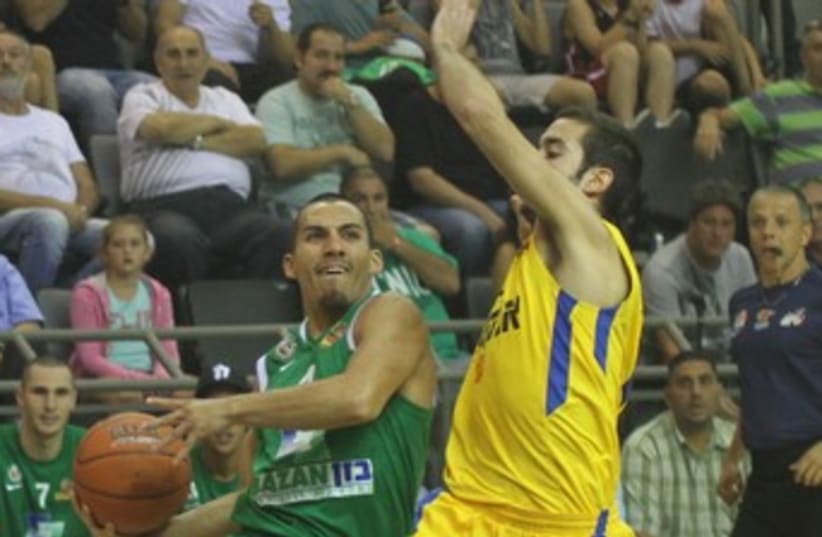
Preview: New regulations and league format, everyone will be chasing Maccabi Tel Aviv.
By ALLON SINAIBSL season gets underway 370(photo credit: Lilach Weiss/BSL)
The Basketball Super League has undergone wholesale changes once more ahead of the start of the 2012/13 season on Sunday.Maccabi Tel Aviv still remains the firm-favorite to win the championship, but yet again there has been a change to the league’s format and to the regulations regarding foreign players.As of this season, each team can choose to register either four or six foreigners to a game.Hapoel Gilboa/Galil and Maccabi Tel Aviv are the only teams which currently intend on registering six foreigners and therefore will have to make sure they have two Israeli players on the floor at any given point in the game.The rest of the league’s sides will be able to play with all four of their foreigners at once.After seven seasons, the BSL has also scrapped the Final Four.The Final Four format to decide the championship was introduced in the 2005/06 season in the hope of creating interest in a league dominated by Maccabi Tel Aviv.Maccabi dropped its first league title in 15 years in the 2007/08 season following a dramatic defeat to Hapoel Holon and failed to claim the championship once more two years later after losing to Gilboa/Galil in the final.However, due to growing criticism from all quarters regarding the unsporting nature of the Final Four format the BSL decided that a best-of-five playoff series will be played in the semifinals, just as it is in the quarters, with a one game winner-takes-all final to take place to decide the title.After 22 games for each club, the league will be split into two sections of six teams each. Each side will play once more against the other teams in its section, with the top eight teams overall to advance to the quarterfinals.Chief Sports Writer Allon Sinai takes stock of the 12 teams battling for BSL supremacy in 2012/13.MACCABI TEL AVIV Since returning to coach Maccabi two years ago, David Blatt has amassed an amazing 66-3 record in local league and cup play.Tel Aviv has overhauled its roster yet again, bringing in seven new players. Nevertheless, it is still difficult to see any team threatening the yellow-and-blue, especially with the cancellation of the Final Four.The blow from the retirement of Israelis David Blu and Tal Burstein was softened by the additions of Sylven Landesberg and Moran Roth, ensuring Maccabi still has the best Israeli core in the league, with Lior Eliyahu, Guy Pnini and Yogev Ohayon all returning for another season.Player to watch out for: Itay Segev. The 17-year-old 2.04-meter forward joined Maccabi on a sixyear deal this summer and is being talked about as a future NBA player.Last season: BSL champion, 23-2 in the regular season, beat BC Habika’a 3-0 in the quarterfinal playoffs.Best-case scenario: Maccabi wins its third straight league and cup double, this time going the entire season unbeaten.Worst-case scenario: Maccabi loses just a single game in 2012/13, but it happens to come at the worst moment – in the BSL title game.MACCABI ASHDOD Ashdod exceeded all expectations in its first two seasons in the BSL, reaching the Final Four title game last term after making the playoffs the previous year.If Ashdod’s preseason form is any indication, it looks to be one of the league’s strongest teams yet again.The core of the roster from the past two seasons, led by Meir Tapiro, has departed, but coach Ofer Berkowitz is back for a third season and Ashdod will be a force to be reckoned with once more thanks to promising young Americans Diamon Simpson, Kenny Gabriel and Chris Allen and veteran Israelis Guni Izraeli, Dror Hagag and Moshe Mizrahi.Player to watch out for: Diamon Simpson. The 25-year-old center has been dominant under the baskets in the preseason and looks set to become a double-double machine in the coming campaign.Last season: 2nd place, 12-12 in the regular season, beat Hapoel Gilboa/Galil 3-1 in the quarterfinal playoffs.Best-case scenario: Ashdod makes a second straight appearance in the title game.Worst-case scenario: Ashdod only barely slips into the playoffs and is sent packing in the quarters.HAPOEL HOLON Holon lost the entire core of its squad from last season, most notably playmaker Moran Roth. However, it still has one of the best coaches in the league in Dan Shamir and has brought in some promising names in the hope of returning to the semis.Frank Hassell, Jerome Dyson and Zack Rosen may lack professional experience, but there is no doubting their talent. At 26-years-old, Ofir Farhi is the oldest player on Holon’s roster, but if there’s anyone who can build a cohesive unit from this group of youngsters it’s Shamir. Player to watch out for: Zack Rosen. The 23-year-old American-Jew was named as the unanimous Ivy League player of the year last season, averaging 18.2 points, 5.2 assists and 3.2 rebounds per game at the University of Pennsylvania.Last season: 3rd – 4th place, 14- 11 in the regular season, beat Hapoel Jerusalem 3-1 in the quarterfinal playoffs.Best-case scenario: Holon reaches the last four for a second straight year, becoming one of the league’s must-watch teams.Worst-case scenario: After lasting just two years at Hapoel Jerusalem and Bnei Hasharon, Shamir also parts ways with Holon following two seasons after failing to guide his kids past the quarterfinals.MACCABI RISHON LEZION Effi Birenboim begins his fourth straight season at Rishon, the league’s longest active streak.The veteran coach guided the club to the Final Four for a second straight year last season and has yet again assembled a roster with great promise.Israelis Amit Ben-David and Nitzan Hanochi give Birenboim a solid backcourt base, with reliable forward Adrian Uter also returning from last season.Youngsters Or Solomon and Lazeric Jones will provide Effi with so much-needed youthful exuberance and Julian Wright will be one of the stories of the season in the BSL, succeed or fail.Player to watch out for: Julian Wright. Despite being picked 13th overall in the 2007 draft, Wright never quite fulfilled his potential in the NBA, but he could prove to be an unstoppable force in the BSL.Last season: 3rd - 4th place, 15- 10 in the regular season, beat Ironi Ashkelon 3-2 in the quarterfinal playoffs.Best-case scenario: Rishon continues its consistent progress since Birenboim took charge and makes the final.Worst-case scenario: Its preseason struggles prove to be a sign of things to come as Rishon’s season ends in the quarters.HAPOEL GILBOA/GALIL Lior Lubin is back for a third season, but the roster has an almost completely new look.Young promising Israelis Yoad Bet- Yosef and Amit Simhon will be hoping to flourish under Lubin’s guidance, but it remains to be seen how they will coexist beside new Americans Kenny Hayes, Rakim Sanders and Mitchell Watt.Dagan Yavzuri and Brandon Hunter give Gilboa some muchneeded experience, but Lubin has got his work cut out for him if the team is to return to the title game after two years.Player to watch out for: Yoad Bet-Yosef. The 24-year-old was one of the National League’s top scorers at Maccabi Be’er Ya’akov last season and will be looking prove he has what it takes to be a star in the top flight.Last season: 5th - 8th place, 16- 9 in the regular season, lost 3-1 to Maccabi Ashdod in the quarterfinal playoffs.Best-case scenario: Gilboa goes one step further than last season and loses in the semifinal playoffs.Worst-case scenario: Gilboa takes one step backward and doesn’t even reach the playoffs.HAPOEL JERUSALEM Jerusalem missed the Final Four title game for a fifth straight year last season, with Sharon Drucker failing to lift the team after replacing the sacked Oded Katash in January.Drucker is still at the helm and he will have no excuse this season after building the roster himself.Israelis Elishay Kadir, Uri Kukia and Dan Grunfeld are back for another campaign, but the rest of the roster has changed, with Drucker mainly bringing in proven veterans.No player is more established and experienced than Meir Tapiro, but despite his excellent play for Ashdod over the past two seasons, he is not set to be a starter and will have to get used to a reduced role at 37- years-old.Jerusalem also knows exactly what it is getting in Americans Josh Duncan and Courtney Fells, who both played in Israel last season, and with the 29-year-old Craig Smith, who has played in the NBA in the past six years, most recently with the Portland Trail Blazers, averaging 3.3 points and 2.3 rebounds last season.However, the x-factor is expected to be 22-year-old Jacob Pullen, who impressed at Biella in Italy last season and will have to shoulder much of the team’s playmaking responsibilities.Player to watch out for: Craig Smith. The 28-year-old forward was a legitimate NBA player for the past six seasons and could be a real steal for Jerusalem.Last season: 5th - 8th place, 14- 11 in the regular season, lost 3-1 to Hapoel Holon in the playoffs.Best-case scenario: Jerusalem returns to the BSL title game after six years.Worst-case scenario: Drucker is gone by January, sacked exactly one year after replacing Katash.IRONI ASHKELON Coach Adi Azulai is back in Ashkelon and he faces an uphill battle.Ashkelon has one of the smallest budgets in the league and by the time it got organized it was left with two weeks to build its roster.Ashkelon’s Israeli core is one of the weakest in the BSL, with Oded Sha’ashoua and Lior Lifshitz the only experienced local players on the team. Azulai is known for his excellent eye for foreigners, and while Taj Gray has shown plenty of promise, the coach will also need the rest of his Americans to raise their level for the team to avoid the relegation playoffs.Player to watch out for: Dudu Shamriz. The 21-year-old guard is entering his third season with the team and should finally get the opportunity he’s been waiting for.Last season: 5th - 8th place, 10- 15 in the regular season, lost 3-2 to Maccabi Rishon Lezion in the quarterfinal playoffs.Best-case scenario: Ashkelon is swept in the quarterfinals after sneaking into the playoffs.Worst-case scenario: Ashkelon lives up to its preseason billing and is relegated.HAPOEL EILAT Oded Katash will be hoping to guide Eilat back to its glory days after owner Doron Herzikowitz relocated BC Habika’a to Israel’s southernmost city.Herzikowitz was promised NIS 1.5 million in backing from mayor Meir Yitzhak Halevi and Eilat is determined to make a splash in its first season back in the big time, with its total budget expected to reach NIS 6.0 million.Eilat had one of Israel’s top clubs in the 1990’s, gaining promotion to the top flight ahead of the 1991/92 season under the guidance of current Israel coach Arik Shivek and remaining there until 1999.American guard Austin Freeman looks to be the undoubted star of the team, while the return to Israel of Afik Nissim gives Eilat a local hero it desperately needed.Player to watch out for: Afik Nissim. The 31-year-old has played abroad in the last nine years and could prove to be the barometer of the team.Last season: 5th - 8th place (as BC Habika’a), 10-14 in the regular season, lost 3-0 to Maccabi Tel Aviv in the quarterfinal playoffs.Best-case scenario: After his traumatic time in Jerusalem, Katash reestablishes his place among Israel’s best coaches by guiding Eilat to the semis.Worst-case scenario: The long haul for road games costs the team a playoff berth.BARAK NETANYA Danny Franco experienced a disappointing campaign at Netanya last season, but he has been given another opportunity.The coach will be depending heavily on his foreign core, with Yehu Orland the team’s only established Israeli player.Franco has at least gone for proven players in his selection of Americans, with only one of them not having previous BSL experience.Ramel Bradley, Deron Washington, Marco Killingsworth and Raymar Morgan (who will be back from injury later in the season) are players Netanya can rely on, but the team will struggle if none of its Israeli youngsters step up.Player to watch out for: Eyal Shulman. The 25-year-old is set to start in Netanya’s backcourt, an opportunity he may never get again.Last season: 9th place, 9-15 in the regular season.Best-case scenario: Netanya returns to the playoffs after a oneyear absence.Worst-case scenario: Netanya goes back to the drawing board after failing to reach the playoffs for a second straight year.BNEI HERZLIYA After a dismal season, Bnei Herzliya is desperate to make amends.Coach Ariel Beit-Halachmi steadied the ship at Herzliya after replacing Adi Azulai in January, and if its preseason form is anything to go by, Herzliya could be one of the dark horses of the season.Veteran foreigners Milt Palacio (34) and Jumaine Jones (33) have vast NBA and European experience, but it remains to be seen if they don’t run out of gas as the season progresses.Niv Berkowitz and Isaac Rosefelt give Beit-Halachmi two solid Israeli options and Herzliya should be a force to be reckoned with once more.Player to watch out for: Ben Rice. The 22-year-old has been tipped for a breakthrough for several years and after missing all of last season due to a knee injury he is healthy again and looking to make his mark.Last season: 10th place, 7-17 in the regular season.Best-case scenario: The experience of Palacio and Jones proves to be the key factor in Herzliya’s drive to the semis.Worst-case scenario: The old legs of Palacio and Jones result in Herzliya not even making the playoffs.MACCABI HAIFA After two nightmare seasons, Haifa looks ready to become a challenger once more. The Greens ended last season bottom of the BSL standings with a 5-19 record and after going through five coaches over the last three years have started completely anew yet again, bringing in American coach Brad Greenberg and replacing the entire roster. Greenberg, a former NBA assistant coach and general manager and NCAA Division I head coach, will have some of the league’s best foreigners at his disposal.Point-guard Paul Stall looks to be a hidden gem, while Donta Smith is the best player in the entire BSL according to Greenberg.Veteran Israeli center Ido Kozikaro is also back in town and together with the team’s return to the renovated Romema Arena, Haifa has every chance of making some real noise.Player to watch out for: Sean Labanowski. The 19-year-old made little impact in his debut season and should display more of his potential this year.Last season: 11th place, 5-19 in the regular season.Best-case scenario: After a threeseason hiatus, Haifa gets back to the semis.Worst-case scenario: Haifa’s season ends on a sour note after being bounced in the quarters.HAPOEL TEL AVIV Five years after being formed by fans, the resurrection of Hapoel Tel Aviv will be completed this season with its return to the top flight.The club was set up under the name of Hapoel Ussishkin in the summer of 2007 following the demise of the original Hapoel Tel Aviv and the demolition of the Ussishkin Arena.The new franchise took over the name and heritage rights of the original Hapoel Tel Aviv in December 2009 and it will be the first fanowned club to play in the BSL after winning the National League championship last season.Erez Edelstein is one of the more experienced coaches in the league and his abilities will be tested to the limit this season with Hapoel having one of the smallest budgets in the BSL.The Reds have made the least amount of changes to their roster of all 12 BSL teams. However, while the continuity should initially work to their advantage, especially with the likes of Matan Naor and Curtis Kelly sticking around, they may eventually discover that what was sufficient for the National League last season will simply not cut it in the top flight.Player to watch out for: Bar Timor. The 20-year-old guard made his breakthrough last season and should benefit from Hapoel’s lack of depth.Last season: National League champion.Best-case scenario: Hapoel sneaks into the playoffs but far more importantly also records a stunning upset against Maccabi in the derby.Worst-case scenario: Even Hapoel’s faithful fans grow tired of following the team to its new home in Rishon Lezion as the losses continue to pile up.
if(catID != 151){
var cont = `Take Israel home with the new Jerusalem Post Store